
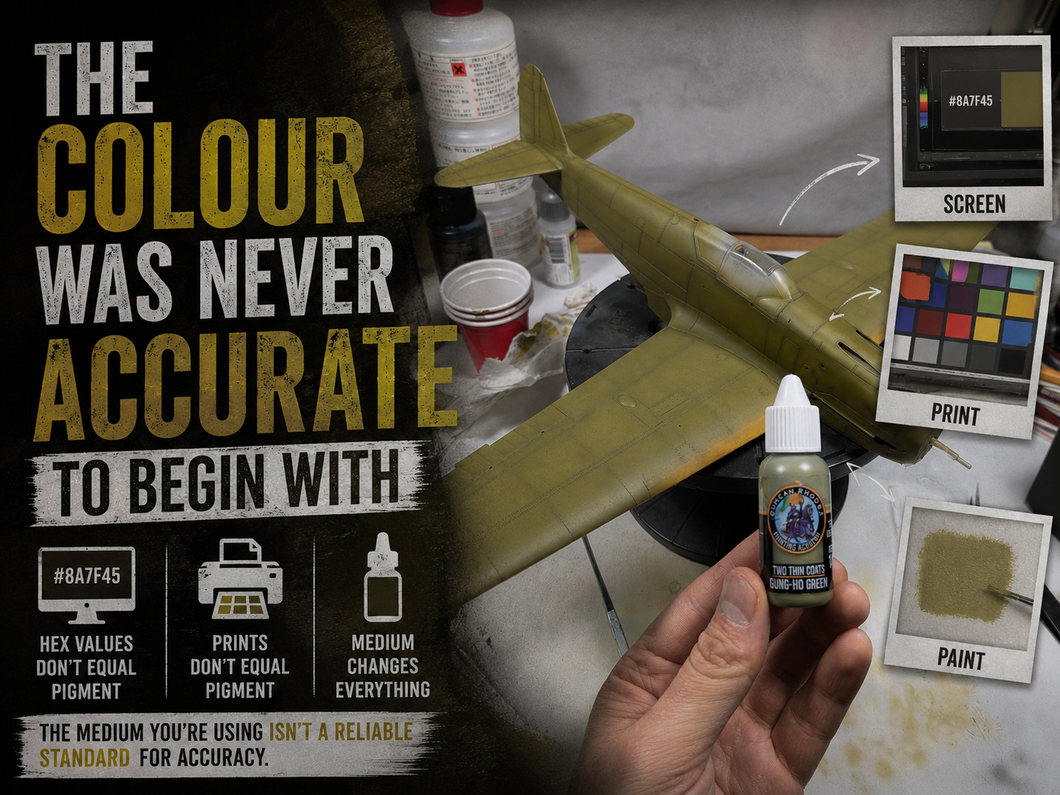
The Colour Was Never Accurate to Begin With
The Colour Was Never Accurate to Begin With
Weekly column · Lessons from the paint counter at WWH · June 2026
We have this conversation at the counter regularly, and it is never a simple one to answer. Someone comes in with a reference image on their phone, points to a colour on screen, and asks which pot matches it. Sometimes the reference is a painting guide. Sometimes it is a forum post. Quite often, for military modellers especially, it is a wartime photograph.
The question sounds simple. It is not simple. Not because the paints are bad or the person is asking the wrong thing, but because the colour they are looking at on that screen was never the colour they think it is. It was not the colour on the original subject either. Between the vehicle that rolled off the production line and the pixel being emitted at them right now, colour has passed through several different physical processes, each of which creates it in a completely different way. By the time it reaches their eye, they are not looking at a colour. They are looking at an interpretation of an interpretation of an interpretation.
Here is what that chain actually looks like, and why the only honest answer at the end of it is to pick what looks right to you.
The problem is not the paint. The problem is that colour looks different depending on the physical process used to create it, and every step between the original subject and your screen uses a different one. Photography, printing, screen backlighting, hex values, colour chips, and human perception are all distinct mediums. None of them translate directly to pigment. The dedicated military colour lines exist, they are well researched, and they are worth buying. But the anxiety of thinking you have matched incorrectly because your screen says so is chasing a standard that was never stable in the first place. Pick the colour that looks right to your eye. That has always been the correct answer.
Start here: the original colour was not reliably applied in the first place
Before a single photograph was taken, before a chip was printed, the paint on the actual vehicle was already a variable.
Military paint specifications existed. Panzer Grey, Dunkelgelb, Olive Drab, British Standard 987C -- these are real formulations with documented histories. The specifications were standardised. The application was not.
Paint was mixed in the field. Supply chains broke down. Batches varied at the factory level. Vehicles were repainted mid-service with whatever was available, sometimes thinned heavily, sometimes applied over surfaces that had not been stripped. A vehicle sitting in an outdoor depot faded differently than one in active theatre. Dust, mud, fuel, exhaust, and sun all shifted the colour before the war photographer even raised a camera.
This is worth stating plainly because it is the foundation of the whole argument: there was no single authoritative colour. There was a specification and then a wide range of real-world results. The colour you are trying to match was itself a range, not a fixed point.
Everything that follows compounds this. But it starts here.
The photograph does not show you the colour
It shows you how that colour interacted with the available light, the film stock, the processing chemistry, and the printing process on that specific day.
Most wartime reference photography was black and white. The colour references that do exist in period photography were subject to overcast skies, direct sun, shade, dust haze, and every other lighting condition a field photographer had no control over. The same vehicle photographed at noon in summer and at dusk in autumn looks like two different colours. It is the same paint.
Colour film of the period introduced its own shifts. Different film stocks rendered the same subject differently. Processing chemistry, storage conditions, and the age of the negative all affect the colour that ends up in the final print. A photograph that has spent decades in an archive before being scanned has shifted further still.
Then the scan itself introduces a new variable. Scanner calibration, bit depth, white balance at time of capture -- these all affect the digital file that ends up in the book, the forum post, or the painting guide you are looking at.
The photograph is not a neutral record. It is a translation, with all the loss that implies.
What a hex value actually is, and why it cannot tell you what to put in your pot
A hex code is an instruction to a screen. It is not a description of a colour.
When someone posts a hex value in a forum thread and says "this is Dunkelgelb," what they mean is: "this is the value I sampled from the image I was looking at, on the screen I was looking at it on, under the colour profile my software was using." That is three variables before you even get to your own setup.
A hex code describes how much red, green, and blue light a screen should emit, on a scale of 0 to 255 per channel. It is an instruction for emitted light. Paint works by absorbing certain wavelengths and reflecting others. These are physically opposite processes. A colour created by mixing light and a colour created by mixing pigment can appear similar to the eye under the right conditions, but they are not the same thing and there is no direct conversion between them.
Layer on top of that: screens vary enormously in how they produce that emitted light. An OLED panel, a standard LCD, and a budget display running the same hex value produce visibly different results. Colour profiles -- sRGB, Display P3, AdobeRGB -- further change what the screen actually does with that instruction. A modern wide-gamut phone display can produce colours so saturated that they have no physical equivalent in pigment. Calibrated professional monitors and uncalibrated consumer displays show the same file completely differently.
Brightness, night mode filters, ambient light sensors that shift colour temperature automatically -- all of these change what you see from the same hex value, sometimes substantially, without you doing anything.
When someone gives you a hex value for a historical colour, they are giving you a number that describes light on their screen on one particular day. That is the best it can be. Matching it to a physical pigment is not a translation. It is a guess dressed up as precision.
The colour chip on the rack is not the colour in the pot
And the chip in the online catalogue is a photograph of a chip, displayed on your screen. That is at least two steps from the actual paint.
Colour chips on paint racks are printed. Printing uses a subtractive colour model -- cyan, magenta, yellow, and black ink -- to approximate colours on a physical surface. The print is then photographed or scanned for the online catalogue, which reintroduces the screen display problem from the previous section. We are aware that our own online catalogue is not exempt from this. No online paint retailer's is.
The physical chips on the rack have a different problem. They are printed at the time of production and do not change. The paint in the pot may shift slightly between batches, and the chip does not update to reflect that. The chip also shows the colour under whatever the ambient light in the store happens to be at the moment you look at it, which changes the appearance of every colour in ways that are real and not correctable by the chip itself.
The chip is a useful approximation. It is not a guarantee. The only reliable test is paint on a surface under the light you will actually be viewing the model in.
The paint itself is a variable
Rare, but real.
Hobby paint manufacturers work to consistent formulations, and the vast majority of pots you open will match the previous ones closely enough that the difference is irrelevant. But pigment is a physical material, and the processes that produce and mix it are industrial, not laboratory-precise. Batch variation exists across the industry. We have seen it a small number of times in our own stock over the years -- usually a subtle tonal shift, occasionally more pronounced.
If you are mid-project and run out of a colour, it is worth testing a new pot against your existing paintwork before committing to a large area. Not because variation is common, but because it is a real variable and the cost of checking is low.
Finally: colour is an interpretation, not a measurement
Two people looking at the same surface in the same light do not necessarily see the same colour.
Colour vision varies between individuals. The distribution and sensitivity of cone cells in the eye differs from person to person. Colour constancy -- the brain's tendency to compensate for changing light conditions and keep perceived colours stable -- means two people in different rooms, or even on opposite sides of the same room, may perceive a colour differently while both believing they are seeing it correctly.
This is not a flaw. It is how vision works. The eye and brain together are not a calibrated instrument. They are a highly efficient interpretation system optimised for survival, not colour accuracy. What you see is real to you. What the person next to you sees is real to them. They are not always the same thing.
Add this to every other variable in the chain and the picture is complete. You are attempting to match a pigment to a reference that passed through: a field application that was itself variable, a photographic process with its own response curve, a printing or scanning step, a screen with its own calibration and technology, a colour chip rendered in a different process again, and finally your own visual system interpreting the result. Every step in that chain is a different medium creating colour in a different way. The idea that a precise match exists at the end of it is a pleasant fiction.
A word in defence of reaching for the named colour
None of the above is an argument against it. It is an argument for understanding what it actually gives you.
Standing in front of a paint rack trying to critically evaluate every candidate for a colour is not always how people want to spend their hobby time. That is completely reasonable. The whole point of the hobby is the painting, and standing at a rack second-guessing yourself is the part that happens before the painting. Named paints like Dark Gull Grey or Dunkelgelb exist partly because they close that decision. You are not buying a guarantee of accuracy. You are buying permission to stop deliberating and start working.
That is a real and legitimate thing to want. The name functions as a signifier of confidence more than a chemical specification. It tells you someone has already done the research and landed somewhere defensible, and you can trust that starting point and move on to the part of the hobby you actually enjoy. There is nothing wrong with that logic.
What is worth knowing is what you walked past to get there. On most racks, a named historical colour sits next to several generic colours that are close candidates -- darker greys, olive tones, warm tans -- that would read similarly in context and cost you nothing extra in accuracy because, as this article has argued, the accuracy was never fully achievable anyway. You may still choose the named paint, and thats cool. Choosing convenience and confidence, which are great reasons.
Use the name as a starting point. Trust the research behind it. Then trust your eye for the rest.
So what do you actually do?
Pick the colour that looks right to you. That is not a resignation. That is the correct answer.
The dedicated military colour lines -- Vallejo Model Air, AK Real Colors, AK 3rd Generation, and others -- are well researched and worth buying if you are building historical subjects. The people who formulated them did serious work. Use them as a starting point with confidence. But understand that the confidence belongs in the research behind the formulation, not in the belief that the pot will match what you see on your screen, because nothing can do that reliably.
A model painted with a non-military green that reads correctly under your display lighting, in your display case, to your eye and the eyes of the people who see it, is a more successful piece of work than one painted with a documented specification colour that looks wrong in context. Colour is a visual impression. The impression is what matters.
We say this at the counter constantly: you are doing the hobby for yourself, not for others. In the very specific case of colour accuracy, that is not just a philosophy. Given the number of variables between you and any reference, it is the only position that makes sense.
The chain at a glance
| Step | How colour is created | The variable it introduces |
|---|---|---|
| Original vehicle | Pigment in oil or alkyd paint, applied by hand or spray | Field mixing, supply variation, weathering, fading, repaints |
| Reference photograph | Light reflected off a surface, captured by film or digital sensor | Ambient light conditions, film stock, processing, age of negative, scan calibration |
| Screen display | Emitted light (RGB) from backlighting through pixel filters | Display technology, calibration, colour profile, brightness, ambient light sensors, night mode |
| Hex value | A numerical instruction to emit specific amounts of red, green, and blue light | Cannot describe a physical pigment; result varies by display |
| Colour chip (rack or catalogue) | Printed ink (subtractive CMYK) or photographed and displayed on screen | Print approximation of pigment, store lighting, does not update with batch changes |
| Paint in the pot | Acrylic or enamel pigment suspended in binder | Batch variation (rare but real); surface and lighting affect final appearance |
| Human eye | Reflected wavelengths interpreted by cone cells and processed by the brain | Individual variation in colour perception; colour constancy effects; context and expectation |
Frequently asked questions
They are worth buying. The research behind lines like Vallejo Model Air, AK Real Colors, and AK 3rd Generation is genuine. Colour historians, museum conservators, and surviving vehicle paint samples have all fed into these formulations. The issue is not with the research. The issue is with using a screen to judge whether you have matched correctly, which the screen cannot reliably tell you. Buy the dedicated colour, trust the formulation, and then trust your eye over the screen.
Understand that they are almost certainly looking at a different interpretation of the same uncertain reference material, on a different screen, with different calibration, through a different visual system. Their confidence is not evidence. Most forum colour disagreements are not one person being right and another being wrong. They are two people comparing different points in the same chain of variables described above. If your colour looks right to you in context, in your space, under your light, that is the outcome the hobby is supposed to produce. That is enough.
Scale effect is real and worth understanding. A colour that reads correctly on a 1:1 object tends to look darker and more saturated when reduced to 1:35 or 1:72, because the smaller surface reflects less light and the shadows between details are proportionally larger. Most experienced modellers lighten and desaturate their colours somewhat for small-scale work. How much is a matter of judgment and preference -- there is no formula that works universally. The principle is that you are painting an impression of the colour, not a chemical copy of it.
Yes. A colour does not need a military pedigree to be right for a subject. If a wargaming green reads correctly on a Japanese fighter under your display lighting, it is the right colour for that model in that context. The impression is what the viewer experiences. The label on the pot is not visible on the finished piece.
Yes, and that is the one context where chasing documented accuracy makes real sense. Competition judging involves another person's expectations and standards, and those standards exist. If you are building for competition, use the dedicated colour lines, document your references, and be prepared to explain your choices. The rest of this article mostly does not apply to you -- but it applies to the very large majority of people who are building for their own display case and their own enjoyment, and who have spent time worrying about something that was never solvable to begin with.
Paint a test piece -- a spare sprue, a piece of card, an old model -- in the same way you intend to paint the final piece. Base colour, wash, highlight, varnish. View it under the lighting you will use to display the finished model, not under a bright work lamp. That is the only test that matters. Your screen cannot tell you whether it is right. Your eye, in context, can.
Counter Notes publishes weekly, drawing on what we see and hear at the paint counter in Toronto. The chain-of-variables argument in this piece reflects conversations we have had at the counter for years. If you have questions about colour matching or paint selection, bring the reference in person -- the conversation is easier in three dimensions.
Looking for a historical colour to start from? We stock dedicated military colour lines including Vallejo Model Air, AK Interactive, and AK 3rd Generation, in store in Toronto and online with Canada-wide shipping.
Recent Posts
-

What Glue Should I Use? A Scale Modelling Adhesive Guide
Wheels & Wings Hobbies · Counter Notes What Glue Should I Use? Lessons from the paint counter at W …Oct 16, 2026 -

John's Starcraft Zerg Queen Paint Guide - Build Feature
Wheels and Wings Hobbies - Miniature Paint Guide John's Starcraft Zerg Queen Archon Studio - Starcra …Sep 24, 2026 -

Vlad's Tomb King on Necrolith Bone Dragon Paint Guide - Build Feature
Wheels and Wings Hobbies - Miniature Paint Guide Vlad's Tomb King on Necrolith Bone Dragon Warhammer …Sep 10, 2026