
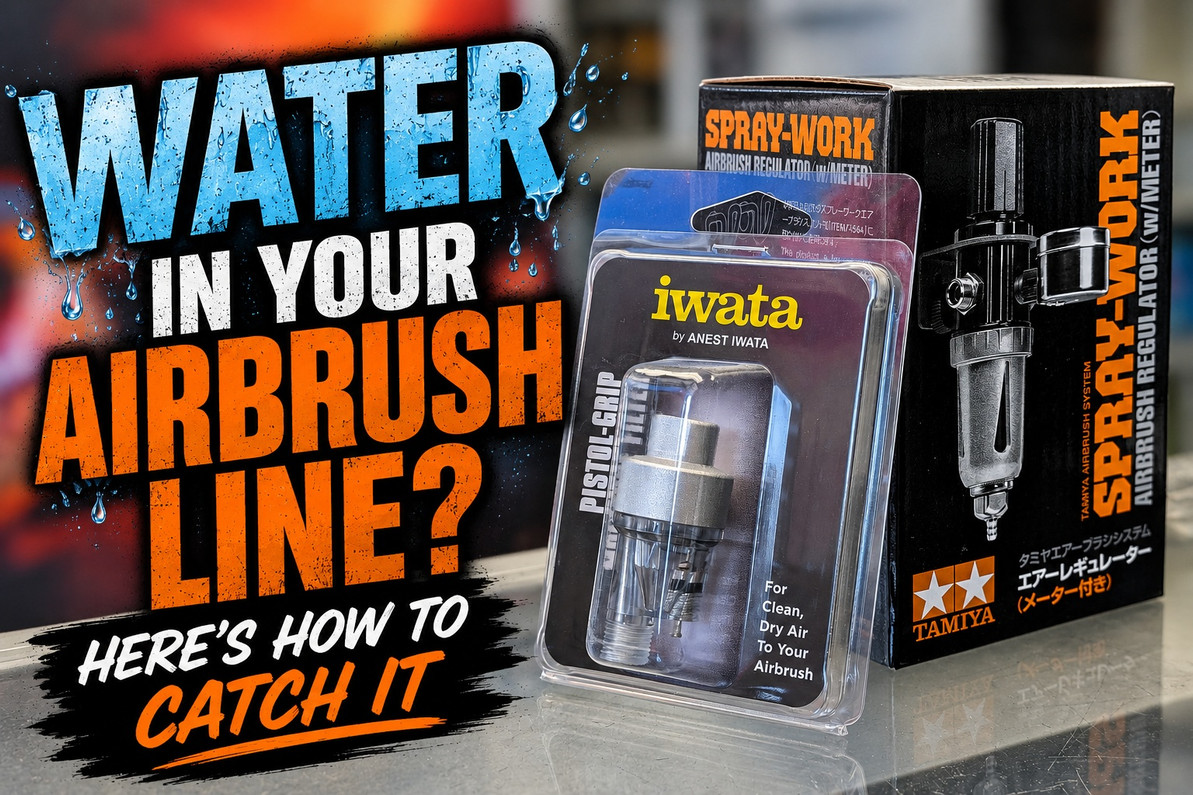
Water in Your Airbrush Line? Here's How to Catch It
Why There's Water in Your Airbrush Line (And How to Catch It)
Weekly column · Lessons from the paint counter at WWH · July 2026
Water spitting out of your airbrush during a humid Toronto summer is not a sign of a failing compressor. It is condensation, and in the heat and humidity we get here it is close to unavoidable. A moisture trap is the answer, and it is answering two things at once: the water compression squeezes out of the air, and the swamp of an environment your compressor is breathing in the first place.
That second part is the one people underrate. Without a trap, humid Toronto summers quietly dictate when you can airbrush at all. You end up waiting for the cool of night, or writing off whole days, because spraying in the afternoon means water in the line and moisture settling into the finish. A trap, or two, is what buys those hours back. The rest of this comes down to where the water forms, where to catch it, and the part no trap can touch.
In the heat and humidity of a Toronto summer, a moisture trap is not optional; it is what lets you airbrush during the day at all. Compressed air sheds its water as it cools in the hose, so a trap belongs at the airbrush end where the air is coolest and it is the last gate before your paint. A second trap at the compressor is worth it on the worst days, but it is insurance, not a different result. And keep one thing in mind that no trap can fix: the humidity in the room itself, which can spoil a finish straight out of the air.
Where the water actually comes from
The truth: it is a two-step process, and the second step is the one that matters.
Air always carries some water as invisible vapour, and warm air holds much more of it than cool air. When your compressor squeezes that air down, two things happen at once. The volume drops, so the same amount of water is now packed into a much smaller space, and the act of compressing heats the air, which lets it briefly hold that concentrated moisture as vapour. At the pump, then, the water is mostly still a gas. Nothing has dripped yet.
Then the hot compressed air starts down the hose, and it cools. Cooler air cannot hold as much vapour, so the excess is forced back into liquid form. That is condensation, the same process that beads water on the outside of a cold glass. By the time the air has cooled to the temperature it reaches at the airbrush, a real amount of that water has turned liquid.
So the water forms where the cooling happens, which is the hose, not the compressor body. In a Toronto July, when the incoming air starts out warm and loaded with moisture, there is simply more water available to condense, and the problem gets more visible. Nothing is malfunctioning. The physics is doing what it always does, just with more raw material to work with.
Where the trap goes, and why it is not complicated
The short version: airbrush end by default. A second at the compressor is for the worst days, not a different result.
A trap can only catch water that has already turned liquid. Warm air still holds its moisture as vapour, which passes straight through. Since the air keeps cooling all the way down the line, the coolest point, and therefore the point where the most water has condensed into something catchable, is the airbrush end. It is also the last gate before your paint. Both facts point the same way, so there is no real puzzle here: put your trap at the airbrush end.
The Tamiya Spray-Work filter installs inline between the hose and the airbrush and catches moisture and dust in that final stretch, with a release valve to drain it. The Iwata Pistol-Grip filter mounts directly on the airbrush itself, which Iwata fairly calls the final defense; its fine 5 micron element and clear bowl let you watch water collect and dump it without removing the filter, and it doubles as a grip. Either one, at the brush end, is the core of your setup.
A second trap up at the compressor pulls bulk water out before it ever travels down the hose, which spares your line and regulator and keeps the little airbrush-end filter from filling up mid-session. On a punishing Toronto afternoon that is worth doing. But be clear about what it is: insurance, the "I did everything I could" move, not a meaningfully drier result than a single good filter at the brush. If you are choosing where one trap goes, it goes at the airbrush. The Iwata FA500DH is the compressor-end option if you want the second one, and if you run an older Iwata Sprint Jet its built-in trap already fills that role, with the Iwata ISMT1 as the replacement assembly. Iwata builds a trap into every compressor from the Sprint Jet up, so if you are shopping the machine comes with one: the Sprint Jet, Smart Jet, Smart Jet Pro, Power Jet Lite, and Power Jet Pro.
The part no trap can touch: the room
A trap cleans the air in your line. It does nothing about the humid air your paint is drying in.
This is the half of the problem most guides skip, and in a Toronto summer it is often the half that actually ruins a finish. Your trap can be delivering perfectly dry air and the paint can still go wrong, because the moisture is not coming through the hose. It is settling into the wet film directly out of the room around you, and the fast-evaporating thinners in a spray coat cool the surface as they flash off, which pulls even more moisture down onto it.
You see it as a milky bloom across the finish, or as fisheye dimples that sometimes only show up a day later once everything has cured. No filter stops this, because no filter touches the air outside the line. The only real lever is the humidity of the space itself.
Which is exactly why, without help, summer humidity quietly sets your painting schedule. It pushes you to spray at night or in the early morning when the air is cooler and drier, and it writes off the worst afternoons entirely. The way you buy those hours back is to dry the space: run the AC or a dehumidifier where you paint, close it up ahead of a session rather than spraying with a window open onto a wet afternoon, and give a coat longer to cure before you judge it. A trap keeps the water out of your air. Drying the room is what keeps it out of your paint.
The thread that runs through it
There are two fronts, not one. A trap handles the water inside your line, and it belongs at the airbrush end where the air is coolest. Drying the room handles the water that attacks your paint from the outside. In the kind of summer we get here you need both, and the reason you need them is the same reason painting feels impossible on a humid afternoon without them: the environment, not just the compressor, is working against you. Deal with both and you get your daylight hours back.
If you are fighting water tonight
A quick order of operations when drops start hitting the model mid-session:
- Clear the line first. Disconnect the hose and blow it out, or drain the trap bowl. Get the standing water out before you chase anything else.
- Make sure there is a filter at the brush end. This is the one that matters most. A small inline or on-airbrush filter catches the water that forms in the final, coolest stretch of hose, right before your paint.
- On a brutal day, add one at the compressor too. It pulls bulk water before it travels down the line and keeps the brush-end filter from filling up. Insurance, not a miracle.
- If the model itself is blooming, look at the room, not the line. No filter fixes this. Wait for a cooler, drier hour, or dry the space with AC or a dehumidifier before you spray.
The goal is not perfectly dry air everywhere. It is dry air at the needle, which comes down to catching water where it forms and keeping the room from undoing your work.
Quick reference: moisture products we stock
| Product | Where it sits | What it actually does |
|---|---|---|
| Iwata FA500DH | Compressor end | Compressor-end second trap. Deflector-plate separator spins condensed water out of the stream before it enters the hose. The optional insurance trap for humid days. |
| Iwata ISMT1 | Compressor (Sprint Jet) | Full replacement trap assembly for older Iwata Sprint Jet IS800 units (IS800, 800USM, 800DE). The trap that already ships on the Sprint Jet. |
| Iwata FA600DH | Compressor end | Moisture filter plus pressure regulator and gauge in one unit. Compressor-end separation and pressure control together. |
| Tamiya Spray-Work Filter | Inline, at airbrush | Installs between hose and airbrush; catches moisture and dust in the final, coolest stretch. Drain via release valve. The default trap, and the one to have if you only run one. |
| Iwata Pistol-Grip Filter | On the airbrush | Mounts on the airbrush as the last gate before paint. Fine 5 micron element, clear bowl for visual checks. A strong pick for your one essential trap. |
Frequently Asked Questions
Warm air holds far more water vapour than cool air, so a humid summer feeds your compressor much wetter air to begin with. More water going in means more water coming out when the compressed air cools in the hose. The mechanism is the same all year; summer just supplies more raw material.
The airbrush end. The air is coolest there, so the most water has condensed into something a trap can actually catch, and it is the last point before your paint. If you run only one trap, that is where it goes. A second one at the compressor is worth adding on very humid days, since it pulls bulk water before it enters the hose, but it is insurance rather than a meaningfully drier result.
In a Toronto summer, yes, add a filter at the airbrush end. A compressor-mounted trap catches water early, but more condenses in the cooler final stretch of hose after it, and only a brush-end filter catches that. So the built-in trap is the helpful second line and the airbrush-end filter is the one doing the decisive work. In a genuinely dry space the built-in one alone may be plenty.
Only if the cause is water coming through the line. If the paint is blooming because the room air is humid, no trap will help, because the moisture is settling into the wet film directly from the air around the model. That is a job for drier air: cooler painting hours, AC, or a dehumidifier in the space.
Check the bowl each session and empty it whenever you see water pooling, more often on humid days. This is exactly why a clear bowl is worth having. A trap that has filled to the line stops separating effectively and simply passes water down the line.
Yes, indirectly. Air sits and cools in a tank, so some water condenses there and can be drained off before it ever reaches the hose, which is part of why tank compressors often feel drier. The flip side is that the tank itself needs draining periodically, or that collected water eventually goes down the line.
Condensation mechanics summarised from standard compressed-air references. Iwata compressor and filter behaviour drawn from Iwata's published product information. Product availability reflects Wheels & Wings Hobbies, Toronto; check individual product pages for current CAD pricing. Counter Notes publishes weekly, drawing on what we see and hear at the paint counter in Toronto.
All recommended products are stocked at Wheels & Wings Hobbies in Toronto and available online with Canada-wide shipping.
Recent Posts
-

What Glue Should I Use? A Scale Modelling Adhesive Guide
Wheels & Wings Hobbies · Counter Notes What Glue Should I Use? Lessons from the paint counter at W …Oct 16, 2026 -

John's Starcraft Zerg Queen Paint Guide - Build Feature
Wheels and Wings Hobbies - Miniature Paint Guide John's Starcraft Zerg Queen Archon Studio - Starcra …Sep 24, 2026 -

Vlad's Tomb King on Necrolith Bone Dragon Paint Guide - Build Feature
Wheels and Wings Hobbies - Miniature Paint Guide Vlad's Tomb King on Necrolith Bone Dragon Warhammer …Sep 10, 2026