
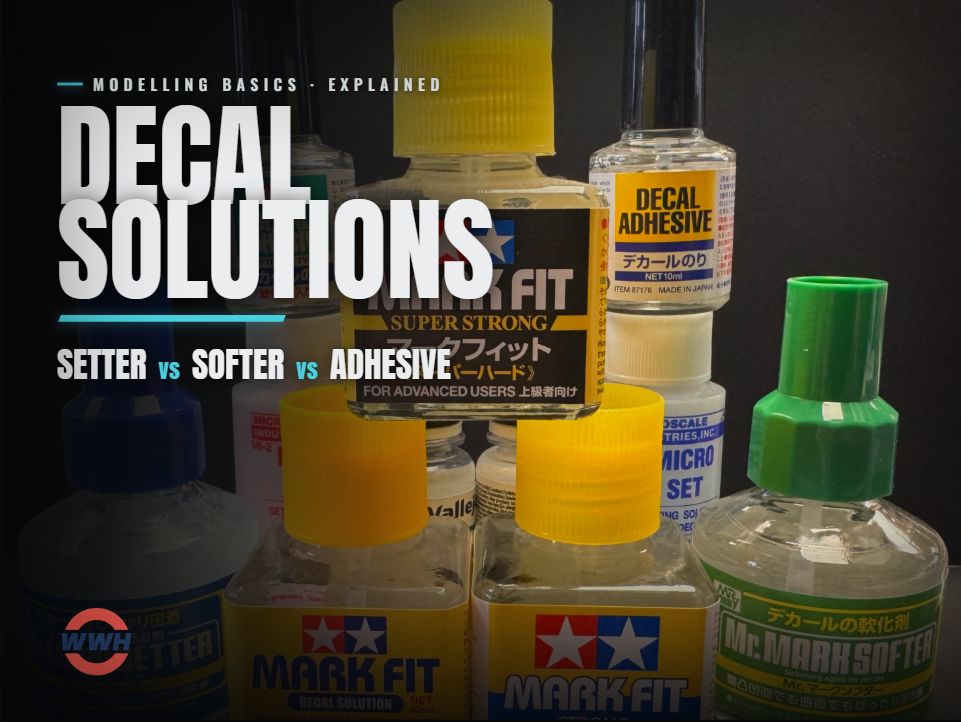
Decal Solutions Explained: Setter vs Softer vs Adhesive
Setter, Softener, or Adhesive? Choosing the Right Decal Solution
Weekly column · Lessons from the paint counter at WWH · July 2026
The little bottles on the decal shelf are the single most confusing corner of the store for people who did not grow up with them. Micro Set and Micro Sol. Mr Mark Setter and Mr Mark Softer. Three strengths of Tamiya Mark Fit. Two Tamiya Decal Adhesives. Customers pick one more or less at random, or buy all of them to be safe, and neither approach is right — because these products are not competing brands of the same thing. They are answers to two completely different problems.
Almost every decal question we field at the counter comes down to one diagnostic: is the decal refusing to conform, or is it refusing to stick? Those are not the same failure, and no single bottle fixes both across the board. Get the diagnosis right and the shelf sorts itself out. Here is how to read it.
There are two families. Softeners and setters (Micro Set/Sol, Mr Mark Setter/Softer, Tamiya Mark Fit) make a decal lie down into panel lines, rivets, and curves - they do nothing for a decal that will not stick. Adhesives (Tamiya 87176 and 87193) restore lost stick to old, brittle, or repositioned decals - they are the answer when the decal lifts off the backing but will not hold. Diagnose the problem first (won't conform vs. won't stick), then pick the family. The Softener-Type adhesive (87193) does both jobs at once, which is why it is the right call for aged and estate-kit decals.
Start here: the one question that sorts the whole shelf
Is the decal failing to conform, or failing to stick? Everything else follows from that.
A decal can fail you in two distinct ways, and people constantly reach for the wrong bottle because the symptoms look superficially similar - a decal that is not sitting right.
Problem A: it sticks, but it won't lay into detail
The decal is stuck to the model, but it bridges over panel lines, tents up on a curve, shows a silvery halo of trapped air around the edges, or refuses to settle onto a rough matte surface. This is a conforming problem, and it belongs to the softener/setter family. The solvent in these solutions temporarily softens the carrier film so it slumps into every recess and the trapped air escapes.
Problem B: it won't stick at all
The decal cracks, curls, floats off the backing, or slides around and refuses to grab the surface. This is almost always an adhesion problem - and it is what happens to decals that have aged. The thin layer of water-activated glue on the back of a decal degrades over the years, so old kits, estate finds, and anything that has been sitting in a loft for a decade will often have decals that release from the paper but have nothing left to hold with. Softener will not save these. They need an adhesive.
The trap to avoid: drowning a non-sticking old decal in Micro Sol or Mark Fit Strong. Softening solvent on a decal that has already lost its glue just makes a fragile film even more fragile, and you will watch it disintegrate. Wrong family, wrong problem.
Family one: softeners and setters (the conforming job)
These make a decal melt down into surface detail. They come as two-step systems and as single-step solutions — the split confuses people more than any other thing on the shelf.
Two-step systems: a setter and a softener working in sequence
The classic Microscale pair is the reference point everyone else is measured against. Micro Set is the mild, mildly acidic first step: you brush it onto the surface before the decal, and it does three quiet jobs at once - it preps and slightly etches the gloss so the decal grips, it cuts the decal's own residual glue so you can slide it into position, and it starts to relax the film. Micro Sol is the aggressive second step: a stronger solvent you brush over the top once the decal is positioned, which melts the film down into panel lines and over curves. The rule modellers repeat is "Set first, Sol second," and the other rule is do not touch it - Micro Sol makes the decal wrinkle alarmingly as it works, and if you poke it you will ruin it. Leave it. The wrinkles pull flat as it dries.
Mr Hobby's pair works on the same logic. Mr Mark Setter is a setting solution with real adhesive character - it grips a decal to a curved surface and holds it - while Mr Mark Softer is a potent solvent aimed at the stubborn, thick decals common in Japanese kits. Mark Softer is strong enough that the standing warning applies doubly: never let it puddle on a decal or it will eat the film beneath it. Independent testing (Tale of Painters) found Micro Sol still edged it out on fine edge-blending - three coats of Micro Sol did what six coats of the current Mr Mark Softer NEO formula did - but both get you there, and if you are already in the Mr Hobby ecosystem the Setter/Softer pair is an excellent match.
Single-step solutions: Tamiya Mark Fit, in three strengths
Tamiya's Mark Fit range collapses the two steps into one bottle with a brush in the cap - you apply the decal, blot the water, then paint the solution over the top. It is the simplest way in for a beginner, and the strengths let you match the solution to how difficult the surface is:
Mark Fit (regular, 87102) - the standard softener for ordinary bumpy and curved surfaces. Mild; the everyday default.
Mark Fit Strong (87135, yellow label) - a more powerful formula for difficult curves and matte-painted surfaces. It is also noticeably thicker than the regular, which is a practical advantage: it stays where you put it instead of running off a slope.
Mark Fit Super Strong (87205, black label) - the strongest of the three on paper. Field reports are genuinely mixed: some modellers see little real-world gain over the yellow-label Strong or Mr Mark Softer, particularly on thick Cartograf-printed decals, which are engineered to resist solvents and shrug off even the strong stuff. Buy it for known-difficult decals, not as a default.
Where do these sit relative to each other? An IPMS/USA bench test lined them up from mildest to strongest as roughly: Mark Fit regular → Micro Set → Micro Sol → Mark Fit Strong → Solvaset. Useful context: Mark Fit regular is on the gentle end, and Mark Fit Strong is genuinely aggressive - stronger than Micro Sol.
The honest caveat that applies to all of them: the decal's own thickness matters more than the label on the bottle. A thick, tough Cartograf decal resists solvent by design, and a delicate ALPS-printed or thin kit decal can be destroyed by a solution another decal would barely notice. Always test on a spare marking or the edge of the sheet before you commit to the one you cannot replace.
Family two: decal adhesives (the sticking job)
These restore lost adhesion. Different problem, different chemistry, different shelf.
This is the family people forget exists, and it is the one that quietly rescues the most projects. When a decal has lost its grip - the old-kit and estate-decal problem, but also decals soaked too long until the glue washed away, or a marking you have had to lift and reposition three times until it stopped holding - the fix is not more solvent. It is glue.
Tamiya Decal Adhesive, regular (87176)
This one is glue and only glue - a solution formulated specifically to restore sticking power to decals that have lost it. You dab it on the surface, position the decal, and wipe away the excess. There is no softening solvent in it, so reach for it when the decal will sit down fine but simply will not hold.
Tamiya Decal Adhesive, Softener Type (87193)
This is the clever one. It combines the 87176 glue with the softening substance from Mark Fit Strong, so it re-adheres and conforms in a single step, and helps avoid silvering into the bargain. For aged decals this is usually the right bottle, because old decals rarely have just one problem - a decade-old marking that has lost its glue has also usually gone brittle and reluctant to lie down over detail. The Softener Type handles both at once, which is why it is our standard recommendation for anyone opening a vintage or estate kit.
The decision in one line: if an old decal has lost its stick, that is 87176. If it has lost its stick and the surface is awkward or you are fighting silvering, that is 87193. When in doubt with an aged kit, 87193 is the safer bet because it covers both failures.
The thread that runs through the whole shelf
Two families, two problems. Softeners and setters make a decal conform; adhesives make a decal stick. Every bottle on the shelf is a variation on one of those two jobs, differing mainly in strength and in whether the work is split across two steps or handled in one. Match the family to the symptom first, then dial in strength: mild solution for a gentle curve and a fresh thin decal, stronger for a difficult matte surface or a tough thick decal, adhesive for anything old that will not hold.
The same principle as always at this counter: knowing what a product is for beats memorising which bottle to grab. Diagnose the failure, and the right solution is obvious.
How to actually apply a decal with these solutions
The method that gives a clean, silvering-free result on a normal, healthy decal:
- Gloss first. Apply decals onto a glossy surface, never a matte one. A gloss coat gives the decal a smooth bed and is the single biggest factor in avoiding silvering.
- Setter down. Brush the setting solution (Micro Set, Mr Mark Setter, or your Mark Fit) onto the spot before you slide the decal into place.
- Position and blot. Slide the decal off its backing, position it, and gently blot the excess water and solution from the edges with a paper towel or cotton bud. Let it dry.
- Softener over the top. Once set, brush the softening solution (Micro Sol, Mr Mark Softer, or the same Mark Fit) over the decal to melt it into the detail.
- Walk away. It will wrinkle. Do not touch it, do not smooth it - the wrinkles disappear as it dries. Repeat thin coats of softener if it has not fully settled, never one heavy flood.
- Seal. Once fully dry and cleaned of any glue residue, seal with a clear coat - matte or flat to kill the gloss and lock the decal down.
For an old or estate-kit decal, skip the solvent-first instinct entirely: dab 87193 Softener Type on the surface, place the fragile decal gently, wipe the excess, and let it grip. It re-glues and conforms in the one pass, which is exactly what a tired old decal needs.
The golden rule under all of it: test on a spare marking first. Decals vary more than solutions do, and the one you cannot replace is not the one to experiment on.
Quick reference: decal solutions we stock
| Product | Family | What it actually does |
|---|---|---|
| Microscale Micro Set | Setter (step 1) | Mild, mildly acidic. Preps the surface, lets you position the decal, starts relaxing the film. Applied before the decal. |
| Microscale Micro Sol | Softener (step 2) | Stronger solvent, applied over a positioned decal to melt it into panel lines and curves. Don't touch as it wrinkles. |
| Mr Mark Setter | Setter (step 1) | Setting solution with strong adhesive character, grips decals to curved surfaces and holds them in place. |
| Mr Mark Softer | Softener (step 2) | Potent solvent for thick, stubborn decals (common in Japanese kits). Never let it puddle, it will eat the film. |
| Tamiya Mark Fit (87102) | Softener (single-step) | The everyday default. Mild single-bottle softener for ordinary bumps and curves. Brush in the cap. |
| Tamiya Mark Fit Strong (87135) | Softener (single-step) | Stronger than Micro Sol. For difficult curves and matte surfaces. Thicker, so it stays where you put it. |
| Tamiya Mark Fit Super Strong (87205) | Softener (single-step) | Strongest on paper; reports mixed on thick Cartograf decals. Buy for known-difficult decals, not as a default. |
| Tamiya Decal Adhesive (87176) | Adhesive | Glue only, no solvent. Restores sticking power to decals that have lost it. For old decals that sit fine but won't hold. |
| Tamiya Decal Adhesive, Softener Type (87193) | Adhesive + softener | Store pick for aged & estate decals: combines the 87176 glue with Mark Fit Strong softening. Re-adheres and conforms in one pass; helps avoid silvering. |
Frequently Asked Questions
Depends on the system. The two-step brands (Microscale, Mr Hobby) are designed as a pair: Set/Setter down first to position and grip, Sol/Softer over the top to conform. Tamiya Mark Fit rolls both jobs into one bottle, so a single Mark Fit is all you need for most work. If you buy the two-step system, use both - the setter alone won't fully conform a decal into deep detail, and the softener alone skips the positioning and adhesion help.
None of the softeners - that is the mistake to avoid. Lost adhesion is an adhesive problem, not a conforming one. Reach for Tamiya Decal Adhesive: the regular 87176 if the decal just needs to stick, or the 87193 Softener Type if it also needs to lie down over detail (which aged decals usually do). Softening solvent on a decal that has already lost its glue will only make a fragile film disintegrate faster.
Silvering is light bouncing off microscopic air trapped under the clear carrier film. Two things prevent it: applying decals over a gloss surface (so there's no rough texture to trap air), and using a softening solution to pull the film down tight into the surface so the air escapes. If silvering has already set in, a softener can often still rescue it. On old decals, the 87193 Softener Type helps here because its softening component conforms the film while it re-glues.
Almost certainly not - wrinkling is exactly what a softening solvent is supposed to do. The film goes soft and buckles as it relaxes, then pulls flat and tight into the surface as it dries. The one way to actually ruin it is to touch it while it's wrinkled: poking or smoothing tears the softened film. Leave it completely alone, give it a couple of hours, and it settles. If it hasn't fully conformed, add another thin coat once dry.
No. Roughly, from mildest to strongest: Mark Fit regular, then Micro Set, Micro Sol, Mark Fit Strong, and Solvaset at the top end (an IPMS bench ranking). Super Strong sits at the aggressive end but real-world reports are mixed. Some modellers see little gain over Strong on thick Cartograf decals, which are built to resist solvent. Stronger isn't automatically better: an overly aggressive solution can destroy a thin or delicate decal. Match strength to the decal and the surface, and step up only if a milder solution won't settle it.
Generally yes; they're all working the same chemistry (mild acid/adhesive for setting, solvent for softening). Plenty of modellers position with Micro Set and conform with a stronger softener from another brand. The thing to respect isn't the label but the strength and your specific decal, a tough decal may need a stronger softener regardless of brand, and a delicate one wants the mildest thing that works. Test on a spare marking before committing on the model.
Product characteristics drawn from manufacturer descriptions (Tamiya, Microscale, Mr Hobby/GSI Creos) and modeller testing. Strength ranking referenced from IPMS/USA's Mark Fit bench review; two-step vs. single-step behaviour and the Mr Mark Setter/Softer comparison cross-checked against Tale of Painters' Mr Mark Setter & Softer NEO review and modelling-forum consensus. Counter Notes publishes weekly, drawing on what we see and hear at the paint counter in Toronto.
All recommended decal solutions are stocked at Wheels & Wings Hobbies in Toronto and available online with Canada-wide shipping.
Recent Posts
-

Farhan Builds the Tamiya 1/24 R32 Nissan Skyline GT-R - Build Feature
Wheels and Wings Hobbies - Scale Model Build Feature Farhan Builds the Tamiya R32 Nissan Skyline GT- …Sep 03, 2026 -

Bob Builds the Wizkids Giant Atlas Rhinoceros Beetle - Paint Guide
Wheels and Wings Hobbies - Miniature Paint Guide Bob Builds the Wizkids Giant Atlas Rhinoceros Beetl …Sep 01, 2026 -

Kyle Builds the Tamiya 1/35 Leopard 2A7 - Arid "What If" Scheme Build Feature
Wheels and Wings Hobbies - Scale Model Build Feature Kyle Builds the Tamiya Leopard 2A7 - Arid "What …Aug 26, 2026