
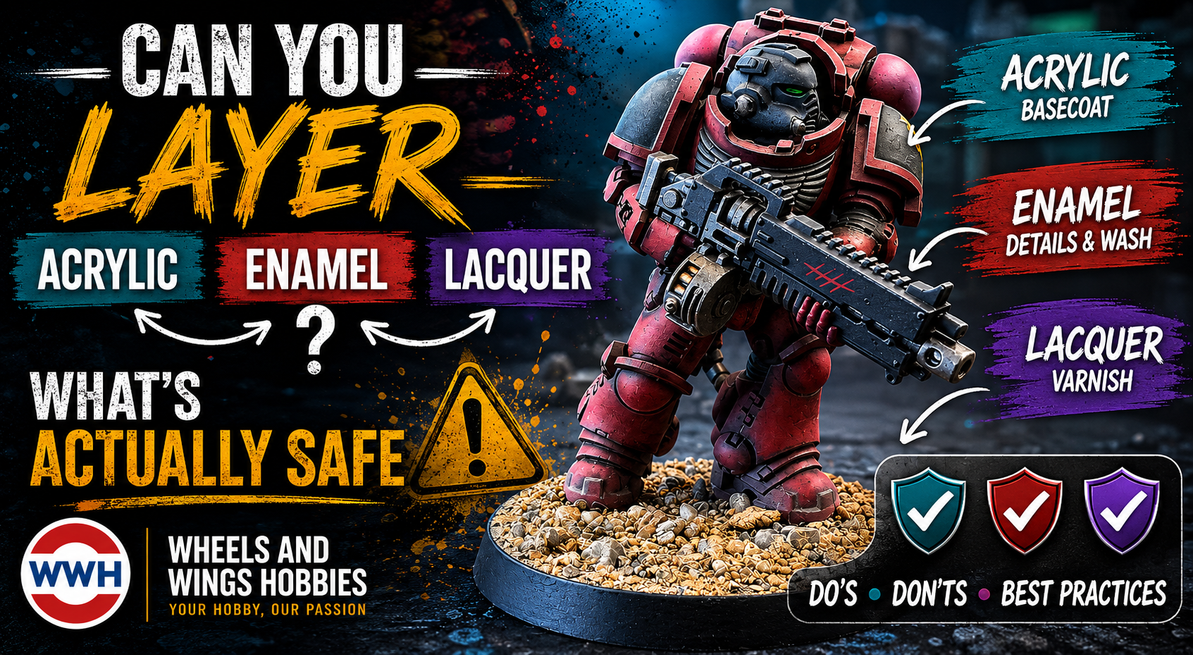
Can You Layer Acrylic, Enamel, and Lacquer Paint? What's Actually Safe
Paint Compatibility: What You Can Actually Layer Over What
Weekly column · Lessons from the paint counter at WWH · May 2026
One of the most persistent pieces of misinformation we hear at the counter goes roughly like this: "You can't put lacquer over enamel" or "you have to stick to one paint type or everything lifts." People have binned half-finished models over this. It deserves a direct answer.
The more accurate framing is this: weaker solvents go over stronger films. Most combinations are fine with proper cure time. A few carry real risk. And one — lacquer directly over enamel — is the combination most worth understanding, because it is genuinely unreliable and the reason why tells you something useful about everything else.
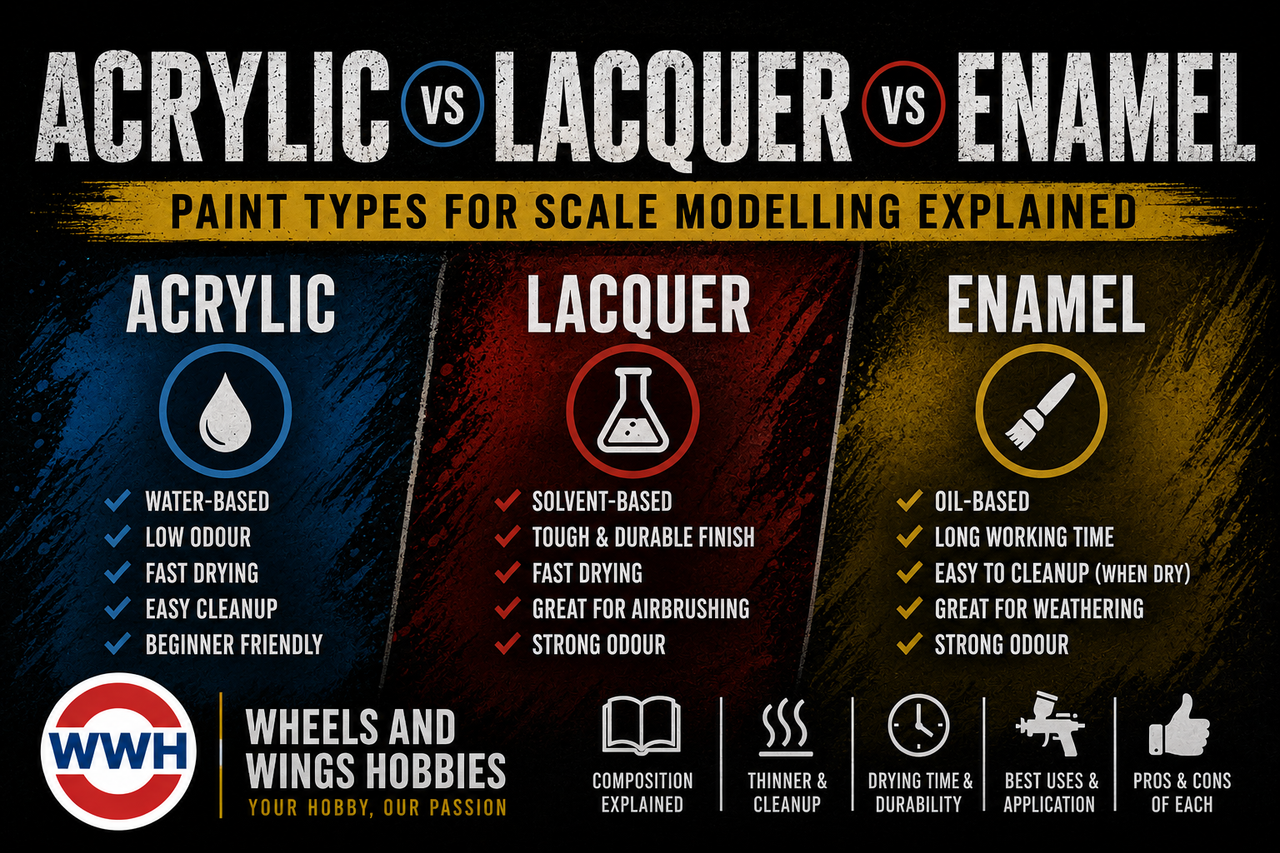
The deeper reference for why the chemistry works the way it does — binders, carriers, and what the labels on paint jars actually mean.
Water-based over anything cured: safe. Enamel over cured acrylic or lacquer: safe. Lacquer over lacquer: safe. Everything else carries some degree of caution — either because of solvent strength, cure time, or both.
The two combinations that cause the most ruined models: lacquer over enamel (lacquer solvents attack the enamel binder regardless of how dry it looks), and lacquer over uncured acrylic (lacquer solvents can lift acrylic that has not fully cross-linked). A barrier coat of cured acrylic varnish resolves the second; nothing reliably resolves the first.
The one principle that explains everything
It is not about paint types being incompatible. It is about whether the solvent in the top coat can dissolve the binder in the layer below.
Every paint has two components that matter here: the binder (the polymer that hardens into the cured film) and the carrier (the solvent that keeps it liquid until you apply it). Compatibility problems happen when the carrier of a fresh coat is aggressive enough to dissolve the binder in the layer below. For the full breakdown of how binders and carriers map to each paint type, see our acrylic vs lacquer vs enamel guide.
Carrier solvents rank roughly from mildest to strongest: water → alcohol → mineral spirits → lacquer thinner. The general rule that follows is weaker over stronger: you can almost always apply a milder carrier over a stronger cured film, because the milder carrier cannot dissolve what the stronger one produced. Going the other direction — stronger carrier over a milder film — is where problems arise.
Cure time matters equally. A paint that is touch-dry is not necessarily safe to coat over. Enamels in particular cure through a slow oxidation process; they remain soluble to strong solvents for far longer than they appear dry to the fingernail. The same applies to fresh acrylic that has not fully cross-linked. Most layering failures happen not because the combination is inherently wrong, but because someone did not wait long enough.
Every combination, honestly assessed
Listed from safest to most risky. "Cured" means genuinely cured — not just surface-dry.
Water-based over anything ✓
The safest direction of travel. Water does not dissolve cured acrylic, lacquer, or enamel binders. Water-based acrylic over a cured layer of anything is reliable — this is why even modellers who prime in lacquer and weather in enamel typically do all their base colour work in acrylic. Note: applying acrylic over fresh, uncured enamel is risky in a different way — enamels off-gas as they cure, and sealing that off-gassing under an acrylic top coat can cause bubbling. Let enamel cure fully first.
Enamel over cured acrylic or lacquer ✓
Safe. Mineral spirits do not dissolve cured acrylic or lacquer films. This underpins one of the most widely-used techniques in the hobby: apply an acrylic base coat, seal it, then use enamel washes or oil paint for weathering, cleaning up with mineral spirits without fear of disturbing the paint below. The seal coat is not strictly required for chemistry reasons, but it gives the wash a smoother surface to flow across and makes clean-up easier.
Enamel over enamel ⚠
Safe with adequate cure time, but the margin is narrower than most people allow for. The mineral spirits in a fresh enamel coat will reactivate an undercured enamel layer below. Surface dry is not enough — enamel cures through oxidation, which takes hours to days depending on temperature, humidity, and coat thickness. When working enamel-over-enamel, allow genuine cure time between coats, not just until dry to the touch.
Lacquer over lacquer ✓
Safe and standard. Each fresh lacquer coat slightly reactivates the surface of the previous one, which actually aids adhesion. This is how lacquer finishing has always worked in automotive and industrial contexts.
Lacquer over fully cured acrylic ⚠
Riskier than it appears. Lacquer thinner is aggressive enough to soften acrylic that has not fully cross-linked, and full cross-linking takes longer than most people allow. A brush-applied lacquer like Dullcote over well-cured acrylic is generally fine in practice. An airbrush-applied lacquer is riskier — at close range or heavy coats, it delivers enough solvent to cause lifting or crazing even on paint that appears long-dry. The reliable approach: allow acrylic to cure for at least 24 hours, apply a clear acrylic varnish barrier if uncertain, then apply lacquer in thin passes.
Lacquer over enamel ✗
The one combination to genuinely avoid. Enamel cures slowly through oxidation and the resulting film — even after days — remains soluble to lacquer solvents. Lacquer thinner attacks the alkyd binder in enamel regardless of how dry the surface appears, causing wrinkling, crazing, or complete lifting. This failure is consistent and is not primarily a cure time problem — it is a solvent-attacks-binder problem. For general use, treat this combination as off-limits.
The workflow that avoids all of this
If you use all three paint types, there is a layer order that makes every transition safe:
Lacquer primer → Acrylic paint → Acrylic varnish seal → Enamel weathering → Acrylic varnish seal → Lacquer final coat
The enamel layer never contacts lacquer solvents directly at any stage. The acrylic varnish seals before the enamel goes on, and again before the final lacquer coat. This is not an elaborate workaround — it is just how experienced modellers naturally work when they use all three types.
Quick reference: layering compatibility
| Top coat → Bottom layer ↓ |
Water-based on top | Enamel on top | Lacquer on top |
|---|---|---|---|
| Cured acrylic below | ✓ Safe | ✓ Safe once fully cured | ⚠ Risky — use barrier coat + light passes |
| Cured enamel below | ⚠ Safe only once fully cured (off-gassing risk if rushed) | ⚠ Safe but wait days, not hours | ✗ Avoid — lacquer solvents attack enamel binder |
| Cured lacquer below | ✓ Safe | ✓ Safe once dry | ✓ Safe — standard practice |
The thread that runs through all of this
The "don't mix paint types" rule is a simplification that got passed on until it became received wisdom. The actual principle is narrower: weaker solvents over stronger cured films. Water is the mildest carrier and goes over anything safely. Lacquer thinner is the most aggressive and needs to be treated with corresponding care. Cure time is always the variable that matters most alongside solvent strength — "dry to the touch" is not the same as "safe to coat over."
The lacquer-over-enamel exception is the one case where increased cure time does not make the combination reliable. It is the only genuinely off-limits combination in standard hobby use. Everything else is manageable with patience and, where needed, a barrier coat.
Frequently Asked Questions
Technically yes — mineral spirits do not dissolve cured acrylic. However, a gloss varnish barrier coat is strongly recommended anyway. It gives the wash a smooth, non-absorbent surface to flow across and makes clean-up with mineral spirits easier without risking mechanical abrasion to the paint below. The barrier is about surface quality and practical control, not chemistry.
The lacquer solvent penetrates and swells the enamel below while the lacquer above begins to set. The enamel buckles — producing a crinkled, shrivelled, or orange-peel texture across the affected surface. It cannot be corrected without stripping back to bare plastic. Catching it in the first few minutes and immediately wiping off the lacquer with solvent sometimes saves the enamel beneath, but results are inconsistent.
Oil paints use linseed oil and sometimes mineral spirits as carriers — they behave like enamels for layering purposes. Safe over cured acrylic or lacquer; do not apply lacquer over uncured oils, as oil paint can take days to weeks to fully cure. Oils over sealed acrylic is one of the most common and reliable weathering combinations in both miniature painting and scale modelling.
Generally yes in practice, but with care. Brush-applied Dullcote over well-cured acrylic is widely used and reliable. Rattle-can Dullcote can cause issues if the acrylic has not fully cured, is applied too heavily or too close, or if the surface is cold or humid. Allow acrylic to cure for at least 24 hours, apply in light passes from a proper distance, and do not try to build coverage in one pass. An acrylic varnish barrier first adds an extra margin of safety.
Yes, same mechanism and same risk. Lacquer primer over enamel paint carries identical risk to lacquer varnish over enamel paint — the solvent content is the same. If you have enamel paint on a model and need to re-prime a section, use an acrylic rattle can or brush-on acrylic primer rather than a lacquer primer.
There is no universal answer — it depends on the brand, temperature, humidity, and coat thickness. For acrylic over enamel: overnight in a warm room is usually enough. For enamel over enamel: 24–72 hours minimum. For lacquer over enamel: we do not recommend this combination regardless of cure time. When in doubt, apply a water-based acrylic coat over the enamel and let that cure — then your surface is acrylic, not enamel, and subsequent lacquer coats are manageable again.
Counter Notes publishes weekly, drawing on what we see and hear at the paint counter in Toronto. For a deeper treatment of paint binders, carriers, and how to choose between paint types, see our full acrylic vs lacquer vs enamel guide. Specific solvent formulations vary by manufacturer — when in doubt, test on a spare part before the model.
All paints, primers, and varnishes referenced are stocked at Wheels & Wings Hobbies in Toronto and available online with Canada-wide shipping.
Recent Posts
-
What Glue Should I Use? A Scale Modelling Adhesive Guide
Wheels & Wings Hobbies · Counter Notes What Glue Should I Use? Lessons from the paint counter at W …Oct 16, 2026 -

John's Starcraft Zerg Queen Paint Guide - Build Feature
Wheels and Wings Hobbies - Miniature Paint Guide John's Starcraft Zerg Queen Archon Studio - Starcra …Sep 24, 2026 -

Vlad's Tomb King on Necrolith Bone Dragon Paint Guide - Build Feature
Wheels and Wings Hobbies - Miniature Paint Guide Vlad's Tomb King on Necrolith Bone Dragon Warhammer …Sep 10, 2026