
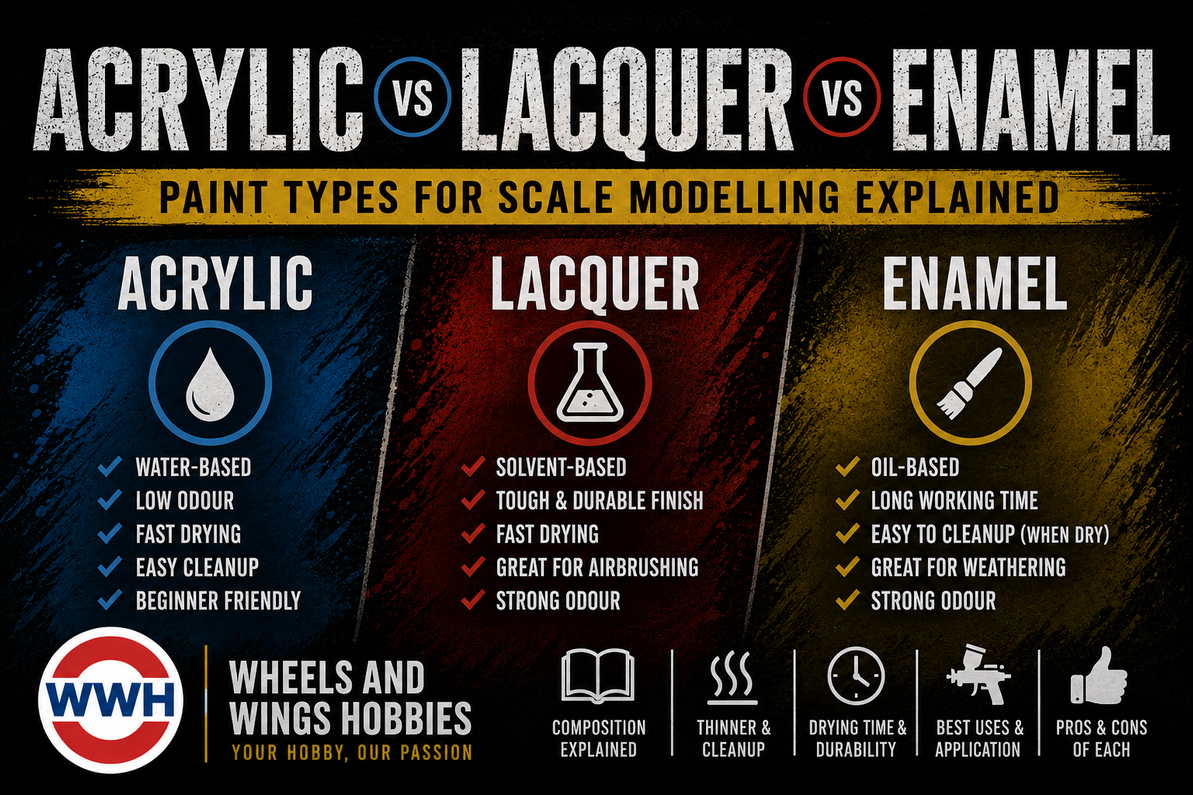
Acrylic vs Lacquer vs Enamel: Paint Types for Scale Modelling Explained
Paint Types for Scale Modelling: Acrylic, Lacquer & Enamel Compared
From a Toronto hobby retailer since 1986 · What the labels actually mean · Updated May 2026
There is a conversation we have at our counter several times a week, and it goes something like this: a customer tells us they use acrylic paints, picks up a bottle of Tamiya, and is surprised when we explain that you can thin it with lacquer thinner. "But it's an acrylic, isn't it?" Yes, and so is most of what you would call a lacquer. The labels on hobby paint jars have done a remarkable job of confusing what each category actually means.
This guide does two things. First, it explains what acrylic, lacquer, and enamel actually are at the chemistry level, without going so deep that you need a degree to follow it. Second, it gives you a practical framework for choosing the right paint type for what you are doing, based on how the paint actually behaves rather than what the marketing says. Understanding the distinction between the binder (the polymer that hardens) and the carrier (what the binder is dissolved or suspended in) is the single most useful thing a modeller can learn about paint, and almost no beginner-level guide explains it correctly.
"Acrylic" describes a binder, not a carrier. Most modern hobby paints, including most "lacquers," use acrylic resins. The practical difference between paints is what carrier they use: water, alcohol, lacquer thinner, or mineral spirits. That carrier determines how you thin the paint, how you clean up, how the paint behaves, and what it can be safely layered with. Enamels are the one category that is genuinely different at the chemistry level; they use an alkyd resin and cure by chemical hardening rather than evaporation. Once you understand the binder/carrier split, label confusion goes away.
The quick mental model
If you only remember three things from this guide, remember these:
- Acrylics are the easiest and healthiest paints to work with indoors.
- Lacquers produce the best finish and the most durable bond, especially through an airbrush.
- Enamels have the longest working time, which makes them the best choice for weathering and for fine brush detail that benefits from blending.
Most modellers eventually use all three, choosing the right paint for each task. The rest of this guide explains why each strength comes from the underlying chemistry, and how to choose between specific products within each category.
The misconception this guide exists to correct
"Acrylic has become synonymous with water-based" is how we usually put it at the counter. It is a useful colloquial shorthand, since most water-based hobby paints really are acrylics, but the reverse is not true. Not all acrylics are water-based. The word "acrylic" is short for poly methyl methacrylate, a family of polymers used to make everything from plexiglass to fake fingernails. Hobby paint companies use various acrylic resin formulations as their binder, but the binder tells you nothing about the carrier the paint is suspended or dissolved in.
The label on a paint bottle usually emphasizes the binder ("acrylic," "enamel," "lacquer") and obscures the carrier. But for a modeller standing at the bench, the carrier is what you actually need to know about. The carrier determines:
- What thinner you use
- What you clean up with
- How quickly the paint dries on your needle and on the model
- How aggressive the paint is to layers underneath it
- How well-ventilated your workspace needs to be
There are four carriers you will encounter in scale modelling: water, alcohol, lacquer thinner, and mineral spirits. Almost every paint you buy uses one of these four. The traditional category labels (acrylic, lacquer, enamel) map onto these carriers imperfectly, which is why the labels create so much confusion. The rest of this guide walks through each traditional category, explains what it actually means at the chemistry level, and then gives you a practical framework based on carriers.
The three traditional paint categories, explained accurately
Acrylic: a binder, not a carrier
Acrylic refers to the polymer binder in the paint, which is the part that hardens to form the cured film on your model. Acrylic binders can be carried in water, alcohol, or lacquer thinner. This is why "acrylic" by itself does not actually tell you how to use the paint.
Most acrylic hobby paints are emulsion acrylics, which means the resin is suspended in a carrier (water or alcohol) using emulsifiers. When you spray or brush the paint, the carrier evaporates, leaving the resin behind. The resin then cures through cross-linking when exposed to oxygen, forming a hard skin that cannot be reactivated by the original carrier. This is why dried acrylic on your model cannot be wiped off with water, even though wet acrylic thins with water perfectly well.
Water-based acrylics, the most common type in our store, include Vallejo (Model Air, Model Color, Game Color, Mecha Color), the AK Interactive 3G acrylic series, Citadel, two thin coats, and Pro Acryl. These paints thin with water or a dedicated water-based acrylic thinner. They will not tolerate lacquer thinner, which damages the binder.
Modern water-based acrylics airbrush extremely well when properly prepared. Vallejo Model Air, AK 3G, Citadel Air, and similar airbrush-optimized lines produce results that rival lacquers for many subjects, but they are more thinner-and-retarder dependent than lacquers. The right airbrush thinner with built-in flow improver and retarder is the difference between an airbrush that flows beautifully and one that tip-dries every thirty seconds. We cannot stress this enough: if you are airbrushing water-based acrylics and struggling, the answer is almost always a proper airbrush thinner, not a different paint.
Alcohol-based acrylics include Tamiya X/XF and Mr. Hobby Aqueous. These are also emulsion acrylics, but the carrier is a blended alcohol rather than water. They thin with their matched alcohol-based thinner (Mr. Hobby Aqueous Color Thinner), with isopropyl alcohol, or, importantly, with lacquer thinner (Mr. Hobby Leveling Thinner or Tamiya Lacquer Thinner with Retarder), which gives a smoother airbrush finish than alcohol does. Water can be used in a pinch but produces weaker results. The only thinner family that does not work is mineral spirits.
Browse the full acrylic range on the acrylic paint category page, or see brand-specific guides for Vallejo Model Air and Vallejo Model Color.
Lacquer: a fast-evaporating solvent carrier (with an acrylic binder, usually)
Lacquer originally referred to paints based on cellulose or nitrocellulose resins, going back about a hundred years. Almost all modern hobby "lacquers," however, use an acrylic resin dissolved in lacquer thinner. The label says lacquer because the paint behaves like a traditional lacquer: fast-drying, hard-bonding, smooth-finishing. But the binder underneath is acrylic. This is why you will sometimes see "acrylic lacquer" on labels, which is technically accurate but adds to the confusion.
What makes a lacquer behave like a lacquer is the carrier, not the binder. Lacquer thinner is a volatile, fast-evaporating solvent that dissolves the resin completely. When you spray, the thinner evaporates quickly, the resin re-hardens, and you get a smooth, durable film that bonds aggressively to whatever is underneath, including taking a slight bite into the surface of plastic models, which is one reason lacquer paint adhesion is so good.
Major lacquer ranges in our store include Tamiya LP, Mr. Hobby Mr. Color (anything with a "C" code in the Mr. Hobby lineup), and the AK Interactive Real Colors range (both military and civil). Real Colors is an acrylic lacquer, meaning an acrylic resin dissolved in lacquer thinner, which is technically what most modern hobby lacquers are.
Hobby lacquer thinners are formulated to be less aggressive than hardware-store lacquer thinner. Mr. Color Levelling Thinner and Tamiya Lacquer Thinner contain the same families of solvents as industrial lacquer thinner but in different proportions, designed not to attack the plastic underneath when used at airbrush quantities. You should not use hardware-store lacquer thinner for thinning paint on a model; reserve it for cleaning your airbrush.
Browse the full lacquer range on the lacquer paint category page.
Enamel: the genuinely distinct category
Enamels are the one category where the label tracks something genuinely different at the chemistry level. An enamel paint uses an alkyd resin as its binder, not an acrylic, carried in mineral spirits. The alkyd resin cures through a chemical hardening process (oxidation and cross-linking with oxygen), not just through evaporation. This gives enamels their characteristic hard glossy finish and their long working time.
The simplest test for whether you have an enamel: it smells like mineral spirits, and it thins with mineral spirits. Tamiya enamel, Humbrol, and Model Master are all classic enamels. The cure time is slow, with touch dry in hours but full cure taking days or even weeks.
Enamels are exceptional for brush painting. The slow drying time means the paint stays workable on the brush and on the model long enough to actually blend it. Enamels also self-level as they dry, smoothing out brush strokes that would be locked in place by faster-drying acrylics. For figure painting, vehicle hand-detailing, and any work where you want a smooth, painterly finish from a brush, enamels remain unmatched. Generations of modellers learned to brush paint with enamels for exactly these reasons, and despite the rise of acrylics, enamels are still the right answer for many brush painting tasks.
The same long working time also makes enamels excellent for weathering. Apply a wash, walk away for a few minutes, and carefully wipe off the excess with a paper towel dampened in mineral spirits; the result is the controlled effect that defines convincing armour weathering and panel line work.
A note about weathering products: many products sold as "enamels" for weathering (washes, filters, pin washes from AK Interactive, Mig, and others) thin with mineral spirits and behave like enamels in terms of compatibility, but they may not have the same alkyd-based hardness as a traditional enamel paint. They are still mineral-spirit-based products and follow the same layering rules as proper enamels.
Browse the full enamel range on the enamel paint category page.
The hybrid acrylics: Tamiya and Mr. Hobby Aqueous
Two paint ranges deserve special mention because they cross category boundaries depending on what you thin them with. Tamiya X/XF acrylics and Mr. Hobby Aqueous both use an acrylic binder that can be carried by multiple solvent families. These are the most flexible paints on the market and a major reason they are so popular.
Thinned with their matched alcohol-based thinner or with water, they behave as emulsion acrylics: cleanup with water, mild smell, and airbrush behaviour similar to other water- or alcohol-based acrylics. Thinned with lacquer thinner, the same paint behaves as a lacquer, with smoother airbrush finish, harder bond, faster drying, and much stronger smell. Many experienced modellers prefer to thin Tamiya acrylics with lacquer thinner specifically because of the smoother finish.
The only thinner family these hybrid paints will not tolerate is mineral spirits. If you bought one bottle of Tamiya XF-2 and one bottle of Mr. Color C-1 you would have, in some technical sense, two acrylic paints. But the Tamiya bottle is a hybrid that can behave as either an emulsion acrylic or a lacquer, while the Mr. Color is a straight-up lacquer with no water or alcohol compatibility.
Universal advice: use the manufacturer's thinner first
Whatever paint you buy, the single most reliable starting point is the thinner that the same manufacturer makes for it. Vallejo Airbrush Thinner with Vallejo Model Air. AK Interactive Acrylic Thinner with AK 3G. Mr. Color Levelling Thinner with Mr. Color. The matched thinner is formulated specifically for that paint's binder, additives, and pigment load, and it removes one variable when something is not working.
Once you are comfortable with how a paint behaves on its matched thinner, then experiment with alternatives if there is a reason to. Many modellers eventually find their preferred combinations (Tamiya acrylics with Mr. Color Levelling Thinner is a famous example), but those preferences are easier to evaluate against the baseline of the manufacturer's recommended setup.
The one exception in the Canadian market is Tamiya X-20A acrylic thinner, which is not currently available due to Health Canada regulations. For Tamiya acrylics, we recommend Tamiya Lacquer Thinner with Retarder, Mr. Hobby Leveling Thinner, or Mr. Hobby Aqueous Color Thinner as the practical alternatives.
Practical comparison: what the carrier actually means at the bench
Reorganized by carrier rather than category, because the carrier is what predicts behaviour. Every modelling paint you handle will fall into one of these four columns.
| Property | Water-based acrylic | Alcohol-based acrylic | Lacquer | Enamel |
|---|---|---|---|---|
| Examples | Vallejo, AK 3G, Citadel | Tamiya X/XF, Mr. Hobby Aqueous | Mr. Color, Tamiya LP, MRP, AK Real Colors | Tamiya enamel, Humbrol, Model Master |
| Binder | Acrylic | Acrylic | Acrylic (usually) | Alkyd |
| Cures by | Evaporation + cross-linking | Evaporation + cross-linking | Evaporation only | Chemical hardening (oxidation) |
| Thinner | Water or acrylic thinner | Alcohol thinner, lacquer thinner, or water | Lacquer thinner | Mineral spirits |
| Drying time | Fast | Fast | Very fast | Slow (hours to days) |
| Smell / ventilation | Low, usable indoors | Mild, ventilation helpful | Strong, spray booth essential | Moderate, ventilation recommended |
| Cleanup | Water or acrylic cleaner | Alcohol or matched cleaner | Lacquer thinner | Mineral spirits |
| Adhesion | Good with primer | Good | Excellent, bites into plastic | Excellent once cured |
| Brush vs airbrush | Excellent for brush, very good for airbrush with proper thinner | OK for brush, very good for airbrush | Poor for brush, very good for airbrush | Excellent for brush, good for airbrush |
Notice that "lacquer" and "alcohol-based acrylic" share the same brush vs airbrush profile and similar drying behaviour, even though their carriers differ. The hybrid acrylics (Tamiya, Mr. Hobby Aqueous) can move between the alcohol-based and lacquer columns depending on what you thin them with, and that flexibility is exactly why those ranges are so popular.
Which paint type for which job
Most modellers end up using more than one type of paint. The categories are not in competition with each other; they are tools for different tasks.
If you are new to the hobby
Start with water-based acrylics. They are the easiest to work with, the safest indoors, and the most forgiving of beginner mistakes. Cleanup is simple, the smell is minimal, and the learning curve is gentlest. Vallejo, AK 3G, and Citadel ranges all fall here. You can do excellent work with water-based acrylics alone for years.
Once you are comfortable with the basics, you can branch out into other paint types for specific tasks where they shine.
If you are painting miniatures (Warhammer, D&D, fantasy/sci-fi)
Water-based acrylics, almost without exception. Citadel, Vallejo Game Color and Model Color, AK 3G, and The Army Painter are all designed for miniature brush painting and are excellent at it. Speedpaints and contrast paints (a newer subcategory) are also water-based acrylics. Brush painting is what these paints are best at, and miniatures are predominantly a brush painting hobby.
If you are choosing between brands within miniature paint, our Vallejo vs Citadel comparison covers the practical differences.
If you are airbrushing aircraft, armour, or automotive subjects
All four paint types airbrush well for these subjects, and the right choice depends on your workspace, ventilation, and how much you value finish quality vs. ease of cleanup.
Modern airbrush-optimized water-based acrylics like Vallejo Model Air, AK 3G Air, and Citadel Air produce excellent results when paired with the right airbrush thinner (one that includes flow improver and retarder). The trade-off is that they are more thinner-and-retarder dependent than other types: skimping on thinner quality is the single most common reason these paints disappoint at the airbrush. With the right thinner, results are excellent. Without it, expect tip dry, spotty coverage, and frustration.
Lacquers (AK Real Colors, Mr. Color, Tamiya LP, MRP) produce the smoothest finish and the most durable bond of any paint type. They are particularly good for multi-stage masking work because the cured film is hard enough to mask aggressively without lifting. The downside is the smell, which means a proper spray booth with extraction is genuinely required, not optional.
Hybrid acrylics (Tamiya X/XF, Mr. Hobby Aqueous) give you the most flexibility. Thin them with their matched alcohol-based thinner for milder handling, or with lacquer thinner for lacquer-like behaviour. Many experienced modellers default to hybrid acrylics specifically for this versatility.
If you are airbrushing and running into spitting, tip dry, or other problems with any paint type, our airbrush troubleshooting guide walks through diagnosis. Tip dry in particular is largely a water-based acrylic problem, and the answer is almost always switching to a proper airbrush thinner with retarder rather than switching paints.
If you are doing weathering, washes, or panel lines
Enamels and enamel-like weathering products. The slow drying time of mineral-spirit-based products lets you apply a wash, walk away for a few minutes, and carefully wipe off the excess with a paper towel dampened in mineral spirits. The result is the controlled effect that defines convincing armour weathering and panel line work. Mineral-spirit-based products can be applied over a fully cured acrylic or lacquer base coat without disturbing it.
AK Interactive's enamel weathering range, Mig's enamel washes, traditional Tamiya enamel, and Humbrol are all common choices for this work.
If you are brush painting figures or fine detail
Either water-based acrylics or enamels, depending on your style and what you are after.
Water-based acrylics are designed for modern miniature painting techniques: layering, glazing, edge highlighting, and the buildup of thin transparent coats that defines competition-level miniature painting. Citadel, Vallejo Model Color, and similar ranges excel at this approach.
Enamels remain genuinely outstanding for brush painting and should not be overlooked. The slow drying time keeps the paint workable on the brush and on the model long enough to actually blend with another colour, and enamels self-level as they dry, smoothing out brush strokes that would be locked in with a faster-drying paint. For figure painting (especially in the European wet-blending tradition), vehicle hand-detailing, and any work where you want a smooth, painterly finish from a brush, enamels deliver results that acrylics struggle to match. The trade-off is the slow recoat time and the mineral-spirits cleanup.
Lacquers and alcohol-based acrylics are not typically used for fine brush detail; they dry too fast and brush-mark too easily. They are airbrush paints primarily.
Layering paint types: what goes safely over what
The general rule: stronger solvents lift weaker films. The carrier of the upper layer is what matters; if it can dissolve the cured film below, you have a problem.
- Water-based acrylic over anything (cured): Safe. Water does not dissolve cured acrylic, lacquer, or enamel films.
- Enamel over fully cured acrylic or lacquer: Safe. This is the standard pattern for enamel washes over a base coat. Make sure the base coat is fully cured first.
- Enamel over fresh enamel: Risky. The second enamel layer's mineral spirits will reactivate the first if it is not fully cured. Wait days, not hours.
- Lacquer over water-based acrylic: Risky. Lacquer thinner is aggressive enough to soften or lift cured acrylic underneath. A clear acrylic or lacquer varnish layer between them protects the acrylic.
- Lacquer over enamel: Risky for the same reason. Lacquer thinner can disturb the alkyd binder of an enamel below.
- Lacquer over lacquer: Safe.
- Acrylic over fresh enamel: Risky. Enamels off-gas as they cure, and a sealed acrylic top coat can trap that off-gassing and cause bubbling. Wait until the enamel is fully cured (which can take longer than you would expect; weeks is not unusual).
A practical rule when in doubt: lay down a clear acrylic or lacquer varnish between layers of different chemistry. The varnish acts as a barrier and prevents the upper layer's solvent from interacting with the layer below.
Use the matched thinner for each carrier family
Mismatched thinners are one of the most common beginner mistakes. The chemistry has to match the carrier, or the binder breaks down and the paint behaves unpredictably:
- Water-based acrylic (Vallejo, AK 3G, Citadel) thins with water or, better, a dedicated acrylic thinner that includes flow improver and retarder. Pure water has high surface tension and does not slow drying, which makes tip dry worse on the airbrush. Lacquer thinner will damage the binder, so do not use it.
- Alcohol-based / hybrid acrylic (Tamiya X/XF, Mr. Hobby Aqueous) is the most flexible. It thins with its matched alcohol-based thinner (Mr. Hobby Aqueous Color Thinner), with isopropyl alcohol, or with lacquer thinner (Mr. Hobby Leveling Thinner or Tamiya Lacquer Thinner with Retarder). Lacquer thinner produces the smoothest airbrush finish. Water can be used in a pinch but produces weaker results. Mineral spirits do not work.
- Lacquer paint (Mr. Color, Tamiya LP, MRP, AK Real Colors) thins with lacquer thinner. There is variation between brands: Mr. Color Levelling Thinner, Tamiya Lacquer Thinner, and AK Real Colors Thinner each have specific formulations, but all are lacquer-family solvents. Mineral spirits, water, and most alcohols do not work.
- Enamel paint (Tamiya enamel, Humbrol, Model Master) thins with mineral spirits, white spirit, turpentine, or a dedicated enamel thinner. These are all the same family of solvents.
For brand-specific thinning ratios, our how to thin Tamiya paints guide covers the chemistry in detail. We also have a dedicated Tamiya acrylic vs enamel vs lacquer comparison for modellers staying within the Tamiya ecosystem.
"So which paint type should I actually buy?"
If you are starting out and want a single answer: water-based acrylic. Specifically, a starter set with acrylic primer, a few core acrylic colours, an acrylic thinner with flow improver, and an acrylic varnish. That is enough to complete your first several models comfortably.
If you are comfortable with acrylics and want to expand, the next addition is usually enamel washes for weathering and panel lines. Even acrylic painters use enamel for this purpose because the slow drying makes the wash technique work properly. Enamels are also worth trying for brush painting, especially if you find yourself wanting more working time than acrylics offer.
Lacquers and alcohol-based hybrids come last for most modellers, and only if you have proper ventilation. They are exceptional for airbrush work but require infrastructure (spray booth, extractor) that the other types do not.
Frequently Asked Questions
Tamiya X/XF acrylics use an acrylic resin binder, the same family as Vallejo and most other "acrylics." But the carrier is alcohol-based rather than water-based, and the resin can also be dissolved in lacquer thinner. So the same bottle of Tamiya XF-2 behaves as an emulsion acrylic when thinned with an alcohol-based thinner or water, and as a lacquer when thinned with lacquer thinner. The binder is the same in both cases; what changes is the carrier you handle the wet paint with. This is why Tamiya is so popular: one bottle, three different ways to use it.
The carrier and the curing mechanism. A traditional lacquer dissolves an acrylic resin in lacquer thinner, a fast-evaporating volatile solvent. When you spray, the thinner evaporates and the resin re-hardens into a film. There is no cross-linking step the way there is with an emulsion acrylic. The hard bond, fast drying, and aggressive adhesion that define lacquer behaviour come from the carrier, not the binder. You will sometimes see "acrylic lacquer" on labels, which is technically accurate but is a confusing term that we wish would go away.
Generally no. Even when two paints share a binder family, the carriers and additives are formulated to work together within a single product line, and mixing across types causes unpredictable results: clumping, separation, or improper curing. Stay within a single paint range when mixing custom colours. Layering different paint types on the same model is fine with care (see the layering section above), but mixing in the same cup is not safe.
Honestly, marketing and shipping. The "Aqueous" branding suggests water-based, which is friendlier to consumers and may help with shipping classification by avoiding the stronger flammable warnings of clearly solvent-based paints. But Mr. Hobby Aqueous is an alcohol-based acrylic, not a water-based one, and it behaves like Tamiya X/XF rather than like Vallejo. The flammable warning on the side of the bottle gives it away. This is one of the clearer examples of paint labelling creating confusion that the chemistry does not actually support.
Tip dry is overwhelmingly a water-based acrylic problem. Water has the highest surface tension of any common liquid and does nothing to slow curing on the needle tip, so water-based acrylics dry on the needle quickly. Alcohol-based acrylics like Tamiya tip-dry far less, and lacquers tip-dry hardly at all. The fix for water-based acrylics is almost always a proper airbrush thinner with built-in flow improver and retarder; switching paints is rarely necessary. Our airbrush troubleshooting guide covers tip dry diagnosis in detail.
No. Enamels remain the best option for two specific things: weathering work (because the slow drying allows controlled wipe-off) and brush painting where you want a smooth, self-levelling finish (because the slow drying lets the paint blend and settle out brush marks). Even modellers who do all their base coats in acrylic or lacquer commonly use enamels for these purposes. The slow drying time that makes enamels less convenient as a fast base coat is exactly what makes them excellent for these specific tasks.
A spray booth is recommended but not strictly required for water-based acrylic airbrushing. The booth contains overspray and improves your working environment, but water-based acrylic overspray itself is far less hazardous than lacquer overspray. For lacquers and alcohol-based acrylics, a spray booth with proper extraction is genuinely essential, not optional. If you do not have a spray booth and are not in a position to install one, sticking with water-based acrylics is the responsible choice.
Yes, this is a common and safe layer order. Water does not dissolve cured lacquer underneath. Many modellers use lacquer for the base coat (because of its smooth finish and durability) and water-based acrylic for detail work and modulation on top. The reverse, lacquer over water-based acrylic, is riskier because lacquer thinner can soften the cured acrylic, and benefits from a varnish barrier in between.
Wheels & Wings Hobbies has operated as a specialty hobby retailer in Toronto since 1986 and stocks the full range of acrylic, lacquer, and enamel paints from major manufacturers including Vallejo, Tamiya, AK Interactive, Citadel, Mr. Hobby, MRP, Gaianotes, and Humbrol. This guide reflects general guidance on paint chemistry and is intended to clarify the binder vs carrier distinction that hobby paint labelling tends to obscure. Specific recipes vary between manufacturers and are not always disclosed; the framework here represents an educated synthesis of widely-documented paint chemistry, our store experience, and standard modelling practice. For brand-specific colour charts, conversion guides, and thinning ratios, see our individual brand reference guides linked throughout.
Acrylic, lacquer, and enamel paints from every major brand available at Wheels & Wings Hobbies in Toronto and online with Canada-wide shipping.
Recent Posts
-
What Glue Should I Use? A Scale Modelling Adhesive Guide
Wheels & Wings Hobbies · Counter Notes What Glue Should I Use? Lessons from the paint counter at W …Oct 16, 2026 -

John's Starcraft Zerg Queen Paint Guide - Build Feature
Wheels and Wings Hobbies - Miniature Paint Guide John's Starcraft Zerg Queen Archon Studio - Starcra …Sep 24, 2026 -

Vlad's Tomb King on Necrolith Bone Dragon Paint Guide - Build Feature
Wheels and Wings Hobbies - Miniature Paint Guide Vlad's Tomb King on Necrolith Bone Dragon Warhammer …Sep 10, 2026