
Tamiya
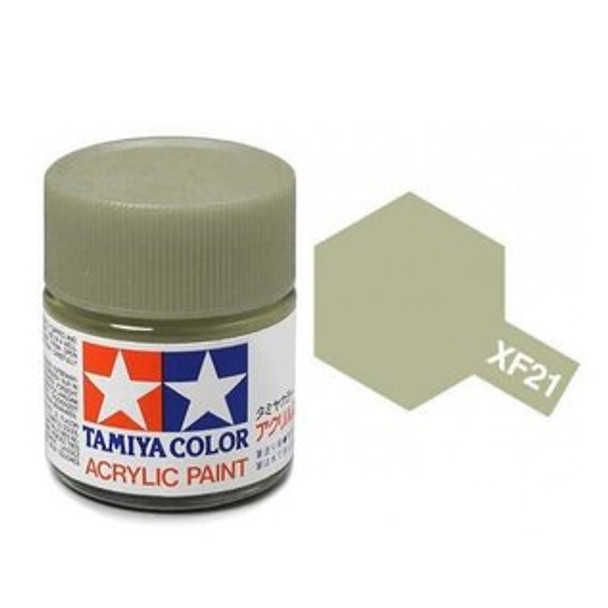
TAMXF21 - Tamiya - Flat Sky Acrylic - 10mL Bottle
- SKU:
- TAMXF21
- UPC:
- 4950344069705
- Condition:
- New
- Availability:
- In-Stock items usually Ship within the next business day
- Shipping:
- Calculated at Checkout

Description
TAMXF21 - Tamiya - Flat Sky Acrylic - 10mL Bottle
Tamiya XF-21 Flat Sky represents RAF Sky (British Standard BS 210) — the pale, slightly warm grey-green adopted as the standard lower surface and fuselage band colour for RAF Fighter Command aircraft from June 1940 onward. Tamiya's original colour guide designates XF-21 as "Lower side of the plane" for Luftwaffe subjects in the range's German aircraft category, but it is most widely known and used as the RAF Sky equivalent, called out directly in Tamiya's Spitfire and Hurricane kit instructions. Sky is one of the most debated colours in British aviation modelling: its exact appearance varied considerably between manufacturers, batches, and weathered examples, and modellers' interpretations range from a pale olive-grey to a light blue-green. XF-21 straight from the jar sits toward the slightly greener, more grey end of the spectrum and is widely accepted as a workable representation — some modellers lighten it slightly with XF-2 Flat White to compensate for scale effect and to better match faded, sun-bleached examples seen in period photographs. It also serves as the primary component in the Spitfire interior grey-green mix (3 parts XF-21, 1 part XF-5, 1 part XF-65) specified in Tamiya's own kit instructions.
Tamiya Acrylic paints are a hybrid acrylic formula built on water-soluble resin — they can be thinned with water, isopropyl alcohol, or lacquer thinner, and clean up easily with water before curing. When thinned with Tamiya Lacquer Thinner, the paint lays down faster, dries harder, and bonds more aggressively to the substrate. The hybrid resin chemistry means the paint film remains slightly soluble after initial drying — subsequent brush strokes can reactivate and lift the layer below if applied without restraint. For this reason, airbrushing is strongly recommended for large surface coverage. Brush painting is workable for detail and touch-up work, but requires a gentle, deliberate stroke and a fully cured base layer. See our Tamiya Acrylic vs. Enamel vs. Lacquer guide for a full breakdown of paint type differences.
- Supermarine Spitfire Mk.I/II lower surfaces and fuselage band — standard Sky undersurfaces and rear fuselage identification band on Spitfires of 610 Squadron (DW•O), 92 Squadron (QJ•B), and 19 Squadron operating from RAF Gravesend, Biggin Hill, and Duxford during the Battle of Britain (July–October 1940); the fuselage band and wing leading edge yellow stripe were added as identification features during this period
- Hawker Hurricane Mk.I lower surfaces — Sky undersurfaces on Hurricanes of 32 Squadron, 111 Squadron, and 303 (Polish) Squadron at RAF Biggin Hill, Northolt, and Leconfield during the Battle of Britain; the colour replaced the earlier black-and-white split undersurface scheme from June 1940 onward
- Spitfire Mk.V lower surfaces — Sky undersurfaces and fuselage band on the numerically dominant Spitfire variant in service 1941–43, operated by squadrons of 11 Group and 12 Group over Northern France and the Channel during Fighter Command sweeps, Circus, and Rhubarb operations, 1941–42; also worn by Desert Air Force Spitfire Mk.Vs operating over North Africa (1942–43) before replacement by Middle Stone and Azure Blue schemes
- Hawker Typhoon Mk.Ib early scheme — Sky undersurfaces on early production Typhoons before Medium Sea Gray replaced it from 1942 onward; Typhoons of 56 Squadron and 266 Squadron operating from Duxford and Matlaske in the home defence role, 1941–42
- De Havilland Mosquito PR/B variants — Sky lower surfaces on early Mosquito photographic reconnaissance variants (PR Mk.I, PR Mk.IV) operating from RAF Benson and RAF Leuchars on high-altitude sorties over occupied Europe, 1941–42, before the PRU Blue scheme became standard
- Spitfire cockpit interior base — the primary component in the standard RAF interior grey-green mix specified in Tamiya's own Spitfire kit instructions: 3 parts XF-21, 1 part XF-5 Flat Green, 1 part XF-65 Field Grey; used on cockpit side walls, instrument panel surrounds, and interior structural members across all Spitfire, Hurricane, and Typhoon cockpit builds
- Fuselage identification bands — the distinctive Sky fuselage band and propeller spinner colour applied to all RAF Day Fighter aircraft from August 1940, used as a quick visual identification feature to distinguish RAF aircraft from Luftwaffe types; painted on the rear fuselage of Spitfires and Hurricanes at squadron level using whatever Sky-equivalent colour was available
- Hawker Tempest Mk.V early scheme — Sky lower surfaces on the small number of Tempest Vs that entered service in February 1944 before Medium Sea Grey was universally applied; 486 (RNZAF) Squadron and 3 Squadron used Tempests in the anti-Doodlebug (V-1) role from June 1944
For full Tamiya paint colour references and modelling compatibility charts, visit our Tamiya Paint Colour Chart — Complete Guide for Scale Modellers.
Thin and airbrush with Tamiya Lacquer Thinner, Mr. Color Thinner, or Mr. Color Leveling Thinner.
- 10ml glass jar
- Part of the Tamiya Acrylic paint range
Related Products

TAMXF19 - Tamiya - Flat Sky Gray Acrylic - 10mL Bottle
Tamiya

TAMX14 - Tamiya - Gloss Sky Blue Acrylic - 10mL Bottle
Tamiya
TAMXF7 - Tamiya - Flat Red Acrylic - 10mL Bottle
Tamiya
TAMXF8 - Tamiya - Flat Blue Acrylic - 10mL Bottle
Tamiya

TAMXF15 - Tamiya - Flat Flesh Acrylic - 10mL Bottle
Tamiya