
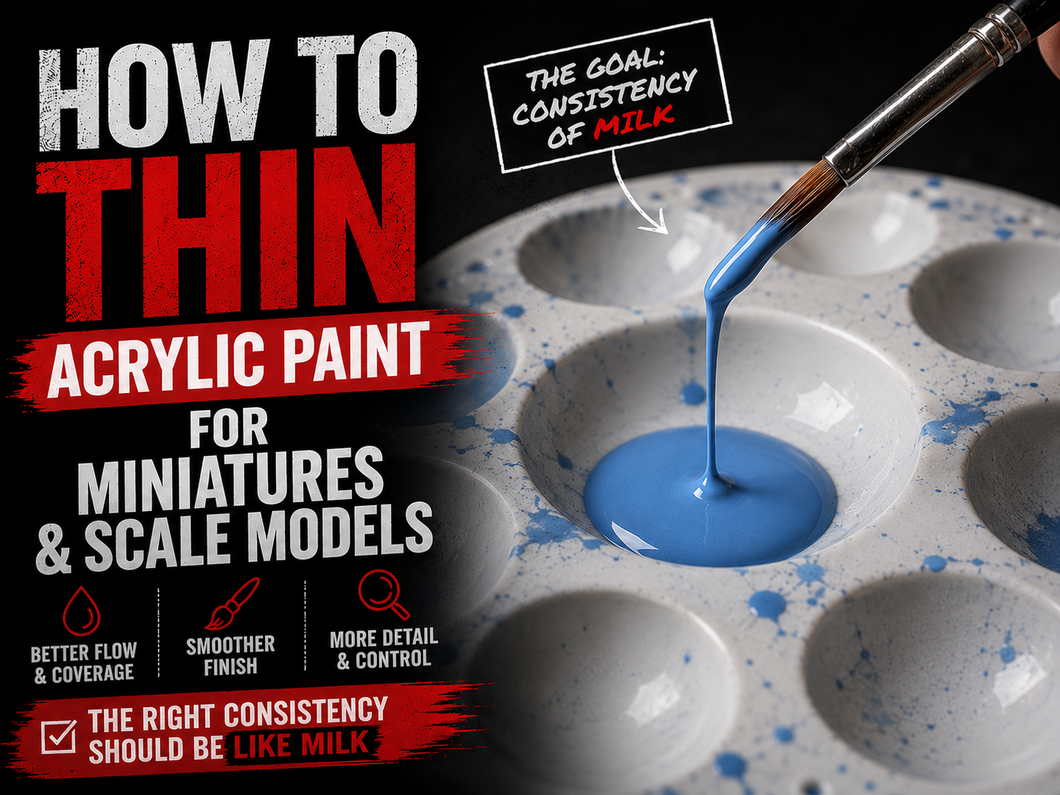
How to Thin Acrylic Paint for Miniatures and Scale Models
How Do I Know If My Paint Is the Right Consistency?
Weekly column · Lessons from the paint counter at WWH · June 2026
Thin your paint. For brush painting with water-based acrylics, water is all you need - no special product required. Aim for the consistency of milk. If your paint is dragging, streaking, or filling in detail, it is too thick. Add water, test on the palette, repeat until it flows cleanly. That is ninety-five percent of the answer. Note: water only works as a thinner for water-based acrylics while brush painting. We strongly discourage using water to thin acrylics for airbrushing, and water will not work at all for enamel or lacquer paints - both require their own dedicated thinners.
The single most common cause of a paintjob going wrong is not brush technique, not colour choice, and not the paint brand. It is paint that is too thick. Applying paint straight from the pot is one of the fastest ways to put a beginner off the hobby entirely - not because they lack skill, but because they have been handed the wrong tool for the job. The paint fights them the whole way through, the result does not look good, and they conclude that painting is not for them. It is for them. The paint just needed water.
The same principle applies to brushes: give a beginner a bad brush and the result will be bad and the process will feel bad, and they will blame themselves for both. Consistency is the same problem. It is not a skill gap. It is a setup problem, and unlike a bad brush, it costs nothing to fix. For brush painting, water-based acrylic paint just needs water. That is it. The fix is free, it takes thirty seconds, and it changes everything about how the paint behaves. This only applies to brush painting - we strongly discourage using water to thin acrylics for airbrushing, and enamel and lacquer paints require their own dedicated thinners regardless of application method.
The reference we use at the counter is milk. Your paint should feel like milk - fluid, consistent, no resistance. Not water, which has no body. Not the thicker consistency it comes out of the pot. Milk. Get to that feel and most consistency problems go away. If it helps, picture someone pouring a glass of it: that smooth, unbroken flow is what you are after.
We will acknowledge the edge case because we have heard it at the counter more than once: “I haven’t drank milk in years” or “I don’t drink milk.” Fair enough. We genuinely do not have a better reference. If milk means nothing to you visually, look up a short video of someone pouring it - ten seconds is enough. Otherwise, thin your paint incrementally and test on the palette until the drag disappears and it flows cleanly. That result, whatever it took to get there, is what milk consistency means.
The remaining five percent is where stage-specific nuance matters: washes need to be thinner than milk to flow into recesses; glazes thinner still. Airbrushing is also its own case - water has too high a surface tension for airbrush use and dedicated airbrush thinner is the right choice there. But for the vast majority of water-based acrylic brush painting, the solution is water, it costs nothing, and it is worth trying before anything else.
Multiple thin coats are always better than one thick one
The most common reason people do not thin their paint is the assumption that thick layers save time. They do not. A thick coat obscures detail, floods recesses, and dries unevenly - and then you spend time fixing it, or stripping the model entirely and starting over. That is the time cost of not thinning: not the thirty seconds it takes to add water, but the hours it takes to recover from a result you were never going to be happy with.
Two or three thin coats take longer per session and produce a cleaner result every time. The detail stays sharp, the colour builds evenly, and you are not fighting the paint. Thin coats are not the slow way. Stripping a model and restarting is the slow way.
 |
Related Guide How to Paint White: Why It Covers So Badly, and the Right Way to Approach It White is the one colour where consistency alone is not enough - pigment load creates a second problem on top. If white is your specific fight, start here. |
Why milk consistency works, and why pot consistency almost never does
Paint straight from the pot is almost always too thick for brush application. Thinning to a milk-like consistency fixes the most common failures before they happen.
Paint at pot consistency is formulated to survive shipping and storage, not to brush on cleanly. For brush application it is almost universally too thick: it drags across the surface, dries with the stroke direction visible, and sits on top of texture rather than settling into it. The assumption that paint comes ready to use straight from the pot is where most of the trouble starts.
Thinning to a milk-like consistency solves this because milk has the right balance of flow and body for a brush to carry and deposit paint cleanly. It moves off the brush with no resistance, settles flat as it dries, and does not pool at the edges of raised detail. That behaviour is what you are trying to replicate when you thin paint - not a specific ratio, not a rule, just that feel.
What you thin with matters too. For brush painting, water alone works but weakens the acrylic binder at higher dilutions and can cause beading and tide marks as it evaporates faster than the pigment. A small amount of acrylic medium mixed with water thins the paint while keeping the binder intact and improving flow. For most brush painting, medium plus water is more reliable than water alone. If you are airbrushing, do not use water to thin your acrylics - use a dedicated airbrush thinner instead. Water does not behave well through a nozzle and we strongly discourage it.
Basecoat consistency: thin enough to flow, thick enough to cover
The test: it should flow off the brush smoothly, leave no raised brushstrokes when dry, and cover in two or three thin passes rather than one thick one.
A basecoat at milk consistency will flow from the brush without resistance, settle flat while drying, and not pool at the edges of detail. If you pull the brush across a surface and can see the individual stroke direction in the dried result, the paint is still too thick. If the paint runs freely off the brush before you have touched the model, it has gone past milk toward water and lost too much body for reliable coverage.
The right number of coats is two or three, not one. A single thick coat trying to achieve full coverage will always be too thick. Two thinner coats that each approach coverage will produce a flatter, more even result with no filled detail. Building coverage across passes rather than forcing it in one is the fundamental shift that makes basecoating feel controllable.
How to test on the palette
Mix your paint on a wet palette and draw a thin line with the brush tip. The line should have clean, defined edges and be slightly translucent at thin areas. If the edges are ragged and the line is completely opaque even in thin areas, the paint is too thick. If the line bleeds or spreads beyond where the brush touched, it is too thin. A good basecoat mix sits cleanly without either failing.
Scale modelling note
For airbrushed basecoats on scale models, consistency is measured by how the paint atomises at your working pressure rather than by brush behaviour. The paint should mist finely onto the surface without spitting or running. Most dedicated airbrush paints are pre-thinned for typical hobby airbrush pressures; if you are thinning model colour or other brush paints for the airbrush, aim for a consistency closer to whole milk and adjust pressure downward rather than thinning too aggressively.
Wash consistency: thin enough to flow freely, not so thin it floods
The test: loaded onto the brush and applied to the model, it should run immediately into recesses under gravity without needing to be pushed there.
Purpose-made shade paints - Citadel Shades, Army Painter Quickshades, Pro Acryl Washes - are pre-formulated to the right consistency for wash work and can be used directly from the pot. When you thin your own washes from regular paint, the consistency needs to be substantially thinner than a basecoat: it should be watery enough to flow freely into crevices but retain enough pigment to leave a visible mark when dry.
The failure modes at each extreme are easy to recognise. Too thick: the wash sits on the surface rather than flowing, dries as a tide mark around the brush stroke, and does not shade recesses at all - it just tints everything. Too thin: the wash floods large areas evenly, loses all pooling behaviour, and produces a flat tint rather than targeted shadow. Either way, the shading effect is lost.
Application technique matters as much as consistency
A well-thinned wash applied to a surface that is too dry, too absorbent, or not sealed will still misbehave. A gloss varnish over the basecoat before washing gives shade paint a non-absorbent surface to flow across and produces cleaner, more controlled pooling. This is why experienced scale modellers almost universally seal before washing, even though the chemistry does not strictly require it for most paint combinations. The technique and the consistency work together.
A useful check: hold the brush tip just above the surface with the wash loaded, and let a single drop fall. If it immediately spreads into nearby recesses on its own, the consistency and surface are both right. If it sits as a dome or ball without spreading, the wash is too thick, the surface is too textured, or both.
Highlight consistency: precise and controlled, not flooded
The test: the paint should stay where the brush tip deposits it without bleeding out. If it spreads beyond the edge, the mix is too thin or the brush is overloaded.
Highlighting requires less thinning than most other stages, not more. The paint needs to be fluid enough to apply without dragging but opaque enough to sit on the raised edge as a clean line. Too much thinning and the highlight bleeds into surrounding areas, losing the crisp edge that makes a highlight read. Too little and the paint drags, pulls up the layer below, and leaves a rough edge.
The single most common highlight mistake is overloading the brush. The brush tip should carry just enough paint to deliver the stroke without pooling. Wipe the side of the brush on the palette before touching the model - the tip should still look loaded, but a light stroke on the palette should not leave a blob. That wicking step is doing most of the control work.
Edge highlights vs blended highlights
Edge highlights - the fine line along the sharpest point of an edge - generally use paint slightly thicker than a blended mid-highlight, because you need the opacity to show on a very small area. Blended highlights sit between the basecoat and the edge highlight in both position and consistency, and benefit from a slightly wetter mix that allows a small amount of wet-into-wet blending at the edges. These are different passes that ideally use slightly different mixes, not one consistency applied twice.
Glaze consistency: barely a tint
The test: on the palette, the mix should look like barely coloured water - a faint tint you can just identify, not a clearly coloured fluid.
Glazing - applying an extremely thin translucent layer to subtly shift colour on finished work - uses the thinnest paint of any stage. The consistency is thinner than a wash and far thinner than a basecoat. When beginners first try glazing, they almost always use a mix that is too thick: it shows too dramatically, covers detail, and produces a stain rather than a subtle shift. A glaze that works is nearly invisible after one pass. The effect builds across multiple passes.
There is no reliable universal ratio. Pigment density varies significantly across paints: a highly saturated dark ink may need six parts medium to one part paint. A lighter, less dense layer colour may be workable at two to one. The palette test is the only guide: look at the pool on your palette in good light. If you can read the colour as a clearly distinct tint, it is too thick. If you can just barely identify it as a colour, you are close.
For more on glazing, including how glaze medium and Contrast medium behave differently and why the wrong one damages both techniques, see our full Three Glaze Myths article.
How to diagnose a consistency problem on a finished model
Most consistency problems leave a recognisable trace in the dried paint. If you know what to look for, you can identify what went wrong and correct it on the next model without guessing.
Visible brushstrokes in the dried basecoat
Paint was too thick. The brushstroke direction has dried into the layer because the paint could not self-level before drying. Fix: thin further and apply in shorter strokes, reloading more frequently.
Chalky or gritty surface texture
Paint was too thick, or dried too fast mid-stroke. The pigment has piled up unevenly rather than settling flat. This is especially common with white and yellow. Fix: thin more aggressively, use a damp brush to keep the working area wetter, and apply in lighter passes.
Tide marks around areas where wash was applied
The wash was too thick, or it ran onto an absorbent surface and dried before it could flow into recesses. The water evaporated first and left a pigment ring at the edge. Fix: seal with a gloss coat before washing, and ensure the wash is thin enough to flow freely.
Highlights that bled and lost their edge
Brush was overloaded, or the mix was too thin. The excess paint flooded beyond where the brush tip touched. Fix: wick more paint onto the palette before touching the model, and mix the highlight slightly thicker than feels natural.
Recesses that look flooded and muddy after washing
Wash was applied too liberally, or over a basecoat that was still slightly wet. The wash could not flow cleanly because the surface was not ready for it. Fix: let the basecoat cure fully before washing, apply the wash in smaller amounts, and wick excess off with a clean dry brush before it dries in unwanted areas.
Quick reference: consistency by stage
| Stage | Palette appearance | How it should behave on the model | Classic wrong symptom |
|---|---|---|---|
| Basecoat | Opaque but flows freely off the brush; skimmed milk | Covers in 2–3 thin passes; no visible brushstrokes when dry | Visible stroke direction baked in; detail filled |
| Wash | Watery and clearly tinted; flows freely off the brush | Runs into recesses under gravity without pushing | Tide marks; sits on surface rather than flowing in |
| Highlight | Opaque, slightly more fluid than basecoat; holds brush tip shape | Stays exactly where deposited; clean edge; does not bleed | Bleeds beyond the edge; floods surrounding area |
| Glaze | Barely a tint; almost clear water with a faint colour cast | Single pass barely visible; effect builds across several coats | First pass too dramatic; looks like a stain not a tint |
What we recommend for thinning
| Product | Best used for | Notes |
|---|---|---|
| Vallejo Acrylic Medium | Basecoats, general thinning | Store pick for everyday thinning. Thins without weakening the binder; improves flow without adding working time. Mix with water rather than using neat. |
| Vallejo Flow Improver | Airbrushing only | An airbrush product, not for brush painting. Reduces surface tension to improve atomisation and prevent tip-dry at the nozzle. Not a substitute for water or acrylic medium at the brush. |
| Vallejo Glaze Medium | Glazing, correction work | Slows drying and discourages flow - keeps glaze where it is placed. Not for washes; not for thinning Contrast paint. |
| Citadel Lahmian Medium | Basecoats and glazing (GW range) | General-purpose thinner for Citadel paints; faster-drying than Glaze Medium so good for multiple passes in one session. |
| Vallejo Airbrush Thinner | Airbrush work | Formulated specifically for airbrush dilution. Not required for brush painting but the right choice for getting model colour and similar paints to airbrush pressure. |
| Masterson Sta-Wet Palette | All stages | Not a thinner, but keeps paint at working consistency rather than skinning over between strokes. Makes every consistency easier to maintain. |
Frequently Asked Questions
Yes, for water-based acrylics while brush painting - and most painters do for general thinning. The limitation is that water alone, at high dilution, weakens the acrylic binder and can cause beading and tide marks. For basecoats and highlights where you are thinning moderately, a small amount of water works fine. For washes and glazes where you are thinning substantially, a dedicated medium mixed with water gives more reliable results. Two things water will not work for: airbrushing acrylics - we strongly discourage it, use a dedicated airbrush thinner instead - and enamel or lacquer paints of any kind, which require their own dedicated thinners. Using water with those will ruin the paint.
Usually one of three things: the paint is too thick and the small volume dries fast, the working environment is warm or dry, or you are working too slowly. Use a wet palette to keep your mix hydrated, thin with a medium that slows drying rather than just water, and reload the brush more frequently. A drop of retarder medium in the mix gives more working time if the environment is the problem.
It depends on how severe. Mild brushstrokes and slight chalkiness can often be corrected with a thin gloss varnish coat, which fills minor surface irregularities and provides a smooth base for further work. Severe texture, raised brushstrokes, or completely filled-in detail usually requires stripping and starting over. Isopropyl alcohol (90% or above) or a dedicated paint remover like Dettol work well on resin and plastic without damaging the kit. Strip to bare plastic, re-prime, and start again - often faster than trying to correct over a badly established base.
Yes, noticeably. Pigment density and binder formulation vary across ranges: some paints thin smoothly and self-level well; others become grainy or lose adhesion quickly when thinned. At the counter, we find Pro Acryl and Vallejo Model Color thin reliably and behave predictably; some Citadel paints, particularly older base paints, can behave unpredictably at high dilutions. This is not an argument for avoiding any range - it is an argument for testing a new paint on a spare part before committing to a large model.
No. Ratios from tutorials (1:1, 2:1, and so on) are a starting point, not a formula, because they assume the same paint and the same medium as the person writing the tutorial. The only reliable guide is the visual test on the palette for the specific paint you are using at that moment. Develop the habit of looking at the mix before touching the model. Over time that assessment becomes fast and instinctive.
Metallics are more sensitive to over-thinning than regular paints: the metallic flake particles separate from the binder at high dilutions, producing a finish that looks transparent rather than metallic. Thin metallics only as much as needed for flow, not to wash or glaze consistency. Contrast paints are pre-formulated and generally used at pot consistency or thinned with Contrast Medium specifically - thinning with water or glaze medium degrades their pooling behaviour. The same underlying principle applies though: know what the paint is doing and thin accordingly.
Pricing reflects Wheels & Wings Hobbies retail in CAD as of June 2026. Counter Notes publishes weekly, drawing on what we see and hear at the paint counter in Toronto.
All recommended products are stocked at Wheels & Wings Hobbies in Toronto and available online with Canada-wide shipping.
Recent Posts
-

Drukhari Kabalite Warrior Paint Guide with Tone Pro
Wheels and Wings Hobbies - Miniature Paint Guide John's Merry "Christmas You're Dead" Kabalite Warri …Oct 26, 2026 -

What Glue Should I Use? A Scale Modelling Adhesive Guide
Wheels & Wings Hobbies · Counter Notes What Glue Should I Use? Lessons from the paint counter at W …Oct 16, 2026 -

John's Starcraft Zerg Queen Paint Guide - Build Feature
Wheels and Wings Hobbies - Miniature Paint Guide John's Starcraft Zerg Queen Archon Studio - Starcra …Sep 24, 2026