
Beginner Airbrush Guides
1. Knowing Your Airbrush
(Before You Ever Pull the Trigger)
An airbrush is a precision tool, not just a paint sprayer. Understanding its core components will save you frustration, money, and broken needles.
The Key Parts of an Iwata Airbrush
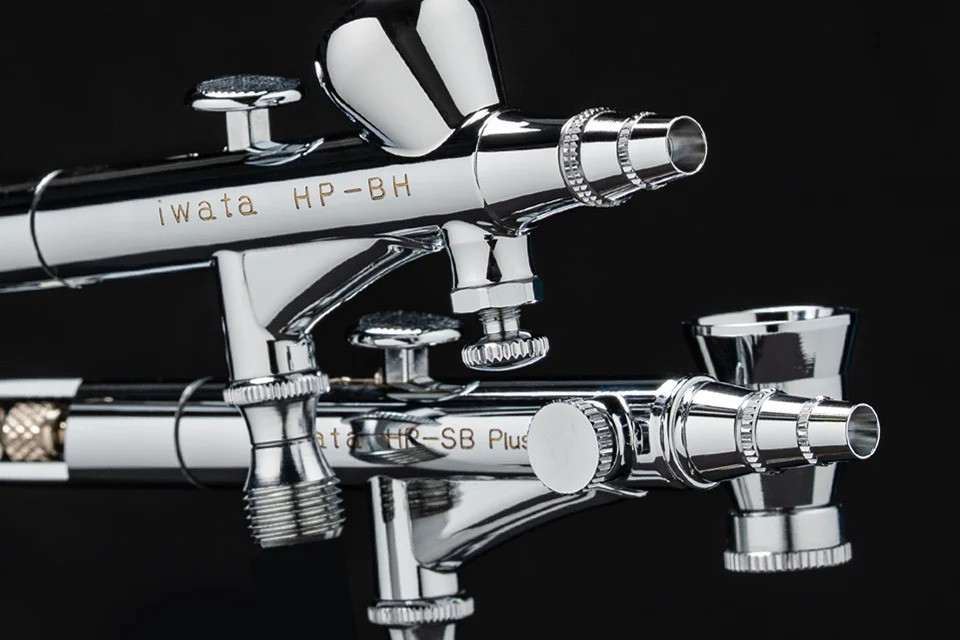
Most Iwata hobby airbrushes (Neo, Eclipse, HP-CS, etc.) share the same essential parts:
-
Needle – Controls paint flow and atomization
-
Nozzle – Where paint is atomized (very delicate)
-
Nozzle Cap / Air Cap – Directs airflow
-
Trigger – Controls air (down) and paint (back)
-
Needle Chuck & Spring – Pulls the needle back smoothly
Beginner Rule #1: Never force anything.
If something doesn’t slide easily, stop.
Don’t Bend Your Needle (This Is the #1 Beginner Mistake)
Bent needles are the most common airbrush failure we see in our shop.
How needles get bent:
-
Removing the needle without loosening the chuck
-
Dropping the airbrush tip-down
-
Over-tightening the nozzle
-
Wiping the needle tip sideways
Pro tip:
When removing the needle, pull it straight out the back, never out the front.
If you do damage one, replacement needles are inexpensive and easy to swap.
Iwata Replacement Needles & Nozzles
Check out our store!
Use Genuine Replacement Parts
Iwata tolerances are extremely tight. Aftermarket needles and nozzles often cause:
-
Poor spray patterns
-
Constant tip dry
-
Inconsistent trigger feel
Stick with OEM parts whenever possible.
Iwata Airbrush Parts & Accessories
Check out our store!
2. Understanding Compressor PSI
(Pressure Is Technique, Not Power)
One of the biggest misconceptions is that higher PSI = better spray.
In reality, lower pressure gives more control — when used correctly.
General PSI Guidelines (Starting Points)
| Technique | PSI Range |
|---|---|
| Fine lines & detail | 10–15 PSI |
| General base coating | 15–20 PSI |
| Primers | 20–30 PSI |
| Metallics & thicker paints | 20–25 PSI |
Always adjust PSI + thinning together — never one without the other.
-
Thicker paint = more PSI
-
Finer detail = less PSI
-
Struggling spray = thin first, then increase PSI
Choosing the Right Iwata Compressor
A good compressor should have:
-
Air tank (reduces pulsing), reduces noise as well since the compressor is on less
-
Regulator
-
Moisture trap
-
Quiet operation (especially for home use)
Iwata Hobby Compressors
Check out our store!
Popular beginner-friendly options include:
-
Iwata Power Jet Pro (dual airbrush capable)
3. Basic Maintenance & Cleaning
(Clean Enough, Not Too Much)
You don’t need to fully disassemble your airbrush every session.
In fact, over-cleaning can cause more damage than under-cleaning.
In-Between Color Cleaning (During a Session)
Use this when switching colors or pausing briefly.
Steps:
-
Empty paint cup
-
Add appropriate thinner
-
Back-flush gently (cover nozzle, light air only), be sure to dump the back flushed liquid!
-
Add more thinner, spray until clear
-
Wipe cup with lint-free cloth or swab
Takes 30–60 seconds
Do this often, even a few times in a prolonged session
End-of-Session Cleaning (Recommended)
At the end of the day:
-
Flush with thinner
-
Remove needle
-
Wipe needle clean
-
Reinsert gently
-
Spray clean thinner once more
No need to remove the nozzle every time.
Deep Cleaning (Occasionally)
Only do a full teardown if:
-
Paint is sputtering despite clean thinner
-
Trigger feels sticky
-
You accidentally let paint dry inside
Deep cleaning too often risks:
-
Stripped nozzle threads
-
Cracked nozzles
-
Lost micro-parts
What Cleaners to Use (And What Not To)
✅ Use:
-
Proper lacquer thinner (for lacquer paints)
❌ Avoid:
-
Acetone (unless specified)
-
Household cleaners
-
Pipe cleaners (they scratch internals)
Airbrush Cleaners & Tools
Check out our store!4. Beginner Guide to Thinning Paint for Airbrushing
Properly thinning your paint is one of the most important skills to master when airbrushing. Even the best airbrush and compressor won’t perform well if the paint isn’t prepared correctly. This guide covers the fundamentals every beginner should understand before pulling the trigger.
1. Why Thinning Paint Matters
Airbrushes are designed to atomize very fine liquid particles. Paint straight from the bottle is almost always too thick to spray consistently. If paint is not thinned correctly, you’ll experience:
-
Tip dry
-
Spattering or sputtering
-
Orange peel texture
-
Clogging and inconsistent spray patterns
Correct thinning allows the paint to flow smoothly, atomize evenly, and lay down clean, controlled coats.
2. Why You Should Avoid Using Water
A common beginner mistake is thinning paint with plain water. While it may seem logical—especially with water-based acrylics—water has high surface tension, which causes problems in airbrushing.
Even when combined with flow improver, water can still:
-
Bead up on the surface instead of laying flat
-
Spray inconsistently
-
Increase the chance of spidering or poor coverage
-
Reduce adhesion and durability
Bottom line:
Water alone does not behave like a proper airbrush thinner. Dedicated thinners are formulated to reduce surface tension, improve flow, and maintain the paint’s chemistry.
3. Know Your Paint Chemistry (This Is Critical)
Not all paints are the same, and using the wrong thinner can ruin your paint or your airbrush.
Before thinning, identify what type of paint you’re using:
-
Acrylic (water-based hobby paints, and hybrid acrylics)
-Use an acrylic water-based airbrush thinner made for hobby paints.
-Hybrid acrylics such as Tamiya acrylics and the Mr Hobby Aqueous series are alchohol based acrylics and thus can be thinned with Lacquer, Alchohol, and water. Because of their unique make up, they are especially popular with airbrush painting as they are technically a solvent based paint. However due to them being a solvent based paint, we do not recommend brush painting with them. -
Lacquer paints
-Use lacquer thinner designed for hobby or model paints. -
Enamel paints
-Use enamel thinner or mineral-spirit–based thinner recommended by the manufacturer.
Using the wrong thinner can cause:
-
Paint curdling or separation
-
Poor adhesion
-
Damage to seals and internal airbrush parts
-
Unpredictable spray behavior
Rule of thumb:
Always use a thinner that matches the paint’s chemistry, preferably from the same brand.
4. Thinning Ratios Are Not Universal
There is no single “correct” thinning ratio that works for every paint.
Thinning depends on:
-
Paint brand and formulation
-
Pigment density
-
Color (some pigments are thicker than others)
-
Airbrush nozzle size
-
Air pressure (PSI)
-
Desired technique (fine detail vs coverage)
A ratio that works for one paint may be completely wrong for another—even within the same brand.
5. The Real Goal: Milk-Like Consistency
Instead of chasing exact ratios, focus on paint consistency.
Properly thinned paint should look and behave like:
-
Milk
-
Smooth and fluid
-
Able to coat the side of a mixing cup evenly
-
Not watery, not syrupy
When lifted with a stir stick, the paint should flow off smoothly without clumping or breaking into droplets.
This consistency allows:
-
Clean atomization
-
Predictable spray patterns
-
Better control at lower air pressures
-
Reduced tip dry and clogging
6. Best Practice for Beginners
-
if preparing your paint outside your airbrush, start with small amounts of paint
-
Add thinner gradually (a few drops at a time)
-
Mix thoroughly (if spraying water based acrylics, add 1 drop at a time of flow improver as needed)
-
Test spray before committing to your model
-
Adjust as needed based on spray behavior
- if preparing your paint inside the cup of your airbrush, start with small amounts of thinner
- Add paint gradually (a few drops at a time)
- Mix thoroughly (if spraying water based acrylics, add 1 drop at a time of flow improver as needed)
- Test spray before committing to your model
- Adjust as needed based on spray behavior
Remember:
It’s easier to add more thinner than to fix paint that’s been over-thinned.
Final Takeaway
-
Don’t rely on water—surface tension matters
-
Always match thinner to paint chemistry
-
Ignore “one-size-fits-all” ratios
-
Aim for milk-like consistency, not exact measurements
Mastering paint thinning will immediately improve your airbrushing results and make the entire process more enjoyable and predictable.
-
Recent Posts
-

Picking Your First Iwata Airbrush
What to consider when picking your first Iwata1. Feed Style-Gravity Feed: Paint cup on top -> easier …2026 Jan 30th -
Make Your Own Masks!
Can't find decals for that cool squadron insignia or unit marking? Why not make a set of masks and p …2026 Jan 21st -

Beginner Airbrush Guides
1. Knowing Your Airbrush (Before You Ever Pull the Trigger) An airbrush is a precision tool, not jus …2025 Dec 18th