
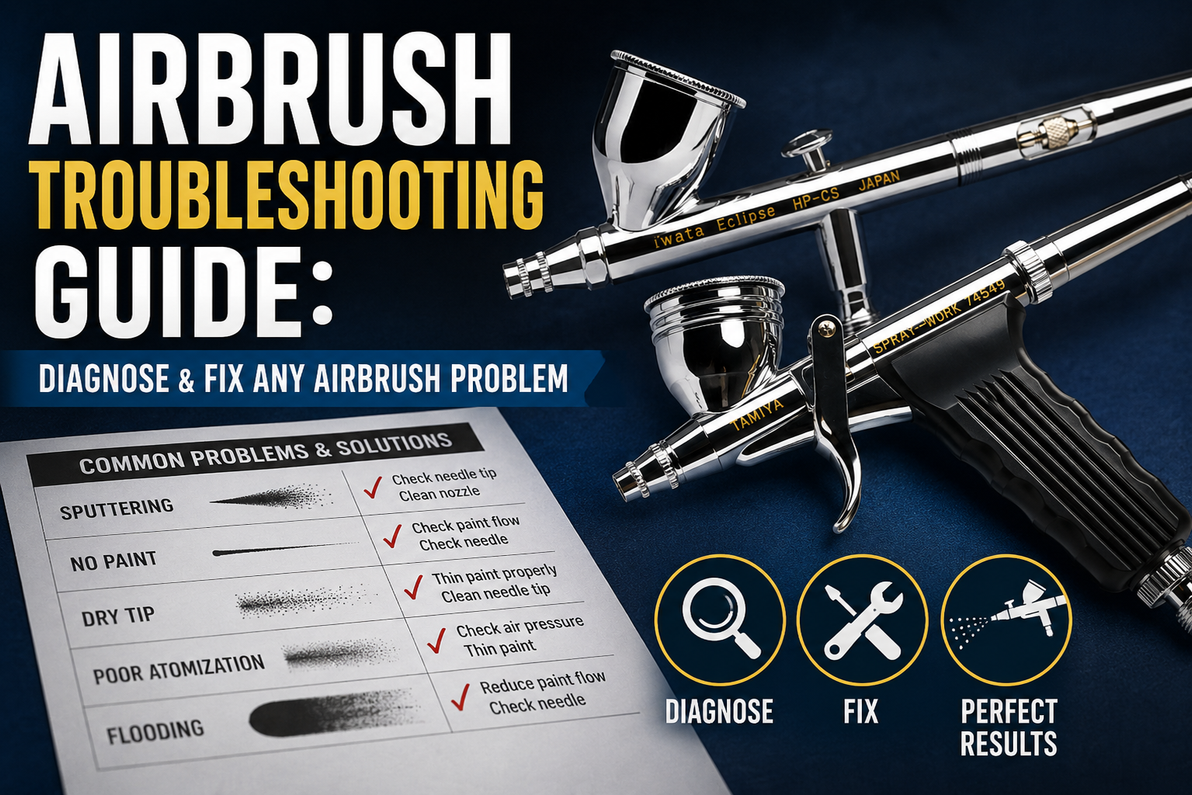
Airbrush Troubleshooting Guide: Diagnose and Fix Any Airbrush Problem
Airbrush Troubleshooting Guide: Diagnose and Fix Any Airbrush Problem
From an Iwata Gold Crown Dealer in Toronto · Diagnose any problem on any airbrush · Updated April 2026
Most airbrush troubleshooting articles give you a long checklist of things to try. We are going to do something different. After years of helping customers diagnose airbrush problems at our Toronto store, we can tell you that nearly every issue you will ever have with an airbrush comes down to a small number of root causes. Once you understand them, you can diagnose any symptom on any airbrush, regardless of brand or model.
Wheels & Wings has sold airbrushes for over 40 years. Across that history we have stocked Paasche, Badger, Grex, Iwata, and Tamiya, and our airbrush technician has hands-on service experience covering all of those plus Harder & Steenbeck, GSI Creos, Vallejo, Gaahleri, and Madworks. As the only Iwata Gold Crown Dealer in Eastern Canada, we have especially deep familiarity with the Iwata range. But the diagnostic framework in this guide is genuinely brand-agnostic: it works on any airbrush, because the underlying physics is the same regardless of who manufactured it.
Almost every airbrush problem has one of five root causes: air pressure, paint thinning, airbrush cleanliness, paint chemistry, or hardware damage. Before doing anything else, ask yourself: is my PSI right for my paint mix? Is my paint properly thinned? Is my airbrush actually clean? Once you understand the framework, the specific symptoms (spitting, clogging, tip dry, no flow) become easy to diagnose. The single most common reason customers bring airbrushes into the store thinking they are broken is that they have not been cleaned thoroughly enough.
The five root causes of every airbrush problem
Before we get into specific symptoms, internalize this framework. Every airbrush problem you will ever have falls into one of these five categories. Once you can identify which category your symptom belongs to, the fix is usually obvious.
1. Air pressure (the one to check before anything else)
Air pressure is the precondition for every other variable, and it is the one most people forget to check. Think of it like troubleshooting an electronic device: before you start diagnosing why something is not working, you confirm the power is actually on. Same principle here. Before you blame your paint, your cleaning, or your hardware, confirm that your PSI is appropriate for your paint mix.
There is no single correct PSI for airbrushing. The right pressure depends on your paint, your thinning ratio, your airbrush, and what you are spraying. As a general rule, find a PSI that reliably sprays for your specific thinner ratio and start there. Most hobby airbrushing happens between 10 and 25 PSI; lower pressures need more thinning to atomize properly, higher pressures handle thicker paint better. If you change your thinning ratio, you may need to change your pressure too.
Control for pressure first, before you change anything else. If your symptoms appeared after a recent compressor adjustment, regulator change, or a switch in paint, the PSI mismatch is likely your problem. Reset to a known-good combination and work from there.
2. Paint thinning (the most common cause once pressure is right)
Paint that is too thick will not atomize properly through an airbrush. The result is spitting, clogging, uneven flow, and inconsistent spray patterns. Most beginners under-thin their paint, often dramatically. The right consistency for airbrushing is usually around the consistency of milk, but it varies by paint type and pressure. If you are reading this guide because something is wrong, the first thing to do is question whether your paint is actually thin enough.
Paired with this is using the right thinner for your paint chemistry. Water-based acrylics need acrylic thinner. Lacquers need lacquer thinner. Enamels need enamel thinner. Mixing the wrong thinner with the wrong paint can cause the binder to break down, the pigment to clump, and the airbrush to behave unpredictably. If you are unsure what thinner to use with what paint, our Tamiya thinning guide covers the chemistry in detail and the same principles apply to other paint families.
3. Airbrush cleanliness (the most underestimated cause)
By far the most common reason customers bring airbrushes into our store thinking they are broken is that they have not been cleaned thoroughly. Dried paint accumulates inside the airbrush in places you cannot see, and over time it interferes with paint flow, causes clogs, makes the trigger feel stiff, and produces all the symptoms beginners assume are mechanical failures.
Cleanliness is also the cheapest fix. A thorough cleaning costs you 15 minutes; a new airbrush costs hundreds of dollars. If your airbrush has been working fine and suddenly is not, before you blame the airbrush, blame the cleaning routine.
4. Paint chemistry behaviour
Different paint families behave differently through an airbrush, and some symptoms are caused by the paint chemistry rather than by anything you did wrong. Water-based acrylics tip-dry faster than lacquers because they cure faster, especially when thinned — and because of this, they build up on the tip of the needle more quickly than lacquers or other solvent-based paints, which benefit from stronger thinners that effectively clean the needle as you spray. Some pigment-heavy colours (whites, yellows, metallics) need significantly more thinning than others. Cold paint flows worse than warm paint.
Recognizing when a symptom is paint behaviour rather than airbrush failure stops you from over-cleaning, over-disassembling, and worrying about a perfectly fine airbrush.
5. Hardware damage
The least common but most definitive cause. Bent needles, damaged nozzles, worn O-rings, and split nozzle caps cause specific, persistent symptoms that do not respond to thinning or cleaning. Damaged Nozzles change to split nozzles. Split nozzle cap change to damaged nozzle caps. Hardware problems are usually obvious once you have ruled out the first three causes: if the symptom persists after thinning correctly and cleaning thoroughly, you are looking at hardware.
As an Iwata Gold Crown Dealer, we stock every Iwata replacement part for current-production airbrushes. Replacing a needle or nozzle is far cheaper than replacing the whole airbrush, and most owners who think their airbrush is dead just need a $15-30 part.
Diagnosing specific symptoms
For each of the symptoms below, we list the diagnostic order: what to check first, second, third. Work through them in order and stop when the symptom resolves. The order reflects what we actually see most often as the cause, not what is theoretically possible.
Why is my airbrush spitting or spattering?
The airbrush sprays in inconsistent bursts, droplets, or splatters instead of a smooth, fine mist. Probably the single most common complaint we hear, and almost always one of four things in this order:
- Paint not thinned enough. Thicker paint cannot atomize properly at normal pressures. Add more thinner to milk consistency and try again. This fixes spitting more often than any other cause.
- Wrong thinner for the paint chemistry. Water in alcohol-based paints, acrylic thinner in lacquers, etc. The paint will not flow correctly. Use the matched thinner for your paint family.
- Too much paint in the cup. An overfilled cup can cause inconsistent feed, especially in gravity-feed airbrushes. Try less paint and see if the spitting resolves.
- Airbrush not clean. Dried paint inside the airbrush disrupts flow. Do a thorough cleaning before assuming the issue is anything else.
If spitting persists after working through all four, the cause is hardware: most likely a damaged nozzle or a bent needle tip. Replace the part and the symptom resolves.
Why does paint dry on my airbrush needle (tip dry)?
Paint accumulates and dries on the needle tip while you are spraying, eventually causing spatter, blocked flow, or both. You wipe the tip, it works briefly, and then the same thing happens again. This is overwhelmingly a water-based paint problem.
Water-based acrylics (Vallejo, Citadel, AK, etc.) tip-dry far more than lacquers because they cure faster. The paint at the very tip of the needle is exposed to air, dries before it has a chance to spray, and accumulates. The fix is to slow the drying time of your paint mix:
- Add a flow improver or retarder to your paint mix. Vallejo Flow Improver, Liquitex Slow-Dri, or any acrylic retarder will slow the drying time on the needle and dramatically reduce tip dry. This is by far the most effective single fix.
- Use proper airbrush thinner rather than water alone. Most dedicated airbrush thinners include retarders in the formulation. Water has the highest surface tension of any common liquid and does nothing to slow curing.
- Lower the air pressure slightly. Lower pressure means less air drying out the tip between sprays. This works in combination with proper thinning, not as a replacement for it.
- Wipe the tip periodically with a damp cotton swab. If you have done all the above and still get some tip dry (which is normal at small amounts), a quick wipe between passes prevents accumulation.
Lacquer paints (Tamiya LP, Mr Color, AK Real Colors) tip-dry far less because the chemistry cures more slowly through evaporation rather than crosslinking. If you are tip-drying constantly with water-based paints, switching paint families is also a legitimate option.
Why does my airbrush keep clogging mid-session?
The airbrush sprays fine for a while, then paint stops flowing or flow becomes erratic. You stop, clean, restart, and the same thing happens again 10 minutes later. The causes are essentially identical to the spitting causes:
- Paint not thinned enough. Same root cause as spitting; clogging is the more severe form. Thin further.
- Wrong thinner for the chemistry. Same logic.
- Airbrush not clean enough at the start of the session. Residue from the previous session creates a starting point for new buildup. Make sure the airbrush is properly cleaned before each session begins, not just after each session ends.
- Tip dry that you did not address. Tip dry left unchecked turns into mid-session clogging.
Mid-session clogging is your airbrush telling you that your paint and cleaning routines need to be tightened up. It rarely indicates hardware failure on its own.
Why is no paint coming out of my airbrush?
You pull the trigger, air comes out, but no paint follows. The cup has paint in it. Nothing is happening. Diagnostic order:
- Is your paint thin enough? If the paint is very thick, it may simply not be flowing. Thin and try again.
- Is there an obstruction in the cup or the front end? Look for dried paint blocking the channel between the cup and the nozzle. Clean thoroughly.
- Is the needle chuck tight? If the needle chuck (the small nut that holds the needle in the trigger mechanism) is loose, pulling the trigger does not actually pull the needle back. Air flows, but the nozzle stays sealed. Tighten the chuck. This is a very common cause and an easy fix.
- Does the needle move smoothly through the body? If the needle is sticking due to dried paint inside the airbrush body, the trigger may move but the needle may not. Disassemble and clean.
Once you have confirmed all four, the only remaining cause is hardware: a blocked nozzle that needs replacement, or a damaged needle that is no longer seating properly.
Why are there bubbles in my airbrush paint cup?
When you spray, air bubbles up through the paint in the cup, sometimes violently. This is the airbrush back-flushing air into the paint reservoir instead of pushing paint forward through the nozzle. Almost always one of two causes:
- The front end of the airbrush is not tight. Specifically the nozzle. If the nozzle is not seated and tightened properly, air pressure pushes back through the loosest path, which is into the cup. Tighten the nozzle. Be careful not to over-tighten, especially on Iwata airbrushes where the nozzles are precision-machined and easy to damage. Finger-tight plus a small additional turn is the right amount.
- A clog severe enough to push air back up. If the front end is tight and you still see bubbles, there is a blockage forcing the air to find another route. Clean the front end thoroughly.
If the nozzle has been over-tightened in the past, it may be cracked. A cracked nozzle will cause persistent backflushing that no amount of tightening fixes. Replace the nozzle.
Why is my airbrush spray pattern inconsistent?
The spray pattern is uneven, asymmetric, or inconsistent shot to shot. Could be a fine mist that suddenly becomes a wide spray, or a curve in the spray pattern that should be straight. Two main causes:
- Inconsistent paint mix. Inconsistent paint produces inconsistent spray. If your thinning is uneven, the airbrush will spray differently from one moment to the next. Stir your paint thoroughly and make sure your thinning is uniform.
- Damaged hardware. A bent needle tip causes the spray to follow the bend, producing a curved or asymmetric pattern. A damaged nozzle cap or chipped nozzle does the same thing in different ways. If thinning is correct and the symptom persists, inspect the needle tip closely (a magnifying glass helps) and the nozzle cap for visible damage.
Bent needle tips can sometimes be straightened carefully on a flat sharpening stone, but replacement is more reliable. Iwata needles are not expensive and a fresh one usually restores spray pattern immediately.
Maintenance: prevent most problems before they start
If you take one thing from this guide, it is that the vast majority of airbrush problems are cleaning problems. A consistent cleaning routine eliminates 80% of the issues this guide describes. Here is what we recommend.
Between colours and at end of session: a quick clean
Empty the cup, fill with airbrush cleaner, spray through until the spray runs clear. Wipe the needle tip. This takes a couple of minutes and prevents dried paint from becoming a deep-cleaning problem later.
For between-colours cleaning, we recommend Iwata Airbrush Cleaner (16oz / 473ml). It is a water-based cleaner safe for use between colour changes during a session. It works on acrylic and water-based paints and does not require disassembly.
We have a short video showing the routine: How To Clean Your Airbrush. Watching it once is faster than reading the routine described in text.
Deep cleaning: every 1-2 weeks (or as needed)
A deep clean involves disassembling the airbrush, cleaning each component individually, soaking the nozzle and cap in cleaner, and reassembling. As a general rule, do this once or twice a month if you airbrush regularly. Heavy users do it daily; occasional users can stretch it longer. You will learn when your airbrush needs a deep clean by how it performs.
For deep cleaning, we recommend Tamiya Airbrush Cleaner (250ml). It is a stronger solvent-based cleaner suited for breaking down dried acrylics and lacquers that the milder Iwata cleaner cannot dissolve. Use in a well-ventilated area.
Replacement parts
Even with perfect maintenance, needles get bent, nozzles wear out, and O-rings degrade. These are consumables, not failures. As an Iwata Gold Crown Dealer, we stock every available Iwata replacement part for current-production airbrushes. A new needle or nozzle costs a small fraction of a new airbrush and usually restores the airbrush to like-new performance.
If you are not sure which part you need, we can help identify the right replacement based on your airbrush model.
When to bring it in
If you have worked through this guide and your airbrush still is not behaving, bring it in. Far more often than not, the issue is something we can identify quickly, either by spotting a cleaning issue you missed or by recommending a specific replacement part. The most common case is customers convinced their airbrush is broken when it just needs a thorough deep clean.
A few important details about our airbrush service:
- Airbrush maintenance and service is offered Monday to Friday during business hours only. We do not service airbrushes on weekends.
- We service Iwata and Tamiya airbrushes only. We are not equipped to service other brands.
- We do not offer a standalone cleaning service. Service work focuses on diagnosis, part replacement, and mechanical repair.
- Service work is not guaranteed to be completed same day. Turnaround depends on the issue and current workload.
Counter consults are free. If you come in with a specific issue ("my spray pattern is off," "the trigger feels stiff," "I think my nozzle is cracked") and we can identify the problem on the spot — a visibly bent needle, an obviously damaged nozzle, a missing O-ring — we will tell you what part you need and set you up with the replacement, no charge. About 80% of the time this is all that is required.
The $15 diagnostic fee applies only to full diagnostic work — situations where you bring in an airbrush and ask us to figure out what is wrong with it. That involves disassembly, inspection, and time at the bench, which is the expertise we are charging for. Customers who bought their airbrush from us get this service free for their first diagnostic.
Either way, asking costs you nothing in the vast majority of cases, and a $15 full diagnostic is significantly cheaper than buying a new airbrush.
Quick reference: symptom to most likely cause
| Symptom | Most likely cause | First fix to try |
|---|---|---|
| Spitting / spattering | Paint too thick | Add more thinner to milk consistency |
| Tip dry | Water-based paint curing too fast | Add flow improver or retarder |
| Clogging mid-session | Paint too thick or airbrush dirty | Thin further; clean before next session |
| No paint coming out | Loose needle chuck or obstruction | Tighten needle chuck; check for clogs |
| Bubbles in cup | Loose nozzle | Tighten nozzle finger-tight plus small turn |
| Inconsistent spray pattern | Inconsistent paint or bent needle | Stir paint; inspect needle tip for damage |
Frequently Asked Questions
Almost certainly because your paint is not thin enough or you are using the wrong thinner for your paint chemistry. New airbrushes are tested at the factory and rarely arrive defective. Before you assume the airbrush is faulty, work through the spitting diagnostic order above. The most common new-airbrush mistake is not thinning paint enough because the new owner has not yet learned what milk consistency looks like.
As a general rule, once or twice a month if you airbrush regularly. Heavy users (daily painters) often do it daily. Occasional users can go longer. The honest answer is that you will learn when your airbrush needs a deep clean by how it performs. Increased tip dry, mild flow inconsistencies, or a less-crisp spray pattern are all signs that a deep clean is overdue.
It is overwhelmingly more likely to be dirty. The single most common reason customers bring airbrushes into our store is the conviction that the airbrush is broken when it has just not been cleaned thoroughly enough. If you have not done a full deep clean recently, do that first before assuming hardware failure. Dried paint inside the airbrush mimics nearly every mechanical failure symptom.
Water alone is not enough. It will rinse out fresh paint but does nothing to dissolve dried paint or paint residue clinging to the internal components. A dedicated airbrush cleaner is essential, and using one is what separates "looks clean" from "actually clean." Iwata Airbrush Cleaner is a water-based formulation safe for between-colour cleaning during a session; Tamiya Airbrush Cleaner is a stronger solvent-based formulation for deep cleans.
The most common sign is a curved or asymmetric spray pattern. The paint follows the bend in the needle. Visually, gently roll the needle on a flat surface and watch the tip; a bent needle wobbles, a straight one does not. You can also feel a bend by carefully running your fingertip along the needle. Bent needle tips can sometimes be straightened on a sharpening stone, but replacement is more reliable and Iwata replacement needles are inexpensive.
Yes, completely. The five root causes (pressure, thinning, cleanliness, paint chemistry, hardware) and the diagnostic chains for each symptom apply equally to Paasche, Badger, Grex, Harder & Steenbeck, GSI Creos, Vallejo, Gaahleri, Madworks, and any other quality airbrush. Our airbrush technician has hands-on service experience across all of these brands plus Iwata and Tamiya. The exact location of components and exact procedures for cleaning may differ between brands, but the underlying physics is universal. If your airbrush sprays paint with compressed air, this guide applies.
Pricing reflects Wheels & Wings Hobbies retail in CAD as of April 2026. Wheels & Wings Hobbies has sold airbrushes for over 40 years, including Paasche, Badger, Grex, Iwata, and Tamiya. Our airbrush technician has hands-on service experience across all of those plus Harder & Steenbeck, GSI Creos, Vallejo, Gaahleri, and Madworks. We are the only Iwata Gold Crown Dealer in Eastern Canada and stock every available Iwata replacement part for current-production airbrushes. This guide reflects our store's general approach to airbrush troubleshooting; in-store service is offered on Iwata and Tamiya airbrushes only, but the diagnostic framework applies to any airbrush.
Airbrush cleaners, replacement parts, and full Iwata airbrush range available at Wheels & Wings Hobbies in Toronto and online with Canada-wide shipping.
Recent Posts
-
Paint Brush Care and Selection: Cleaning, Conditioning, and Choosing a Size
Wheels & Wings Hobbies · Counter Notes How to Take Care of Your Paint Brushes (And How to Pick the …Aug 19, 2026 -
Kyle Builds the Cyberhobby 1/35 Panzer III Ausf.K — Grossdeutschland Build Feature
Wheels and Wings Hobbies - Scale Model Build Feature Kyle Builds the Cyberhobby 1/35 Panzer III Ausf …Aug 12, 2026 -

Zenithal Highlighting for Beginners: Airbrush, Aerosol, or Dry Brush
Wheels & Wings Hobbies · Counter Notes Zenithal Highlighting: The Cheapest Way to Add Depth Before Y …Aug 07, 2026