
Tamiya
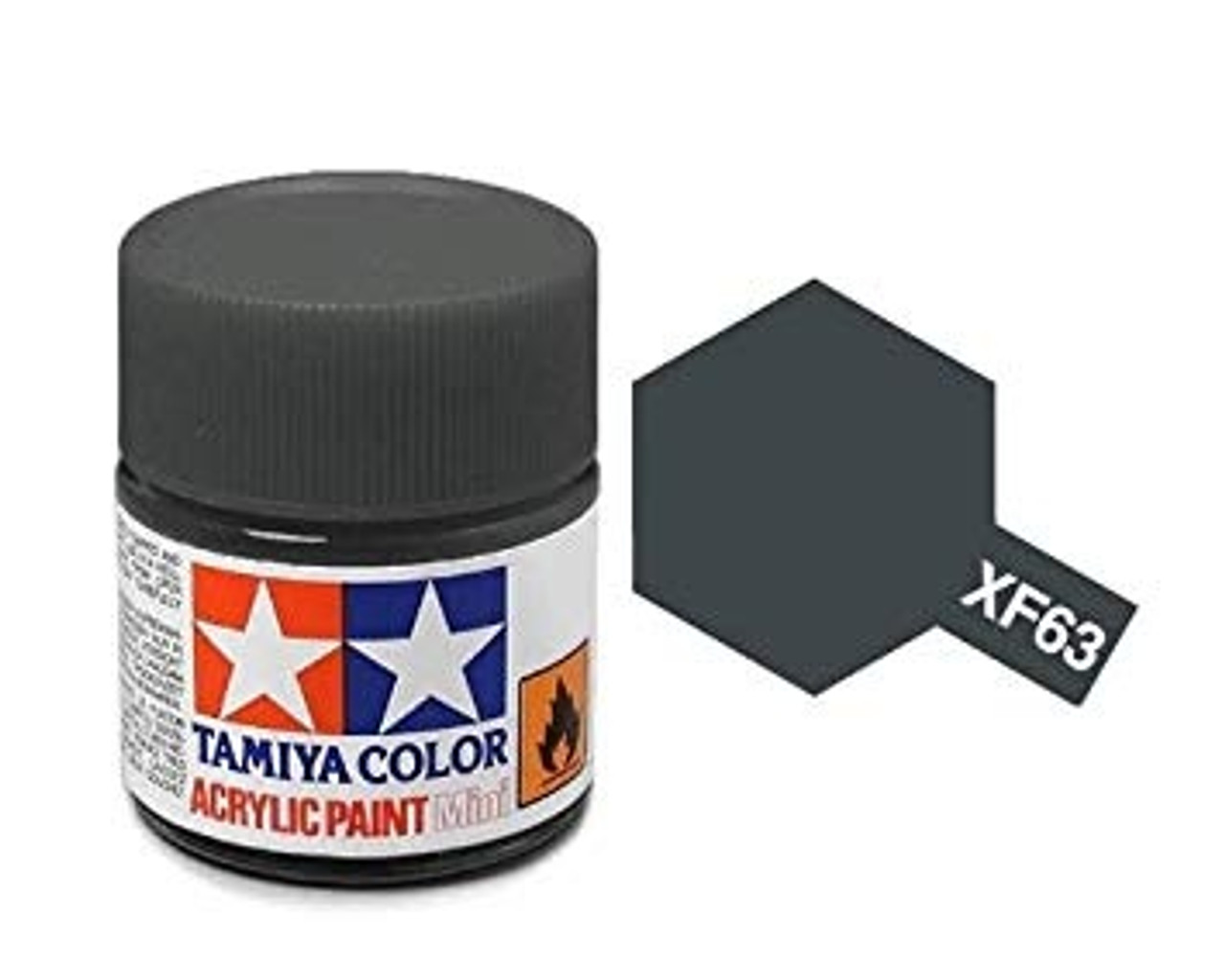
TAMXF63 - Tamiya - Flat German Gray Acrylic - 10mL Bottle

- SKU:
- TAMXF63
- UPC:
- 45035890
- Condition:
- New
- Availability:
- In-Stock items usually Ship within the next business day
- Shipping:
- Calculated at Checkout
Description
TAMXF63 - Tamiya - Flat German Gray Acrylic - 10mL Bottle
Tamiya XF-63 Flat German Gray represents RAL 7021 Dunkelgrau / Panzergrau ("Panzer grey" or "dark grey") — the standard overall colour of all Wehrmacht armoured vehicles, self-propelled guns, artillery, and wheeled transport from the beginning of the war in September 1939 through to February 1943, when the mandatory introduction of Dunkelgelb (RAL 7028) officially replaced it as the base colour for German AFVs. Tamiya's original colour guide designates XF-63 directly as "German tanks." RAL 7021 is a deep, dark, near-neutral grey — darker than medium grey but distinctly lighter than black — with a very slight blue-grey undertone on some production batches that has fuelled decades of modelling debate. Tamiya XF-63 is somewhat lighter and slightly bluer than the physical colour card, which makes it naturally suited to 1/35 scale-effect application and as a starting point for progressive lightening and weathering. For a closer match to the darker authentic chip, a small addition of XF-1 Flat Black is commonly used. The standard formula for a scale-effect Panzer grey is 7 parts XF-63 + 3 parts XF-60 Dark Yellow to warm and lighten it toward the faded appearance seen on operational vehicles.
Tamiya Acrylic paints are a hybrid acrylic formula built on water-soluble resin — they can be thinned with water, isopropyl alcohol, or lacquer thinner, and clean up easily with water before curing. When thinned with Tamiya Lacquer Thinner, the paint lays down faster, dries harder, and bonds more aggressively to the substrate. The hybrid resin chemistry means the paint film remains slightly soluble after initial drying — subsequent brush strokes can reactivate and lift the layer below if applied without restraint. For this reason, airbrushing is strongly recommended for large surface coverage. Brush painting is workable for detail and touch-up work, but requires a gentle, deliberate stroke and a fully cured base layer. See our Tamiya Acrylic vs. Enamel vs. Lacquer guide for a full breakdown of paint type differences.
- Polish Campaign (September 1939) — overall RAL 7021 Panzergrau on all German armoured vehicles participating in the invasion of Poland; Panzer I, Panzer II, Panzer III B/D, Panzer IV B/C, and Panzer 38(t) operated in overall dark grey throughout the campaign; some vehicles carried additional camouflage earth patches applied in the field over the grey base
- France and the Low Countries (May–June 1940) — overall Panzergrau on the full range of German AFVs in the decisive Western Campaign; Panzer III E/F and Panzer IV D of Rommel's 7th Panzer Division at Arras and Dunkirk, and the armoured units of Fall Rot (Case Red) that drove to the Channel coast; this remains the most frequently modelled German grey period
- Barbarossa and early Eastern Front (June 1941–early 1943) — overall RAL 7021 on German AFVs at the start of Operation Barbarossa, including the Panzer III H/J, Panzer IV F1/F2/G, StuG III B/C/D/E, Sd.Kfz.251 half-track, and the Panzer IV serving with Panzergruppe 1 (von Kleist), 2 (Guderian), 3 (Hoth), and 4 (Hoepner) across the length of the Eastern Front; winter 1941/42 vehicles often carried hastily applied whitewash over the grey base
- North African Campaign (1941–early 1942) — early DAK vehicles arrived in grey before the introduction of tropical tan overpaint; Rommel's 5th Light Division and 15th Panzer Division at El Agheila (February 1941) and the first advance to Tobruk (April 1941) deployed in grey before being repainted in the sand-brown RAL 8000 / RAL 7008 North African scheme
- Balkan Campaign (April 1941) — overall Panzergrau on German AFVs in the invasion of Yugoslavia and Greece; 12th Army armoured units including Panzer III and Panzer IV variants operating in the mountainous Macedonian terrain and the rapid advance through Greece to Crete
- Tiger I (early production) — some early Tiger I tanks delivered to sPzAbt 502 on the Leningrad Front (August–September 1942) were in overall Panzergrau before the introduction of Dunkelgelb; the transition period produced Tiger Is in both grey and yellow, making accurate period reference essential for specific subjects
- Scale-effect darkening and chipping base — XF-63 used over XF-1 Flat Black as a zenithal pre-shade base before Dunkelgelb or Panzergrau topcoats are applied; also used as the bare metal/deep chip tone when simulating worn paint on German AFVs revealing primer beneath the base colour
- RAL 7021 formula mixing — for a warmer, more historically accurate Panzergrau, mix 7 parts XF-63 + 3 parts XF-60 Dark Yellow; the standard Tamiya community approach for achieving the correct, slightly warm dark grey that the colour card specifies without the slight blue-grey cast that straight XF-63 can suggest
For full Tamiya paint colour references and modelling compatibility charts, visit our Tamiya Paint Colour Chart — Complete Guide for Scale Modellers.
Thin and airbrush with Tamiya Lacquer Thinner, Mr. Color Thinner, or Mr. Color Leveling Thinner.
- 10ml glass jar
- Part of the Tamiya Acrylic paint range
Related Products

TAMXF20 - Tamiya - Flat Medium Gray Acrylic - 10mL Bottle
Tamiya

TAMXF56 - Tamiya - Flat Metallic Gray Acrylic - 10mL Bottle
Tamiya

TAMXF19 - Tamiya - Flat Sky Gray Acrylic - 10mL Bottle
Tamiya

TAMXF66 - Tamiya - Flat Light Gray Acrylic - 10mL Bottle
Tamiya
TAMXF75 - Tamiya - Flat IJN Gray Acrylic - 10mL Bottle
Tamiya