
Tamiya
TAMXF27 - Tamiya - Flat Black Green Acrylic - 10mL Bottle
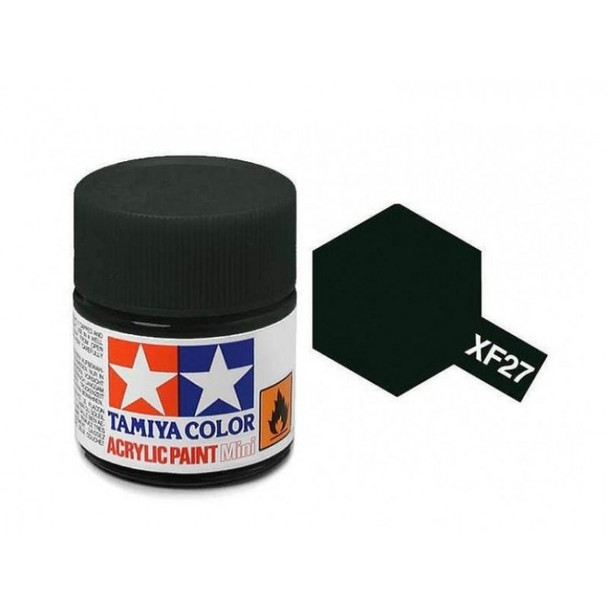
- SKU:
- TAMXF27
- UPC:
- 45035746
- Condition:
- New
- Availability:
- In-Stock items usually Ship within the next business day
- Shipping:
- Calculated at Checkout

Description
TAMXF27 - Tamiya - Flat Black Green Acrylic - 10mL Bottle
Tamiya XF-27 Flat Black Green represents RLM 70 Schwarzgrün ("black-green") — one of the two standard upper-surface dark greens that defined Luftwaffe camouflage from 1938 through to mid-1944. Introduced alongside RLM 71 Dunkelgrün in the revised L.Dv. 521/1 of 1938, RLM 70 was the darker of the two greens, forming a two-tone splinter pattern with RLM 71 over an RLM 65 Hellblau lower surface. This scheme was mandated for all Luftwaffe aircraft types with the exception of maritime patrol aircraft, and it was first applied to the Messerschmitt Bf 109 from 1937 in its earliest pre-war form. From 1940 onward, fighters transitioned away from RLM 70 — replacing it with RLM 02 Grau in mottled upper fuselage work — while bombers and reconnaissance aircraft retained the full RLM 70/71 scheme through to mid-1944. In the Sammelmitteilung directive of July 1944, RLM 70 was formally replaced by RLM 82 Hellgrün, though existing stocks continued to be applied through the end of the war. XF-27 is used directly for RLM 70 and is also the green component in the RLM 74 Graugrün mix (3 parts XF-24 + 2 parts XF-27) and RLM 73 Dunkelgrün maritime green (2 parts XF-24 + 3 parts XF-27 + 1 part XF-2).
Tamiya Acrylic paints are a hybrid acrylic formula built on water-soluble resin — they can be thinned with water, isopropyl alcohol, or lacquer thinner, and clean up easily with water before curing. When thinned with Tamiya Lacquer Thinner, the paint lays down faster, dries harder, and bonds more aggressively to the substrate. The hybrid resin chemistry means the paint film remains slightly soluble after initial drying — subsequent brush strokes can reactivate and lift the layer below if applied without restraint. For this reason, airbrushing is strongly recommended for large surface coverage. Brush painting is workable for detail and touch-up work, but requires a gentle, deliberate stroke and a fully cured base layer. See our Tamiya Acrylic vs. Enamel vs. Lacquer guide for a full breakdown of paint type differences.
- Messerschmitt Bf 109 B/C/D/E upper surfaces — the definitive early-war upper surface dark green; RLM 70 applied to all pre-war and early-war Bf 109 variants from B-series through E-7, worn by JG 2, JG 3, JG 26, JG 51, JG 52, and JG 53 in the Polish campaign (September 1939), French campaign (May–June 1940), and Battle of Britain (July–October 1940); on fighters, RLM 70 was progressively replaced by RLM 02 mottle on the fuselage sides from 1940 while retained on upper wing and fuselage spine
- Heinkel He 111 H upper surfaces — full RLM 70/71 two-tone splinter pattern on the He 111 H-series operated by KG 26, KG 53, KG 55, and LG 1 throughout the war; the He 111 retained the RLM 70/71 scheme long after fighters had switched to RLM 74/75, making it one of the most common RLM 70 applications in large-scale bomber kits
- Junkers Ju 88 A upper surfaces — RLM 70/71 scheme on the Ju 88 A-1/A-4 operated by KG 30, KG 51, KG 54, and KG 76 in bombing, anti-shipping, and reconnaissance roles from 1939 through 1944; the long service life of the Ju 88 makes RLM 70 an essential colour for any serious Luftwaffe bomber collection
- Junkers Ju 87 B/D Stuka upper surfaces — RLM 70/71 scheme on the Ju 87 B operated by StG 2, StG 51, and StG 77 in the Blitzkrieg campaigns of 1939–41 before the tropical Ju 87 D introduced North African desert colours; European-theatre Ju 87s retained RLM 70/71 through to late production
- Dornier Do 17 Z / Do 215 upper surfaces — RLM 70/71 on the medium bomber serving with KG 2, KG 3, and KG 76 in the Battle of Britain and early Eastern Front operations, 1940–41; the Do 17's slim fuselage makes the two-tone splinter pattern particularly prominent in scale builds
- Messerschmitt Bf 110 C/D upper surfaces — RLM 70/71 on the Zerstörer heavy fighter serving with ZG 26 and ZG 76 during the Battle of Britain; also on early night-fighter Bf 110 variants of NJG 1 and NJG 2 before the dedicated night-fighter paint scheme replaced the green upper surfaces in 1941
- RLM 74 Graugrün mixing — XF-27 is the green component in the RLM 74 mix (3 parts XF-24 Dark Gray + 2 parts XF-27 Black Green), producing the late-war grey-green upper surface mottle applied to Fw 190 A-8/A-9, Bf 109 G-10/K-4, and night fighters from 1943 onward
- RLM 73 Dunkelgrün maritime mixing — 3 parts XF-27 + 2 parts XF-24 + 1 part XF-2 approximates RLM 73, the darker green of the RLM 72/73 maritime pattern used on Focke-Wulf Fw 200 Condor, Heinkel He 115, and Dornier Do 24 patrol aircraft over the Atlantic and North Sea, 1940–44
For full Tamiya paint colour references and modelling compatibility charts, visit our Tamiya Paint Colour Chart — Complete Guide for Scale Modellers.
Thin and airbrush with Tamiya Lacquer Thinner, Mr. Color Thinner, or Mr. Color Leveling Thinner.
- 10ml glass jar
- Part of the Tamiya Acrylic paint range
Related Products
TAMXF5 - Tamiya - Flat Green Acrylic - 10mL Bottle
Tamiya

TAMXF67 - Tamiya - Flat NATO Green Acrylic - 10mL Bottle
Tamiya

TAMXF26 - Tamiya - Flat Deep Green Acrylic - 10mL Bottle
Tamiya

TAMXF61 - Tamiya - Flat Dark Green Acrylic - 10mL Bottle
Tamiya
TAMXF11 - Tamiya - Flat IJN Green Acrylic - 10mL Bottle
Tamiya