
Tamiya
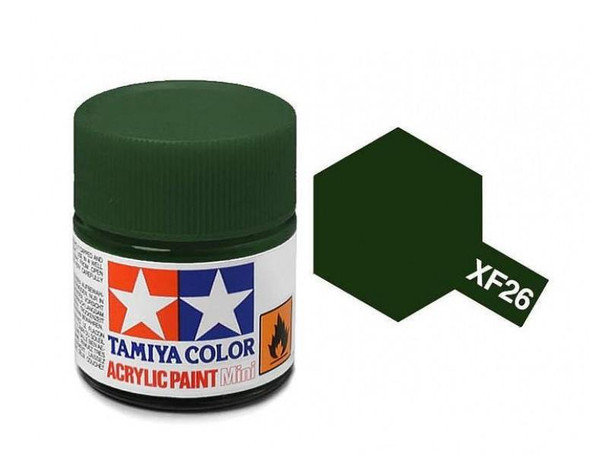
TAMXF26 - Tamiya - Flat Deep Green Acrylic - 10mL Bottle
- SKU:
- TAMXF26
- UPC:
- 45035739
- Condition:
- New
- Availability:
- In-Stock items usually Ship within the next business day
- Shipping:
- Calculated at Checkout

Description
TAMXF26 - Tamiya - Flat Deep Green Acrylic - 10mL Bottle
Tamiya XF-26 Flat Deep Green is a rich, dark, saturated green designated in Tamiya's original colour guide as "Camouflage" for Luftwaffe aircraft — serving as the closest out-of-the-bottle approximation for the mid-to-late-war Luftwaffe upper surface greens and as a critical mixing component across a wide range of RLM colour formulas. It sits at the darker, more chromatic end of the green spectrum in the Tamiya range, providing the depth and saturation needed for late-war German upper surface camouflage work. Used alone, XF-26 is a reasonable representation of RLM 82 Hellgrün ("light green") when mixed 8:1 with XF-61 Dark Green and a touch of XF-2 Flat White — the mid-to-late-war upper surface green that replaced RLM 71 from mid-1944 onward. It also forms the green component in RLM 72 Grün (mixed 1:1 with XF-65 Field Grey) used on Luftwaffe maritime patrol aircraft, and contributes to RLM 74 Graugrün approaches when blended with XF-18. Beyond Luftwaffe applications, XF-26 appears in mixes for early French Air Force camouflage greens and is useful for any deep, vegetation-tone green across ground subjects and diorama work.
Tamiya Acrylic paints are a hybrid acrylic formula built on water-soluble resin — they can be thinned with water, isopropyl alcohol, or lacquer thinner, and clean up easily with water before curing. When thinned with Tamiya Lacquer Thinner, the paint lays down faster, dries harder, and bonds more aggressively to the substrate. The hybrid resin chemistry means the paint film remains slightly soluble after initial drying — subsequent brush strokes can reactivate and lift the layer below if applied without restraint. For this reason, airbrushing is strongly recommended for large surface coverage. Brush painting is workable for detail and touch-up work, but requires a gentle, deliberate stroke and a fully cured base layer. See our Tamiya Acrylic vs. Enamel vs. Lacquer guide for a full breakdown of paint type differences.
- RLM 82 Hellgrün base — primary component in the RLM 82 mix (8 parts XF-26 + 1 part XF-61 Dark Green + 1 part XF-2 Flat White) representing the brighter, more saturated green used on upper surfaces of late-war Luftwaffe fighters and bombers from mid-1944 to May 1945, including Bf 109 G-10/K-4 operated by JG 3, JG 52, and JG 301 in the Defence of the Reich role, and Fw 190 A-8/A-9 operated by JG 2, JG 4, and JG 26 over the Western Front
- Focke-Wulf Fw 190 D-9 upper surface — RLM 82/83 upper surface scheme on the Dora operated by III./JG 54 at Achmer and IV./JG 3 at Gütersloh during the final months of the war, 1944–45; the Fw 190 D-9 is one of the most popular late-war Luftwaffe subjects and XF-26-based mixes are essential for accurate upper surface work
- Messerschmitt Me 262 A upper surface — RLM 82/83 mottle on the world's first operational jet fighter serving with JG 7 Nowotny and KG(J) 54 from August 1944; late-production Me 262s received factory-applied RLM 82/83 upper camouflage over RLM 76 lower surfaces
- RLM 72 Grün maritime — mixed 1:1 with XF-65 Field Grey to produce RLM 72 Dunkelgrün, the darker green component of the RLM 72/73 maritime camouflage scheme applied to Luftwaffe patrol and anti-shipping aircraft including the Focke-Wulf Fw 200 Condor operating with KG 40 over the Atlantic (1940–43), Heinkel He 115 seaplanes with Küstenfliegergruppe units over the North Sea and Norwegian coast, and Junkers Ju 88 A/C maritime variants
- Heinkel He 111 H maritime scheme — RLM 72/73 upper surface pattern on He 111 H variants engaged in anti-shipping operations with KG 26 (torpedo strike) and KG 100 (pathfinder) over the Atlantic and Arctic waters, 1941–43
- French Armée de l'Air camouflage base — XF-26 used alone or with minor adjustments as the starting point for the dark green component of early French Air Force schemes on the Dewoitine D.520, Bloch MB.152, and Morane-Saulnier MS.406 fighters operating during the Battle of France (May–June 1940)
- Diorama vegetation and foliage — XF-26 used as a dark base coat for scale foliage, hedgerow bocage, and tropical vegetation in dioramas before highlighting with progressively lighter greens; its strong chromatic depth makes it effective as a shadow base under lighter highlight layers
- RLM 82/83 late-war general mixing — XF-26 used alongside XF-5 Flat Green, XF-58 Olive Green, and XF-3 Flat Yellow in personal mixes for the wide range of late-war Luftwaffe green variations seen across different aircraft manufacturers, production batches, and field-applied touch-up paints that characterised German aviation in the final year of the war
For full Tamiya paint colour references and modelling compatibility charts, visit our Tamiya Paint Colour Chart — Complete Guide for Scale Modellers.
Thin and airbrush with Tamiya Lacquer Thinner, Mr. Color Thinner, or Mr. Color Leveling Thinner.
- 10ml glass jar
- Part of the Tamiya Acrylic paint range
Related Products
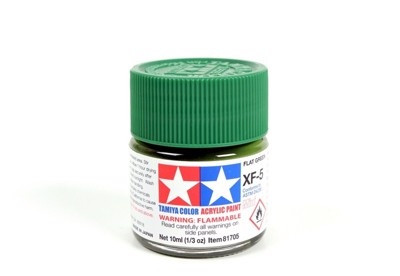
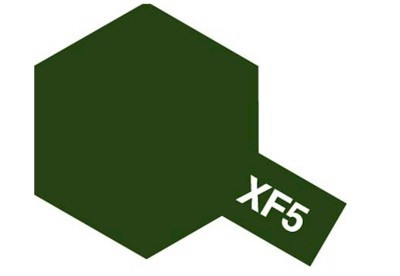
TAMXF5 - Tamiya - Flat Green Acrylic - 10mL Bottle
Tamiya

TAMXF61 - Tamiya - Flat Dark Green Acrylic - 10mL Bottle
Tamiya

TAMXF58 - Tamiya - Flat Olive Green Acrylic - 10mL Bottle
Tamiya
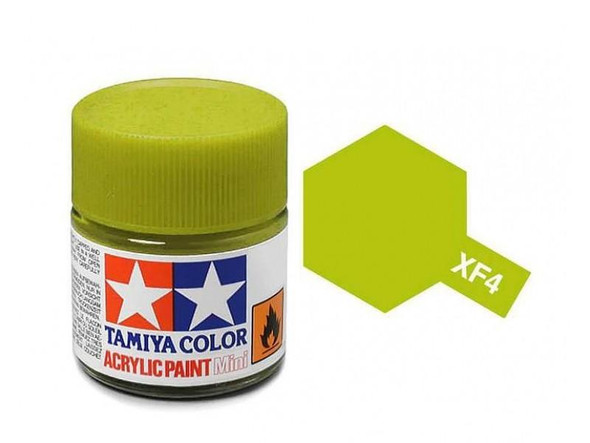
TAMXF4 - Tamiya - Flat Yellow Green Acrylic - 10mL Bottle
Tamiya
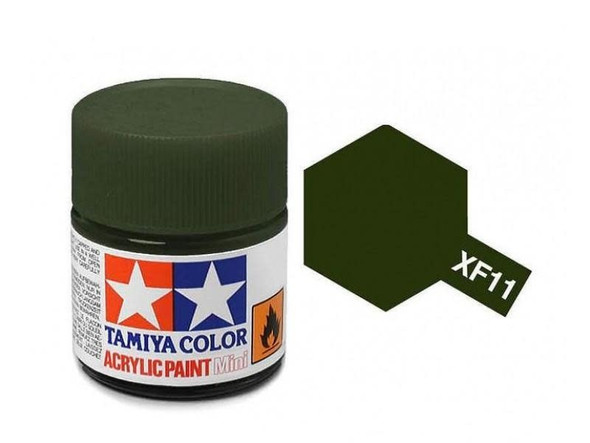
TAMXF11 - Tamiya - Flat IJN Green Acrylic - 10mL Bottle
Tamiya