
Tamiya
TAMXF25 - Tamiya - Flat Lt Sea Gray Acrylic - 10mL Bottle

- SKU:
- TAMXF25
- UPC:
- 4950344069743
- Condition:
- New
- Availability:
- In-Stock items usually Ship within the next business day
- Shipping:
- Calculated at Checkout

Description
TAMXF25 - Tamiya - Flat Lt Sea Gray Acrylic - 10mL Bottle
Tamiya XF-25 Flat Light Sea Gray is a cool, pale grey designated in Tamiya's original colour guide as "Hull of British ships" — representing Admiralty Pattern 507C Light Grey, the standard light grey used by the Royal Navy from the mid-1930s onward. AP 507C served as the overall hull and superstructure colour for vessels stationed in Mediterranean, foreign, and warm-climate commands, where the lighter tone provided better counter-shading against bright conditions. It was equally used as the light component in the full spectrum of Admiralty disruptive camouflage schemes applied to Home Fleet and Atlantic escort vessels throughout the war, including the Standard Camouflage Colours (MS and B series) and the simplified G-series colours introduced in May 1943 (G45, the 1943 successor designation to 507C). In Tamiya's original catalogue, XF-25 is also listed as "Camouflage" for Luftwaffe aircraft — it provides a workable base for RLM 63 Grungrau, the early Luftwaffe grey-green, mixed approximately 1:1 with XF-2 Flat White.
Tamiya Acrylic paints are a hybrid acrylic formula built on water-soluble resin — they can be thinned with water, isopropyl alcohol, or lacquer thinner, and clean up easily with water before curing. When thinned with Tamiya Lacquer Thinner, the paint lays down faster, dries harder, and bonds more aggressively to the substrate. The hybrid resin chemistry means the paint film remains slightly soluble after initial drying — subsequent brush strokes can reactivate and lift the layer below if applied without restraint. For this reason, airbrushing is strongly recommended for large surface coverage. Brush painting is workable for detail and touch-up work, but requires a gentle, deliberate stroke and a fully cured base layer. See our Tamiya Acrylic vs. Enamel vs. Lacquer guide for a full breakdown of paint type differences.
- Royal Navy overall 507C Mediterranean scheme — standard overall hull and superstructure colour on RN warships stationed in the Mediterranean, Indian Ocean, and foreign stations from 1936 onward; applied to cruisers and destroyers of the Mediterranean Fleet including HMS Warspite, HMS Valiant, HMS Queen Elizabeth, and their screen destroyers during the North African campaign and operations against the Italian Navy, 1940–43
- Home Fleet disruptive camouflage light tone — the lighter grey component in Admiralty disruptive pattern camouflage schemes applied to Home Fleet battleships, battlecruisers, and cruisers; 507C used alongside 507A Dark Grey in standard two-tone schemes on HMS King George V, HMS Prince of Wales, HMS Hood, and HMS Repulse during the search for and action against Bismarck (May 1941)
- Standard Camouflage Colours light panels — 507C used as the light or medium-light element in MS and B-series disruptive designs applied to destroyers and smaller escorts operating in the North Atlantic and Western Approaches convoy escort role, 1941–43; combined with MS1, MS3, MS4, and B5 in standardised Admiralty disruptive patterns from CAFO 679/42
- G45 equivalent (1943 onward) — from May 1943 the Admiralty formalised 507C as G45 under the simplified G-series paint system; the colour itself was unchanged and G45/507C continued as the light grey standard through to the end of the war and into the post-war period, used on British Pacific Fleet warships including HMS Victorious, HMS Indomitable, and escort destroyers at Okinawa and the Japanese Home Islands, 1945
- Commonwealth and Allied warships — 507C widely adopted by Royal Australian Navy, Royal Canadian Navy, and Royal New Zealand Navy warships operating under Admiralty direction; HMAS Canberra, HMCS Haida, and HMNZS Achilles all wore 507C-based schemes at various points during the war
- Convoy escort superstructures — light grey superstructure tone on destroyer and frigate classes operating in Western Approaches escort duty including the V&W-class, Town-class (ex-USN flush-deckers), and Flower-class corvettes in basic light and dark grey schemes during the Battle of the Atlantic, 1939–45
- RLM 63 Grungrau base — XF-25 mixed approximately 1:1 with XF-2 Flat White provides a workable representation of early Luftwaffe RLM 63, the grey-green used on pre-war and early-war German aircraft including Dornier Do 17 and Heinkel He 111 variants in the Spanish Civil War, 1936–39, and early Polish and French campaign aircraft before the RLM 70/71/65 scheme became standard
- General naval and ship camouflage mixing — XF-25 used as the light component in two-tone ship camouflage painting across 1/350, 1/700, and 1/1200 scale Royal Navy and Commonwealth warship kits; pairs naturally with XF-54 Dark Sea Grey for full Home Fleet and Atlantic schemes
For full Tamiya paint colour references and modelling compatibility charts, visit our Tamiya Paint Colour Chart — Complete Guide for Scale Modellers.
Thin and airbrush with Tamiya Lacquer Thinner, Mr. Color Thinner, or Mr. Color Leveling Thinner.
- 10ml glass jar
- Part of the Tamiya Acrylic paint range
Related Products
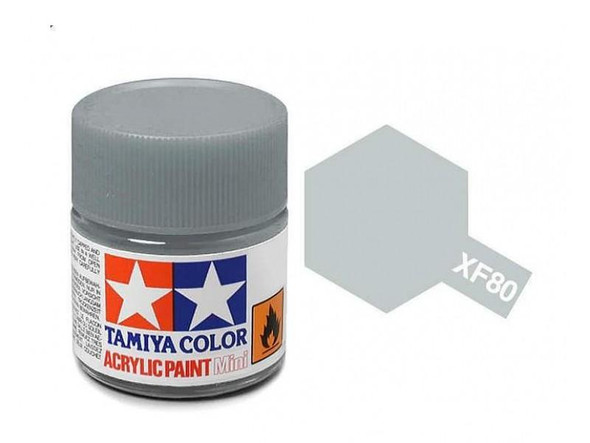
TAMXF80 - Tamiya - Flat RN Lt Gray Acrylic - 10mL Bottle
Tamiya
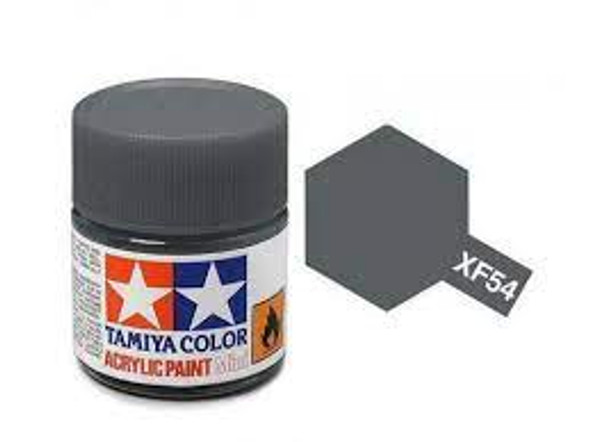
TAMXF54 - Tamiya - Flat Dark Sea Gray Acrylic - 10mL Bottle
Tamiya
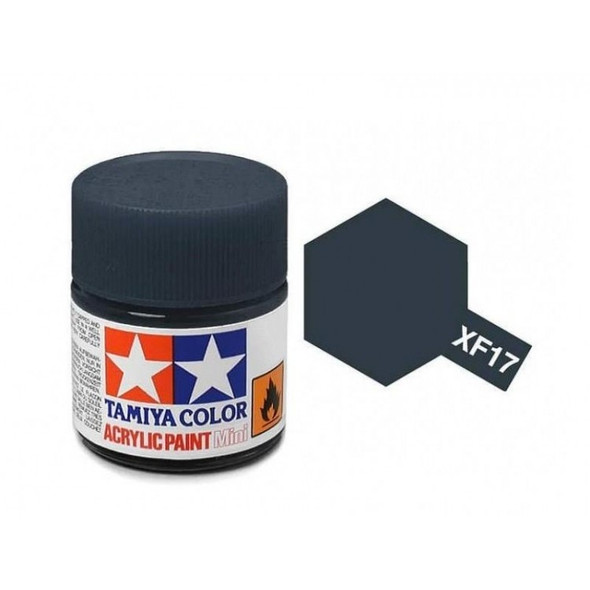
TAMXF17 - Tamiya - Flat Sea Blue Acrylic - 10mL Bottle
Tamiya

TAMXF20 - Tamiya - Flat Medium Gray Acrylic - 10mL Bottle
Tamiya

TAMXF56 - Tamiya - Flat Metallic Gray Acrylic - 10mL Bottle
Tamiya