
Tamiya Acrylic vs Enamel vs Lacquer — Which Paint Should You Use?
Tamiya Acrylic vs Enamel vs Lacquer — Which Paint Should You Use?
From a Toronto hobby retailer since 1986 · Choosing between Tamiya's three paint formulas · Updated May 2026
If you are new to scale modelling, the Tamiya paint aisle can be overwhelming. Tamiya alone produces three completely different paint formulas — acrylic, lacquer, and enamel — and knowing which one to reach for makes a real difference to your finished build. This guide walks through each formula, when to use it, and how the three work together in a typical workflow.
For a broader explanation of how acrylic, lacquer, and enamel differ at the chemistry level — and why "acrylic" does not always mean "water-based" — see our Acrylic vs Lacquer vs Enamel guide. This post focuses specifically on the Tamiya range and how to choose between the three within it. Once you know which formula suits your build, check our complete Tamiya paint colour chart to find the exact colour you need, or browse our full Tamiya paint range.
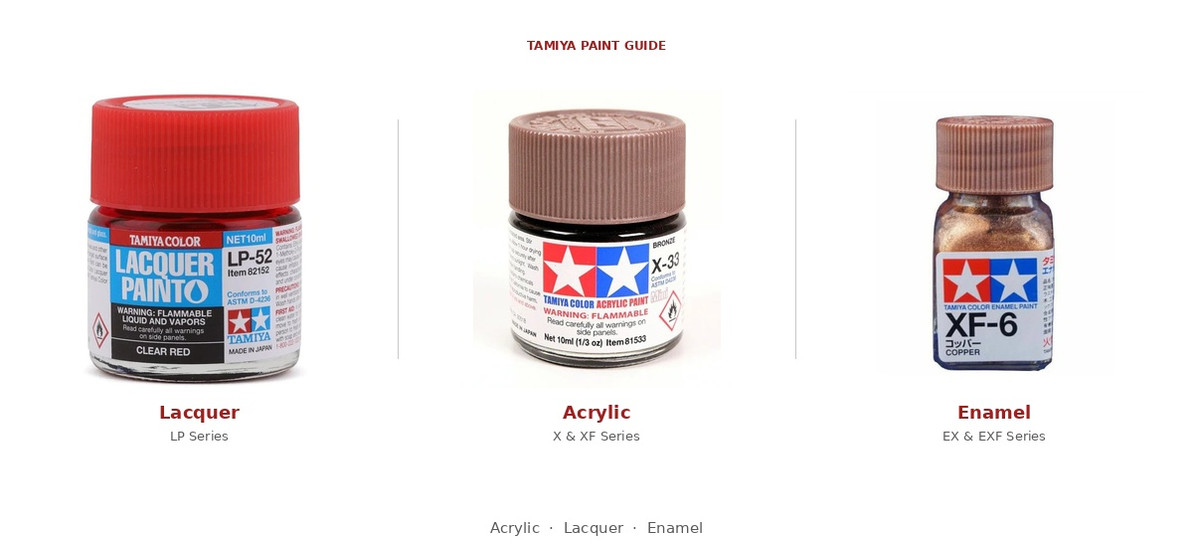
Tamiya X/XF acrylics are hybrid acrylics — thin them with lacquer thinner for the best airbrush results, or with alcohol or water for milder handling. Tamiya LP lacquers are the professional airbrush choice for hard, smooth base coats. Tamiya enamels are slow-drying oil-based paints used for panel line washes and weathering over a sealed base. Most modellers pick either acrylic or lacquer as their primary base coat, and use enamel for weathering on top. Never apply lacquer over enamel — even when the enamel looks dry, it is rarely fully cured underneath.
Tamiya Hybrid Acrylics (X and XF Series)
Tamiya's acrylics are best understood as a more versatile, lower-odour lacquer. They are a hybrid formula — not a standard water-based acrylic — and can be thinned with water, isopropyl alcohol, or lacquer thinner. For best airbrushing results, a Tamiya lacquer thinner retarder type (such as Tamiya 87194 or Mr. Leveling Thinner) is the recommended thinner — the retarder slows the dry time just enough to let the paint level beautifully. Hand painting is possible but can be tricky — the second coat can reactivate and lift the first if you are not careful.
The range is split into two series: XF colours are flat/matte finish, and X colours are gloss finish. Both are the same hybrid acrylic formula — the only difference is the sheen level.
Cleanup: Isopropyl alcohol or lacquer thinner.
Pros: Versatile thinning options, lower odour than lacquers, fast drying, excellent airbrush performance with retarder thinner.
Cons: Hand painting requires care — thin coats and patience.
Tamiya LP Lacquers
Lacquers are the professional choice for airbrushing. They dry fast, lay down smooth, and cure to a hard, durable finish that handles weathering products and decals without lifting. If you want a flawless base coat, this is it.
Best for: Airbrushing base coats on any subject — especially automotive, armour, and aircraft where finish quality matters. The retarder thinners (Tamiya 87194 or Mr. Leveling Thinner) slow the dry time enough to allow the paint to self-level into a mirror-smooth finish.
Cleanup: Lacquer thinner only. Use with proper ventilation.
Pros: Superior durability, fast drying, excellent airbrush performance.
Cons: Requires lacquer thinner and ventilation. Not suitable for brush painting.
Tamiya Enamels (X and XF Enamel Series)
Enamels are oil-based and dry slowly — which sounds like a downside until you understand how modellers actually use them. That slow dry time is the point. Enamels are the preferred choice for panel line washes, chipping techniques, and weathering effects because they stay workable long enough to blend, manipulate, and wipe away mistakes.
Best for: Hand painting detail work, panel line washes, and weathering over a sealed base coat. Always apply over a fully sealed acrylic or lacquer layer — enamel thinner will not damage sealed layers beneath.
Cleanup: Enamel thinner (Tamiya X-20, available in 10ml, 40ml, and 250ml).
Pros: Forgiving and blendable, ideal for weathering and detail work.
Cons: Slow dry time, requires enamel thinner, must be applied over a sealed base.
How the three work together
Most modellers pick either Tamiya acrylics or LP lacquers as their primary base coat — not both. The choice comes down to personal preference, ventilation, and workflow. Both are excellent. Once your base coat is down and sealed, enamels come into play for weathering.
The reason enamels are so popular for weathering is chemistry. Because enamels are a dissimilar paint type to your acrylic or lacquer base, enamel thinner can clean up your wash without touching the sealed layers beneath. This makes panel lining and weathering effects forgiving and controllable.
A common workflow:
- Acrylic or lacquer base coat (airbrushed)
- Seal with a gloss clear coat
- Apply decals
- Seal again with gloss clear
- Enamel wash for panel lines and weathering effects
- Final seal with flat or semi-gloss clear to taste
One critical rule: avoid applying lacquer over enamel at any stage. Even if an enamel layer looks and feels dry, it can still be chemically active — and lacquer thinner will attack it, causing wrinkling and lifting. Enamels are notoriously slow to fully cure beneath the surface. Plan your workflow so that lacquer is never going on top of enamel.
A note for Canadian modellers
Tamiya aerosol spray cans (TS series) are not available for sale in Canada. Tamiya X-20A acrylic thinner is also currently unavailable due to Health Canada regulations.
For thinning Tamiya acrylics, we recommend Tamiya Lacquer Thinner with Retarder or Mr. Hobby Leveling Thinner for best results — the retarder slows the dry time and gives the paint time to level properly. Mr. Hobby Aqueous Color Thinner is also compatible and available.
Ask us in store if you are unsure which to use.
Wheels & Wings Hobbies has operated as a specialty hobby retailer in Toronto since 1986 and stocks the full Tamiya paint range — X/XF acrylics, LP lacquers, and X/XF enamels — alongside compatible thinners, cleaners, and clear coats. This guide reflects general guidance on choosing between Tamiya's three paint formulas based on store experience and standard modelling practice. For a broader chemistry framework covering all paint types, see our Acrylic vs Lacquer vs Enamel guide.
Shop Tamiya acrylics, lacquers, and enamels in store at 1880 Danforth Ave, Toronto, or browse our full Tamiya paint range online.
Recent Posts
-
Citadel / Warhammer Colour Complete Paint Guide — All Lines | Wheels & Wings Hobbies
Wheels & Wings Hobbies · Paint Reference Citadel Colour Complete Guide — Warhammer Colour Complete …May 08, 2026 -
Citadel Technical Paints — Complete Guide | Warhammer Colour
Wheels & Wings Hobbies · Paint Reference Citadel Technical Paints — Warhammer Colour Complete list …May 08, 2026 -
Citadel Spray Primers — Complete Guide | Warhammer Colour
Wheels & Wings Hobbies · Paint Reference Citadel Spray Primers — Warhammer Colour Complete listing …May 08, 2026