
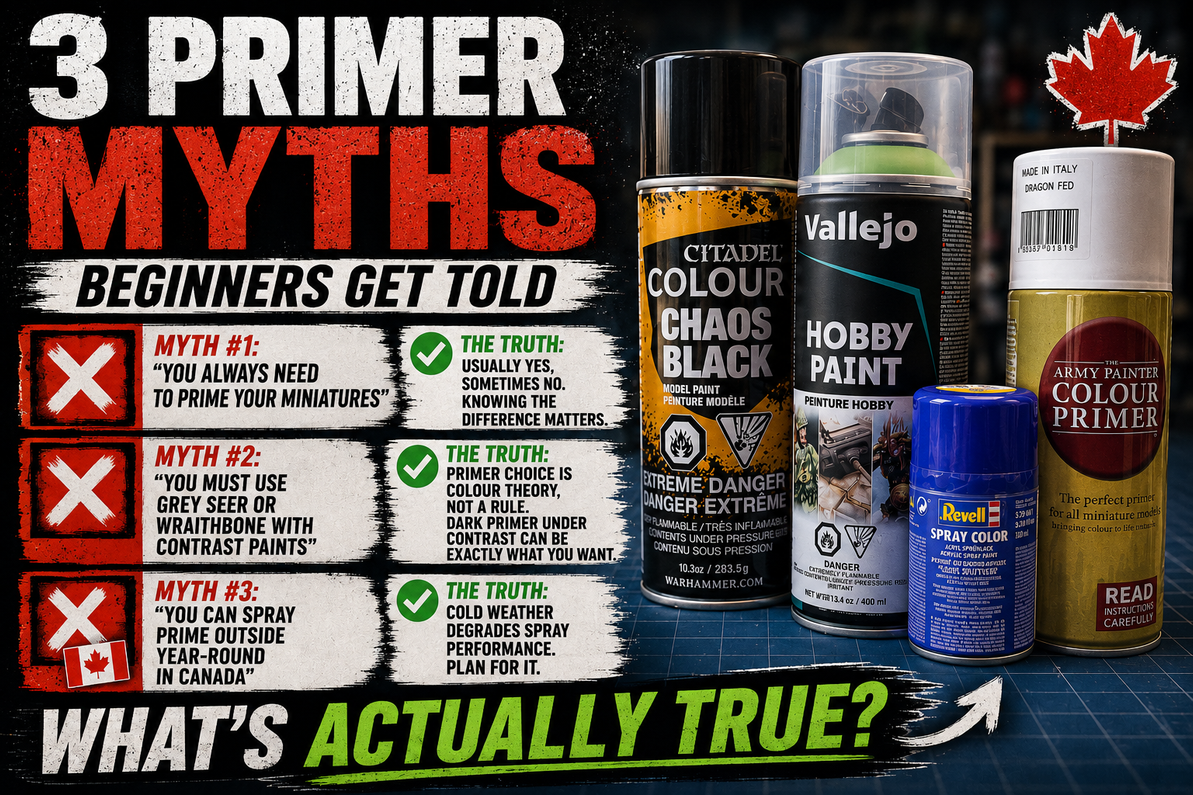
Three Primer Myths Beginners Get Told (And What's Actually True)
Three Primer Myths Beginners Get Told (And What's Actually True)
Weekly column · Lessons from the paint counter at WWH · April 2026
Welcome to the first entry in our new weekly column. Every week, we are going to take three things beginner painters get told as gospel (usually by other well-meaning beginners, sometimes by older guides, sometimes by the loudest voice in a forum thread) and unpack what is actually true. The goal is not to argue. It is to help newer painters develop the kind of judgment that comes from spending years watching how paint actually behaves on actual miniatures, instead of repeating rules nobody can explain.
We start with primer because primer is where the most stubbornly wrong advice lives. Every week at the paint counter we hear the same three primer claims repeated by beginners, and every week we have to gently explain that the truth is more interesting. Here are those three myths, and what is actually true.
Primer matters more than most beginners think, but the conventional wisdom is too rigid. You should usually prime, but there are legitimate exceptions. Dark primer under Contrast paint is not a mistake; it is a colour theory choice. And spray priming in Canadian winter is possible but requires planning. Primer is a thinking step, not an execution step. Learn to think about it.
Myth 1: "You always need to prime your miniatures"
The truth: usually yes, sometimes no. Knowing the difference matters.
The most common version of this myth is the absolute one: every miniature, every time, no exceptions, always prime. We hear customers repeat it as though it is a law of physics. It is not, and treating it as one obscures the actual reasoning, which is what beginners need to develop.
The actual reasoning: primer creates a chemical bond between bare plastic and paint, which dramatically improves adhesion and durability. The reason this matters is handling. Miniatures that get picked up, moved across a table, knocked over, packed in foam, transported to game nights, and generally lived with will see paint chip and flake without primer. We see the result come back to the counter all the time: a customer holding a Warhammer model with patches of bare plastic showing through where their grip touched it during a game, convinced their paint is defective. The paint is fine. The model was not primed.
For anything that will be handled regularly (Warhammer miniatures, Gunpla kits, board game pieces, tabletop terrain) prime. This is not negotiable in any practical sense. The cost of a can of primer is rounding-error compared to the time you spent painting and the time you will spend repainting if it chips off.
The legitimate exceptions:
- "Hot" paint chemistry. Some paints, particularly true lacquers like Tamiya LP, bond aggressively to bare plastic on their own. Experienced modellers sometimes skip primer when using these because the paint itself does the adhesion work. This is not beginner territory; it requires knowing what your paint actually is.
- You are still figuring out whether you enjoy the hobby. If you bought your first model and your first three paints to try the hobby out, telling you to also buy primer before you have painted a single thing is just adding cost and friction to something that should be fun. Try painting first. If you love it, prime your next one. The ruined first model is not the end of the world.
The actual mistake is not "skipping primer." It is not knowing whether your specific situation is one where primer is essential or one where it is optional. If you have to ask, prime. If you understand the chemistry and the use case, make the call.
Myth 2: "You must use Grey Seer or Wraithbone with Contrast paints"
The truth: primer choice is colour theory, not a rule. Dark primer under Contrast can be exactly what you want.
This is the myth we push back on most often. Every Contrast tutorial on YouTube, every Warhammer painting guide, every forum thread about Contrast paints repeats the same line: you must use Citadel Grey Seer or Wraithbone. Anything else is wrong. Black primer with Contrast is a beginner mistake.
It is not a mistake. It is a colour theory decision, and treating it as a rule misses the point of how Contrast paints (and Speedpaint, and Xpress Color) actually work.
Contrast paints are translucent. They are designed to let the colour underneath show through, which is why they pool in recesses and thin out on raised areas. The underlying primer is part of the final colour, not just a base for it. Light primer means more of the Contrast colour shows through, producing the bright, vibrant look that Games Workshop's tutorials demonstrate. Dark primer means less light passes through, producing a moodier, more shaded result. Neither is wrong. They are different aesthetic choices.
Some examples of where dark primer under Contrast is genuinely the right choice: painting Death Guard or other grimdark factions where you want a sickly, muted look; painting nurgly skin tones where you want sallow and necrotic rather than fresh and pink; painting any model where the box-art "look" feels too clean and bright for your scheme. Dark primer with Contrast over the top can produce results that simply cannot be achieved with Grey Seer.
And here is something that almost nobody talks about: try coloured primers. Not just light or dark, but actual primary or secondary colours. A red primer under a yellow Contrast produces a sunset-like deep amber that you cannot get any other way. A blue primer under a green Contrast shifts the entire piece toward a cooler, jewel-toned green. A yellow primer under a red Contrast warms the result and adds vibrancy. These are not gimmicks; they are basic colour theory applied to the layered translucent system that Contrast paints actually are. We see customers reach for white primer reflexively every time and it pains us a little, because the depth and character you can achieve with a coloured primer underneath is genuinely impressive for very little additional effort. The Contrast paint does almost all of the work; you just have to give it an interesting starting colour.
The reason this myth persists is that Games Workshop's official tutorials all use Grey Seer or Wraithbone. They have a commercial interest in selling you specific Citadel primers, and their tutorial production assumes a single look that matches their box art. That is fine for them, but it is not the same as primer choice being a rule of painting.
The deeper lesson here is colour theory. Once you understand that everything in your final paint job (primer, basecoat, midtones, shades, highlights) is a layered colour stack, you stop following rules and start making decisions. A black primer with light Contrast is not better or worse than light primer; it is a different result. Knowing which result you want is the actual skill.
What to do instead: if you are starting out and following GW tutorials closely, Grey Seer and Wraithbone are fine and will give you the look the tutorial promises. Once you have painted a few models that way, deliberately try a black primer with the same Contrast colour on a test model. Compare the two. The difference is colour theory, made visible. That is the real lesson.
Myth 3: "You can spray prime outside year-round in Canada"
The truth: cold weather degrades spray performance. Plan for it.
This one is local to us as a Canadian retailer, and we field it every winter. A customer comes in for a primer can in February, sprays their model in the garage or on the back porch, and ends up with a fuzzy, gritty, pebbled finish that no amount of paint will save. The model has to be stripped and started over.
Spray primer needs warmth to work properly. Below roughly 10-15°C, the propellant in the can does not deliver paint at the right pressure or droplet size, the paint itself does not flow properly out of the nozzle, and the surface of the model is too cold for the paint to bond cleanly. The result is the gritty texture every Canadian painter has seen at least once.
You can still prime in cold weather. You just have to plan for it. Here is what we tell customers:
- Warm the can immediately before spraying. Keep it indoors at room temperature for at least an hour beforehand, and ideally hold it in your hands for a few minutes before you start. Never warm it with anything beyond body heat; spray cans should never go on a heater or in hot water.
- Reduce outdoor exposure time. Have everything ready before you go outside. Spray, come back inside immediately. Do not stand around outside admiring your work.
- Spray with the wind at your back. Wind chill drops the working temperature even further; you want the can and the model in the calmest conditions you can manage.
- Test the can first. Hold it upside down and spray briefly to clear any nozzle clogs; cold weather makes clogs more common.
- Clean your model thoroughly first. When adhesion conditions are already compromised by temperature, you cannot also have dust, mould-release, oils from your hands, or any other contaminants on the model. Wash with soap and water, dry completely, then prime.
Better yet: skip the spray entirely in winter. If you have an airbrush and a place to use it indoors, airbrush priming is the ideal cold-weather solution. You control the temperature, the pressure, and the environment. We recommend Vallejo Mecha Primer for airbrush priming, available in white, black, and grey. It is our stores favourite primer full stop. The durability is exceptional, it works on anything you would use a hobby primer on, and it is what we recommend to literally everyone who owns an airbrush. At $21.50 for 200ml it is also strong value compared to spray cans on a per-millilitre basis.
If you do not have an airbrush, brush-on primer is your winter friend. Application is trickier than spray (you need to thin the primer, work in even strokes, and avoid overworking the surface) but it eliminates the cold-weather variables entirely. Pro Acryl Brush-On Primer (Black) and Pro Acryl Brush-On Primer (White) at $6.99 each are our brush-on recommendations. Pro Acryl makes some of the best brush primers on the market and they are designed specifically for the application.
If you must use spray and the temperature is below 10°C, accept that the result may not be perfect and have a backup plan. Better to know the model might need to be stripped and re-primed than to spend hours painting over a compromised base.
The thread that runs through all three
Each of these three myths is the same kind of mistake at a deeper level. They are all examples of treating primer as a checkbox (something you do or do not do, with one right answer) rather than as a thinking step that should be matched to your specific situation.
Plan your build accordingly. Match your primer choice to the overall colour and finish you want, the conditions you are working in, and what you are actually trying to achieve. The painters who consistently produce good work are not the ones who memorize rules; they are the ones who understand what each step is doing and adjust accordingly.
And most importantly: do not throw yourself into the fire without the knowledge needed to succeed and enjoy the process. The hobby is supposed to be fun. The point of pushing back on these myths is not to make you feel like you have been doing it wrong; it is to give you the framework to make better decisions on the next model.
Quick reference: primers we recommend
| Primer | Application | Best for | Price (CAD) |
|---|---|---|---|
| Vallejo Mecha Primer (200ml) | Airbrush | Store favourite: everything that needs durability | $21.50 |
| Pro Acryl Brush-On Primer | Brush | Cold weather, no airbrush, single-model jobs | $6.99 |
| Vallejo Surface Primer | airbrush | Versatile, multiple colours, smaller batches | $5.49 (17ml) to $21.50 (200ml) |
| Vallejo Spray Primer (400ml) | Spray can | Batch priming armies, warm weather | $19.98 |
| Citadel Chaos Black Spray (400ml) | Spray can | GW tutorials, batch priming, warm weather | $22.95 |
| Army Painter Colour Primer (400ml) | Spray can | Coloured primer for skipping basecoat, warm weather | $22.95 |
| Revell Basic Color Spray Primer (150ml) | Spray can | Smaller batches, scale model kits | $18.95 |
Frequently Asked Questions
For anything you will handle, transport, or play with: yes. The handling is what causes paint to chip off unprimed plastic, and Warhammer miniatures are designed to be handled. The cost of a can of primer is small compared to the time spent re-painting a chipped model.
Yes, and the result is a darker, moodier version of the same colour. Light primer (Grey Seer or Wraithbone) gives you the bright, vibrant look that GW tutorials demonstrate. Dark primer gives you a more shaded, atmospheric look. Neither is wrong; they are different aesthetic choices. For factions like Death Guard or any scheme where you want a moodier finish, dark primer under Contrast can be exactly what you want.
Below roughly 10-15°C, spray primer performance starts to degrade noticeably. The propellant does not deliver paint at proper pressure, the paint does not flow properly out of the nozzle, and the surface of the model is too cold for clean adhesion. You can prime at lower temperatures with careful technique (warm the can first, minimize outdoor time, clean the model thoroughly) but the safer winter option is brush-on or airbrush priming indoors.
For beginners with an airbrush, Vallejo Mecha Primer is our top recommendation: durable, forgiving, works on essentially anything you would prime as a hobbyist. For beginners without an airbrush, a coloured spray primer matched to your overall scheme (black for dark schemes, white for bright ones) is the simplest path. Brush-on primers like Pro Acryl are an excellent winter alternative or for painters working on single models at a time.
It is good practice and becomes essential in cold weather. Mould release, dust, and oils from your hands all reduce primer adhesion. A quick wash in warm soapy water followed by a thorough rinse and dry removes all of these and gives the primer the best surface to bond to. In summer you can often get away without it; in winter, when adhesion is already compromised by temperature, you cannot.
Pricing reflects Wheels & Wings Hobbies retail in CAD as of April 2026. This is the first entry in our weekly Counter Notes column, with new entries published every week, drawing on what we actually see and hear at the paint counter at our Toronto store. Counter Notes is for painters who want to develop the kind of judgment that comes from understanding why things work, not just following rules.
All recommended primers are stocked at Wheels & Wings Hobbies in Toronto and available online with Canada-wide shipping.
Recent Posts
-

What Glue Should I Use? A Scale Modelling Adhesive Guide
Wheels & Wings Hobbies · Counter Notes What Glue Should I Use? Lessons from the paint counter at W …Oct 16, 2026 -

John's Starcraft Zerg Queen Paint Guide - Build Feature
Wheels and Wings Hobbies - Miniature Paint Guide John's Starcraft Zerg Queen Archon Studio - Starcra …Sep 24, 2026 -

Vlad's Tomb King on Necrolith Bone Dragon Paint Guide - Build Feature
Wheels and Wings Hobbies - Miniature Paint Guide Vlad's Tomb King on Necrolith Bone Dragon Warhammer …Sep 10, 2026