
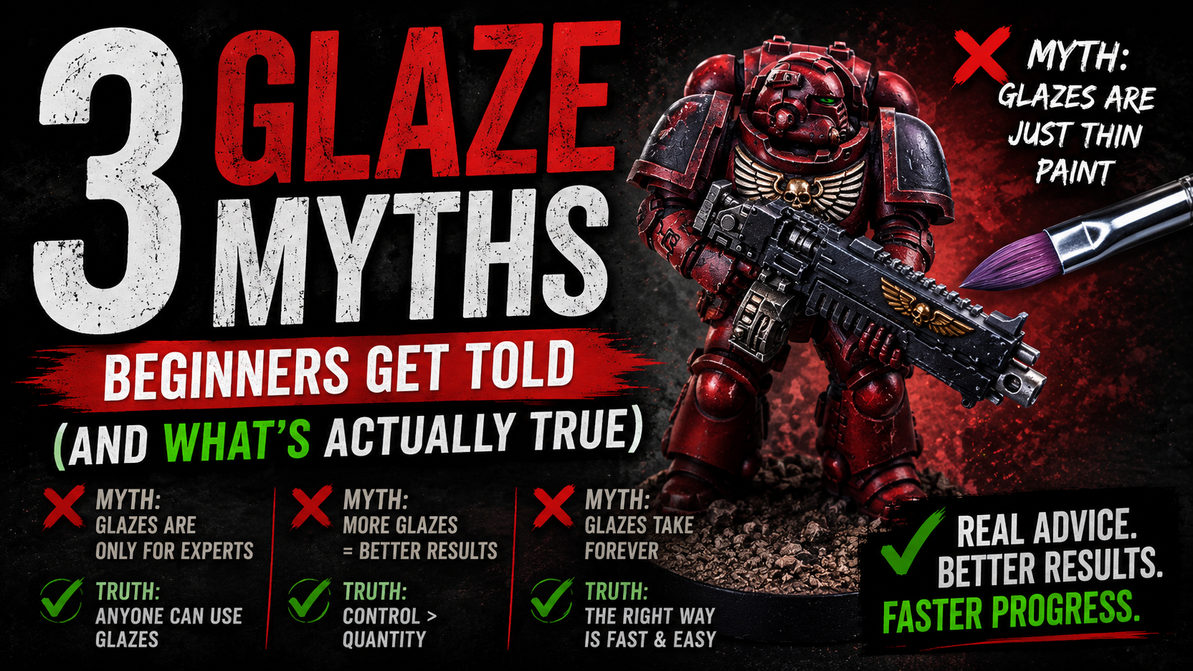
Three Glaze Myths Beginners Get Told (And What's Actually True)
Three Glaze Myths Beginners Get Told (And What's Actually True)
Weekly column · Lessons from the paint counter at WWH · May 2026
At its simplest, glazing means applying an extremely thin, translucent layer of paint over fully dried work to subtly shift colour without covering detail. That single sentence clears up most of the confusion — and yet it is somehow absent from most beginner introductions to the technique.
When Games Workshop discontinued their dedicated Glaze range in 2019 alongside the Contrast launch, a generation of painters concluded that glazing had been superseded. It had not. The myths that followed are still circulating. Here are the three we hear most often, and what is actually true.
Contrast handles the opening pass of a paintjob efficiently. Glazing handles the closing — the correction, refinement, and unification work that Contrast has no answer for. They are not competing approaches to the same job. The medium chemistry matters too: glaze medium and Contrast medium behave in opposite ways, and using the wrong one degrades both techniques.
Myth 1: "Glazing is pointless now — Contrast does the same thing faster"
The truth: Contrast handles the opening pass. Glazing handles the closing. They solve different problems at different stages of the same paintjob.
When GW discontinued their Glaze range alongside the Contrast launch, a lot of painters read it as a verdict: technique superseded, move on. The forum version adds wet blending to the argument — that wet blending produces better colour transitions anyway, and Contrast handles the rest, so glazing has no remaining job. Neither version holds up.
What Contrast actually replaced was the initial shaded base-colour pass over a light or zenithal primer. Before Contrast, painters who wanted a translucent shaded base would apply thin glaze passes over a zenithal highlight, building colour and shade simultaneously. Contrast does that job faster and more consistently for most purposes, which is why GW made the product rationalisation they did. For batch painting armies, it is the right tool.
What glazing does that Contrast has no answer for:
Colour correction on finished work
You have basecoated, shaded, and highlighted a model, and the colour has drifted — the red reads orange, the shadow came out too cold, a transition is too harsh. A glaze adjusts without overpainting. Contrast cannot do this on a dry, multi-colour model. Wet blending cannot work on a dry surface.
Unifying colour temperature
Competition painters almost universally apply a thin unifying glaze — a warm or cool tint — at a late stage to make the light source read consistently and pull together sections painted in different sessions. There is no product shortcut for this.
Smooth gradients without wet blending skill
Multiple thin passes over dry paint, each assessed before the next, can produce transitions comparable to wet blending with a much wider correction window. Scott (Miniac), one of the more respected painting educators online, routinely does a rough wet blend and then follows up with glazes to smooth the result — both in sequence, not one instead of the other.
Skin tones and organic surfaces
Human skin is translucent in real life. Multiple thin glazes of slightly different warm flesh tones, layered over each other, produce depth that single-coat approaches cannot replicate. If your faces look flat or plastic under a lamp, glazing is almost certainly part of the missing step.
A concrete exercise: paint a face your usual way. Let it dry fully. Apply a single pass of a very thin warm flesh glaze across the entire surface. Let it dry and compare. That one pass will smooth transitions, add warmth, and unify the face in a way that is hard to describe before you have seen it. Once you have, the argument about glazing being obsolete stops being interesting.
Myth 2: "You need glaze medium to glaze — without it, you can't do the technique"
The truth: you can glaze without dedicated medium, but water alone has real limitations — and once you are using medium, which one you pick changes the result.
Glazing is a technique, not a product category
You can glaze with water-thinned paint, with inks, or with Contrast paint applied over dry painted areas where you want tinting rather than pooling. What makes something a glaze is translucency and intent, not which medium you used to get there.
Why dedicated medium exists
Water-thinned paint is harder to control. At higher dilutions, water alone tends to cause paint to bead on the surface, dry too fast at the brush edges, and leave tide marks — the ring where water evaporates faster than pigment. At very high dilution, water alone can weaken the acrylic binder enough to reduce durability and adhesion. Glaze medium addresses all of this: it slows drying so the glaze settles evenly and maintains the binder so the layer bonds properly.
Not all mediums behave the same
Lahmian Medium has low viscosity and dries faster — better for applying multiple passes in a single session without long waits. Vallejo Glaze Medium produces a more matte surface and a longer working window, which suits careful correction work where you want time to adjust. Treating "glaze medium" as one thing is a mistake beginners make repeatedly.
The medium does not do the skill
The skill is knowing how thin to make the mix — and there is no universal ratio. Every paint has different pigment density. A dark, highly pigmented ink may need a 5:1 or 6:1 medium-to-paint ratio. A light layer paint may be close at 2:1. The test is visual: on your palette, the mix should show barely a tint, not a noticeably coloured fluid. Always test before touching the model.
Without glaze medium yet: start with water-thinned paint on a wet palette. Keep your mix conservative, test every pass, and work in thin layers. The results will be less consistent, but you will develop the feel for what you are trying to achieve — which is the prerequisite for the medium to help you at all.
Myth 3: "Contrast paint is just thinned paint mixed with glaze medium"
The truth: they behave in opposite ways, and practical testing confirms the difference is real and observable.
This claim persists because the two products are both translucent and look superficially similar. But glaze medium and Contrast medium are designed to make paint move in opposite directions on a surface.
How they differ in practice
Glaze medium behaves as though formulated to keep paint still — it slows drying and discourages aggressive flow, which is exactly what you want for even correction glazes. Contrast medium behaves as though designed to make paint move actively: toward low areas, away from raised surfaces. That is what produces the simultaneous shade-and-highlight effect in a single pass.
The evidence
The Tale of Painters medium comparison, which ran Contrast paint thinned with six different mediums against identical test models, found that Vallejo Glaze Medium made Contrast noticeably more matte and produced stronger, less controlled pooling — not the smooth shade-to-highlight graduation the paint is engineered for. The extended drying time also means paint keeps moving on the model after placement, which removes the control that makes the result consistent.
The reverse mistake
Building a DIY Contrast substitute by mixing regular paint with glaze medium is an equally common error. You can produce a translucent paint this way, and it may work well as a glaze for correction work. But it will not pool and graduate the way Contrast does. You have made a good glaze, not a Contrast substitute.
Practical upshot: thin Contrast with Contrast Medium. Glaze with glaze medium. When GW discontinued their dedicated Glaze paints (Guilliman Blue, Waywatcher Green, Lamenters Yellow, Bloodletter) in 2019 alongside the Contrast launch, the reasoning was that Contrast replaced one specific use case — the initial shaded base-colour pass over a light primer. It was a product rationalisation, not a verdict on the technique. The correction and finishing uses of glazing have no equivalent in the Contrast range.
The thread that runs through all three
GW's product rationalisation contributed to a generation of painters who encountered Contrast before they ever encountered traditional glazing, and who understandably concluded that the older technique had been made obsolete. It had not. Contrast handles the opening pass efficiently. Glazing handles the correction and finishing work. Wet blending is an alternative path to smooth transitions with different tradeoffs. Match the tool to the stage of the job.
The same pattern as last week: understanding what each step is for will always outperform following rules about which product to buy.
If you want to start glazing tonight
You do not need much. A simple first setup:
- Vallejo Glaze Medium (or Lahmian Medium if you paint GW)
- One warm brown — Rhinox Hide or similar
- One flesh tone — Vallejo Flat Flesh works well
- A wet palette to slow drying time
Where to start: faces and cloaks first. Avoid flat armour panels until you have a feel for the technique — even coverage on a large unbroken surface is harder than on the varied geography of a face.
Method: mix more medium than you think you need. Test on your palette first — the glaze should be barely a tint. If the first pass looks dramatic, the glaze is usually too thick. Apply in multiple light passes rather than trying to see immediate results. Let each pass dry before the next. Build gradually.
The goal of the first session is not a finished model. It is seeing what a single thin translucent pass does to finished work. That moment of understanding is what the technique actually is.
Quick reference: glazing products and mediums we stock
| Product | Type | What it actually does |
|---|---|---|
| Vallejo Glaze Medium (17ml) | Glaze medium | Store pick for glazing: slows drying, even coverage, extended working time. Not for thinning Contrast. |
| Citadel Lahmian Medium (24ml) | General medium | Thins paint without breaking the binder; faster-drying than Glaze Medium; good for multi-pass glazing in a single session. |
| Citadel Contrast Medium (24ml) | Flow medium | Thins Contrast without degrading pooling behaviour. Behaves in the opposite way to glaze medium — do not use for correction glazing. |
| Vallejo Flow Improver (17ml) | Wetting agent | Encourages paint to flow into recesses; used for wash work and wet blending. A few drops in water — not mixed neat. |
| Vallejo Model Color Ink (17ml, range) | Translucent ink | Very high tinting power. Excellent for vivid glazes, OSL, and colour-shifting metallics. Usually needs heavy further thinning for correction work. |
| Citadel Contrast Paint (18ml, range) | Flow-optimised translucent paint | Simultaneous shade and base pass over light primer. Not a substitute for correction glazing on finished work. |
Frequently Asked Questions
A wash is applied to flow into recesses and pool in low areas — it is a shading tool. A glaze is applied evenly across a surface to modify colour without deliberate pooling. The difference is in how the medium behaves and how you apply it: flow-encouraging mediums produce wash behaviour; slower-drying mediums discourage it. Many shade paints can be used as glazes if applied carefully to a flat area, and a glaze can shade if directed selectively to recesses. Intent and medium separate them more than product category.
Not if you want Contrast to behave like Contrast. Practical testing shows Glaze Medium makes Contrast more matte and produces stronger, less controlled pooling — not the even shade-to-highlight graduation the paint is designed for. For thinning Contrast, use Contrast Medium specifically.
On your palette, it should be barely a tint — colour you can see, but just. If you can see the colour clearly as a fluid, it is too thick. No visible tint at all, too thin. There is no universal ratio; every paint has different pigment density. Dark inks may need 5:1 or 6:1 medium to paint. Light layer paints may be workable at 2:1. Test before touching the model, every time.
Usually after, for correction work — basecoat, wash to establish recesses, then glaze to correct colour drift or smooth transitions. You can glaze before washing on a zenithal-style approach where you want a translucent colour layer first. If you are unsure, wash first, let it dry fully, then assess what glazing can improve.
This is a genuinely unresolved debate. Painters who used the pre-Contrast zenithal glazing method argue they had more colour control without the pooling variability Contrast can produce on certain textures. Contrast proponents argue the speed and consistency make the difference irrelevant for most purposes. The honest answer: similar results, different tradeoffs. Contrast is faster and more consistent for batch work. Manual zenithal glazing gives more colour flexibility. Neither is wrong.
A soft round or filbert with good liquid-holding capacity. Apply with the side of the brush for larger areas, not the tip. Wick excess liquid onto a paper towel before touching the model — if the brush runs dry mid-stroke, it leaves a hard tide mark exactly where you do not want one. If the glaze drags or lifts the layer below, either the surface is not fully dry or there is too much medium in the brush.
Pricing reflects Wheels & Wings Hobbies retail in CAD as of May 2026. Medium comparison findings referenced from Tale of Painters' six-medium comparison (April 2022, updated December 2023). Counter Notes publishes weekly, drawing on what we see and hear at the paint counter in Toronto.
All recommended products are stocked at Wheels & Wings Hobbies in Toronto and available online with Canada-wide shipping.
Recent Posts
-

What Glue Should I Use? A Scale Modelling Adhesive Guide
Wheels & Wings Hobbies · Counter Notes What Glue Should I Use? Lessons from the paint counter at W …Oct 16, 2026 -

John's Starcraft Zerg Queen Paint Guide - Build Feature
Wheels and Wings Hobbies - Miniature Paint Guide John's Starcraft Zerg Queen Archon Studio - Starcra …Sep 24, 2026 -

Vlad's Tomb King on Necrolith Bone Dragon Paint Guide - Build Feature
Wheels and Wings Hobbies - Miniature Paint Guide Vlad's Tomb King on Necrolith Bone Dragon Warhammer …Sep 10, 2026