
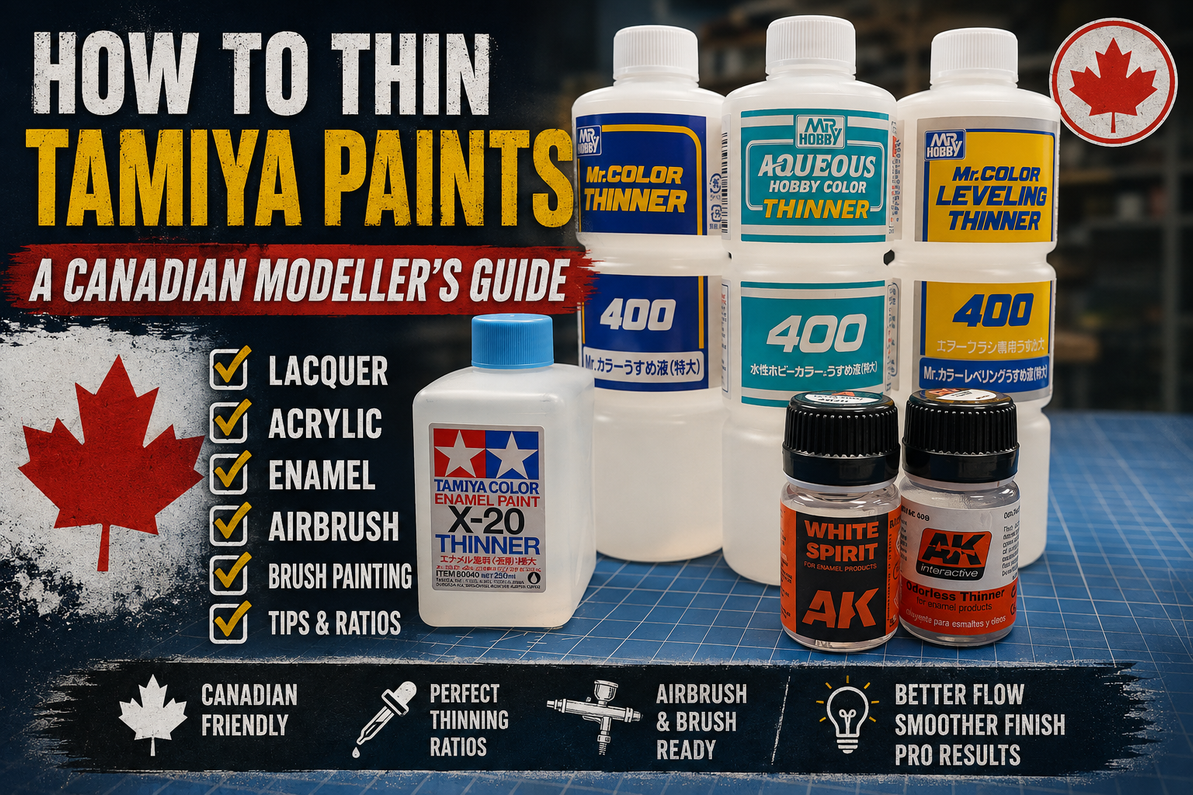
How to Thin Tamiya Paints: A Canadian Modeller's Guide
How to Thin Tamiya Paints: A Canadian Modeller's Guide
Acrylics, lacquers, and enamels · Updated for current Canadian availability · Updated October 2026
Most online guides to thinning Tamiya paints will give you exact ratios and exact PSI numbers. We are not going to do that, because those numbers are wrong, or at least not consistently right. Paint behavior varies by colour, by pigment, by bottle age, by humidity, by airbrush, by nozzle size, and by the specific surface you are painting. The single most common mistake we see at the counter is modellers following a precise guide and then wondering why their paint is spitting, pooling, or refusing to atomize. This guide takes a different approach: we teach you the principles, and we explain what we actually recommend at our store as Canadians working with the products that are available to us.
Aim for the consistency of milk, not a specific ratio. Start at 1:1 paint-to-thinner and adjust from there based on how the paint flows. PSI is determined by surface area and how much paint you want to put down, not a fixed number; 10-25 PSI covers nearly everything. For Tamiya X/XF acrylics, Tamiya X-20A is back on Canadian shelves and is the simple, manufacturer-matched default. For the smoothest airbrush finish, we still reach for Mr Hobby Mr Leveling Thinner or Tamiya Lacquer Thinner with Retarder. For LP lacquers, use those same lacquer thinners. For XF enamels, Tamiya Enamel Thinner or AK Interactive white spirits. Skip the false precision and learn to feel the paint.
Canadian availability update: X-20A is back
October 2026: Tamiya X-20A Acrylic Thinner (TAM81040, 250ml) is back in stock and available in Canada again. After more than a year off the shelf over Health Canada's child-resistant packaging requirement, Tamiya's own acrylic thinner is once again the easy first answer for X/XF acrylics.
One regulatory issue is still in place. Tamiya Lacquer Thinner (standard, without retarder) remains unavailable in Canada, flagged by Environment Canada because its 2-butoxyethanol concentration exceeds allowable limits for import.
The lacquer-based alternatives we recommended while X-20A was away are all still on the shelf and still excellent, so you now have a genuine choice rather than a workaround. Read on for when each one makes sense.
The two principles that replace fixed numbers
1. Aim for the consistency of milk
When customers ask us how thin Tamiya paint should be for airbrushing, our answer is always the same: the consistency of milk. Properly thinned Tamiya paint should run off your stir stick or palette knife in a smooth, continuous stream. Not in heavy droplets like cream, and not in a thin spray like water. If you have ever poured milk from a carton, you know exactly what we mean. That is what you are aiming for.
As a starting point, mix 1 part paint to 1 part thinner. Stir thoroughly. Pull out your stir stick and watch how the paint runs off. Too thick? Add more thinner. Too thin? Add a few drops of paint. The 1:1 ratio is a starting point, not a rule. Some Tamiya colours (particularly the more pigment-heavy whites and yellows) need significantly more thinner to reach milk consistency, while some of the lighter wash colours need less.
This is why we do not publish hard ratios. A ratio that works for XF-2 Flat White will not work for X-1 Black, and a ratio that works at 23°C will not work at 16°C. Learn what milk consistency looks like in your specific paint at your specific temperature, and you will never need a chart.
2. Match your PSI to the surface area you are covering
Air pressure for airbrushing Tamiya paints generally falls in the 10-25 PSI range, but the right number depends on what you are painting, not on the paint itself. Large surface areas (aircraft fuselages, vehicle hulls, terrain pieces) benefit from higher pressure (18-25 PSI) for faster, more even coverage. Fine detail work, freehand camouflage edges, and small components benefit from lower pressure (10-15 PSI) for tighter control and softer overspray.
There is no rule that says lower PSI is harder than higher PSI. We have a video on our YouTube channel where an entire airbrush demonstration is performed at 12 PSI start to finish: First Impressions: Tamiya HG III Super Fine Airbrush (skip to 7:35 for the airbrushing). The result is a clean finish across the full piece. The catch with low PSI is that your paint must be thinned more aggressively to atomize properly. If you drop your pressure without thinning further, you will get spatter, tip dry, and uneven coverage. Pressure and thinning are coupled. Lower one, you usually need to raise the other.
Start in the middle of the range, around 18-20 PSI, and adjust based on what you are seeing on the model. Too much overspray? Drop the pressure and thin further. Paint pooling? Raise the pressure or thin less. Like ratios, the right PSI is the one that produces the result you want, not the one a chart told you to use.
Tamiya paint families and which thinner to use
Tamiya makes three main paint families, and each one has its own chemistry. Using the wrong thinner with the wrong paint will produce poor results: the paint may separate, fail to atomize, dry oddly, or fail to bond to the surface. The good news is that the chemistry boundaries are clear and easy to remember.
Tamiya X/XF acrylics (the standard range)
Tamiya's X (gloss) and XF (flat) range is the most widely used Tamiya paint family. Despite being labelled as acrylic, these paints are not water-based acrylics in the way Vallejo or Citadel paints are. They are alcohol-based, which is why they smell strongly when opened and why they atomize through an airbrush quite differently from a true acrylic. Understanding this is what unlocks proper thinning: water-based thinners are not the optimal partner for an alcohol-based paint.
With X-20A back on Canadian shelves, the manufacturer's own thinner is once again the straightforward choice. It is formulated for these paints, it is forgiving, and it handles airbrushing, brush thinning, and brush cleanup from one bottle. That said, many experienced modellers moved to lacquer thinner with Tamiya X/XF long before X-20A ever went missing, and for good reason: a lacquer thinner sits closer to what the paint actually is and generally gives a smoother, better-levelled airbrush finish. Both routes are valid. Pick X-20A for simplicity and an easy learning curve; pick a lacquer thinner when the finish is the priority.
What we recommend:
- Tamiya X-20A Acrylic Thinner (TAM81040, 250ml, $11.95): Tamiya's own thinner for X/XF acrylics, the easy default for airbrush and brush work, and the most beginner-friendly option
- Mr Hobby Mr Leveling Thinner (T108, 400ml, $19.95): the premium option, produces the smoothest airbrush finish and self-levels exceptionally well
- Tamiya Lacquer Thinner with Retarder (TAM87194, 250ml, $11.95): lacquer performance while staying with the Tamiya brand; the retarder slows drying time, which helps when airbrushing
- AK Interactive High Compatibility Thinner (400ml, $20.95): an excellent European alternative with comparable performance to Mr Leveling Thinner
Mr Hobby Aqueous Color Thinner (T111, 400ml, $11.95) is chemically the closest match to X-20A from another brand and also produces good results, particularly for brush work.
For brush painting Tamiya X/XF acrylics, the dynamic shifts. The fast-evaporating lacquer thinners we recommend for airbrushing dry too quickly on the brush, which causes streaking. For brush painting, X-20A or Mr Hobby Aqueous Color Thinner work better, and plain water, used sparingly, works in a pinch.
Tamiya LP lacquers
Tamiya's LP range is true lacquer paint: pre-thinned for airbrushing, fast-drying, and producing an exceptionally smooth finish straight out of the bottle. Many modellers airbrush LP paints without thinning at all. When thinning is needed, you need a true lacquer thinner. Water-based thinners and X-20A do not work with LP paints.
What we recommend:
- Tamiya Lacquer Thinner with Retarder (TAM87194, 250ml, $11.95): the in-house option; the retarder reduces tip dry on detail work
- Mr Hobby Mr Leveling Thinner (T108, 400ml, $19.95): the same product we recommend for X/XF, equally suitable for LP, especially for high-gloss finishes
- AK Interactive High Compatibility Thinner (400ml, $20.95): works equally well across both paint types
Note that Tamiya's standard Lacquer Thinner (without retarder) is still not available in Canada due to the 2-butoxyethanol regulatory issue. The retarder version (TAM87194) you see on our shelves is differently formulated and remains available. It is also the version most airbrush users prefer anyway, because the retarder gives you more working time before the paint sets.
Tamiya XF enamels (and panel line accent colours)
Tamiya's enamel paints, including the popular Panel Line Accent Color products that most armour and aircraft modellers use for weathering, are mineral-spirit-based and require an enamel-specific thinner. Lacquer thinners and acrylic thinners (X-20A included) will not work; using them will at best produce poor results and at worst will eat into the paint underneath. Watch the labels here: X-20 (no A) is the enamel thinner, X-20A is the acrylic thinner.
What we recommend:
- Tamiya X-20 Enamel Thinner (TAM80040, 250ml, $9.95): the standard, works perfectly with all Tamiya enamels and panel line products
- Tamiya X-20 Enamel Thinner (TAM80030, 40ml, $4.50): the smaller size for users who only weather occasionally
- AK Interactive White Spirit Enamel Thinner (100ml, $12.95): an excellent alternative
- AK Interactive Odourless White Spirit Enamel Thinner (100ml): the odourless version for users sensitive to enamel fumes, otherwise identical performance
Tamiya enamel thinners have not been affected by the Canadian regulatory issues. The chemistry is different (mineral spirits, not 2-butoxyethanol-based), so this category has remained stable throughout.
Can you use isopropyl alcohol to thin Tamiya paints?
Yes, but with caveats. 91% or 99% isopropyl alcohol works as a thinner for Tamiya X/XF acrylics because the paint is alcohol-based to begin with, and IPA is cheap, available at any pharmacy, and produces acceptable results for many modellers. A significant portion of the scale modelling community uses IPA as their primary Tamiya thinner without issue.
That said, IPA is not what we recommend at the store. Compared to X-20A or a lacquer thinner like Mr Leveling Thinner or Tamiya Lacquer Thinner with Retarder, IPA dries faster (which causes more tip dry), atomizes less smoothly through an airbrush, and can produce a slightly grainier finish on close inspection. For brush painting it is more usable; for fine airbrush work, the difference between IPA and a proper hobby thinner is real and visible.
Use lower-percentage IPA (70% or below) and you will introduce too much water for an alcohol-based paint, which can cause separation and poor flow. If you are going to use IPA, use 91% or higher.
For LP lacquers and XF enamels, do not use IPA. The chemistry is wrong, and the results will be poor or actively bad. Use the lacquer or enamel thinners recommended above.
Brush thinning Tamiya paints
Brush painting Tamiya paints follows the same milk-consistency principle as airbrushing, but with one key difference: the fast-evaporating lacquer thinners we recommend for airbrush work dry too quickly on the brush, leading to streaking and uneven coverage. For brush painting, slower-drying thinners are preferable.
For X/XF acrylics, X-20A is the natural brush-painting thinner and doubles as a brush cleaner afterward. Mr Hobby Aqueous Color Thinner is a good alternative. Plain water also works in a pinch; used sparingly, it can extend working time without compromising the paint significantly.
For LP lacquers, brush painting is generally not recommended, because the paint dries too fast to brush evenly. LP is designed for airbrush use. If you must brush LP, use the Tamiya Lacquer Thinner with Retarder, work quickly in small areas, and expect the result to be less smooth than an airbrushed finish.
For XF enamels, brush thinning is straightforward: Tamiya X-20 Enamel Thinner or AK white spirits, thinned to a consistency that flows off the brush without dragging or pooling. Enamels brush better than acrylics or lacquers because they dry more slowly and self-level more effectively.
The most common Tamiya thinning mistake we see at the counter
It is not under-thinning, over-thinning, or using the wrong thinner, though all of those happen. The single most common mistake we see is modellers following a guide step-by-step and then being unable to diagnose the result.
A guide says to thin Tamiya 60/40 paint-to-thinner at 18 PSI. The modeller follows the instructions exactly. The paint spits, or pools, or fails to cover, or dries badly. They have done what the guide said. They cannot understand what went wrong. And because they followed a precise recipe rather than learning to feel the paint, they have no framework for figuring out what to adjust. Do they thin more, drop the PSI, change the needle, change the paint, change the temperature?
The fix is to stop following recipes and start watching the paint. Mix to milk consistency. Spray a test piece. Look at what is actually happening. Is the paint atomizing in a fine mist, or is it spitting droplets? Is the surface drying smoothly, or is there texture? Is the paint covering the colour underneath, or do you need more passes? Each of those observations tells you what to adjust, and the adjustment is independent of any chart.
This is not a beginner-vs-expert distinction. The best modellers in the world do not paint by ratios; they paint by feel. The reason recipes feel safer is that they remove the responsibility for judgment, but they also remove the ability to fix things when judgment is what is needed. Build the judgment.
Quick reference: which thinner for which paint
- Tamiya X-20A (easy default)
- Mr Leveling Thinner (best airbrush finish)
- Tamiya Lacquer Thinner with Retarder
- AK High Compatibility Thinner
- Mr Hobby Aqueous
- 91%+ IPA (acceptable)
- Tamiya Lacquer Thinner with Retarder
- Mr Leveling Thinner
- AK High Compatibility Thinner
- Tamiya X-20 Enamel Thinner
- AK White Spirit (Enamel)
- AK Odourless Enamel Thinner
Frequently Asked Questions
Yes. As of October 2026, Tamiya X-20A Acrylic Thinner (TAM81040, 250ml) is back in stock and shipping across Canada. It is the simplest choice for Tamiya X/XF acrylics, for airbrushing, brush thinning, and cleanup. If your priority is the smoothest possible airbrush finish, Mr Hobby Mr Leveling Thinner or Tamiya Lacquer Thinner with Retarder are still worth trying alongside it.
Either works. X-20A is Tamiya's own thinner, slower to bite, and more forgiving, which makes it the better starting point for newer airbrushers and the better choice for brush painting. Lacquer thinners such as Mr Leveling Thinner sit closer to the paint's chemistry and generally level out to a smoother airbrush finish, which is why many experienced modellers prefer them. If you already have one you like, there is no need to switch.
For LP lacquers, often yes. They are pre-thinned for airbrushing and many modellers spray them straight from the bottle. For X/XF acrylics and XF enamels, no. They are too thick straight from the bottle to atomize properly through an airbrush and will spit, clog, and fail to lay down evenly. Always thin X/XF and XF enamels for airbrushing.
Because air pressure is determined by what you are painting, not by the paint itself. A large surface area benefits from higher pressure for faster, more even coverage; fine detail work benefits from lower pressure for tighter control. The same Tamiya paint, at the same thinning ratio, can be sprayed at 12 PSI or 25 PSI depending on the goal. If you lower the pressure, you generally need to thin the paint further to keep it atomizing properly. Pressure and thinning are coupled, and a single number cannot capture the relationship.
Mr Color Thinner is the standard formulation; Mr Leveling Thinner is the same base product with added retarders that slow drying time and improve flow. The Leveling version produces a smoother, glossier finish and is preferred for fine airbrush work, particularly on glossy finishes and gradient blends.
Generally no, at least not on the palette. Tamiya X/XF acrylics are alcohol-based; Vallejo and Citadel are water-based. Mixing them on a palette can cause the binders to separate and the paint to behave unpredictably. You can layer one over the other once the underlying coat is fully cured, but mixing them in a wet state is not recommended. If you need to mix paint brands, stick with similar chemistry: Tamiya with other lacquer-or-alcohol-based paints, Vallejo and Citadel with each other.
Tamiya Lacquer Thinner (standard, without retarder). It is flagged for 2-butoxyethanol concentration above Environment Canada limits and would require reformulation before returning, and we have no ETA. Tamiya Lacquer Thinner with Retarder is differently formulated and remains available, and X-20A is back. We will update this guide if anything changes.
Pricing reflects Wheels & Wings Hobbies retail in CAD as of April 2026; X-20A availability and pricing updated October 2026. Recommendations reflect store-level guidance to customers based on the products currently available in Canada. The regulatory situation affecting Tamiya's standard Lacquer Thinner is current as of this writing, and we will update the guide as it evolves. This guide reflects our store's general approach. Technique varies by individual modeller, and we encourage all modellers to develop their own feel for thinning rather than follow any single guide as a fixed recipe.
All recommended thinners and Tamiya paints are stocked at Wheels & Wings Hobbies in Toronto and available online with Canada-wide shipping.
Recent Posts
-

What Glue Should I Use? A Scale Modelling Adhesive Guide
Wheels & Wings Hobbies · Counter Notes What Glue Should I Use? Lessons from the paint counter at W …Oct 16, 2026 -

John's Starcraft Zerg Queen Paint Guide - Build Feature
Wheels and Wings Hobbies - Miniature Paint Guide John's Starcraft Zerg Queen Archon Studio - Starcra …Sep 24, 2026 -

Vlad's Tomb King on Necrolith Bone Dragon Paint Guide - Build Feature
Wheels and Wings Hobbies - Miniature Paint Guide Vlad's Tomb King on Necrolith Bone Dragon Warhammer …Sep 10, 2026