
Tamiya
TAMXF76 - Tamiya - Flat IJN Gray Green Acrylic - 10mL Bottl e

- SKU:
- TAMXF76
- UPC:
- 4950344070053
- Condition:
- New
- Availability:
- In-Stock items usually Ship within the next business day
- Shipping:
- Calculated at Checkout

Description
TAMXF76 - Tamiya - Flat IJN Gray Green Acrylic - 10mL Bottle
Tamiya XF-76 Flat Gray Green (IJN) is described by Tamiya itself as "a fine depiction of the gray-ish green shade used on IJN aircraft in the early stages of the war in the Pacific." It represents hairyokushoku (灰緑色, literally "ash grey-green") — the overall finish applied to Imperial Japanese Navy aircraft from around 1940 through the early Pacific War period, 1941–43. This is the characteristic light grey-green overall colour seen on A6M Zero, B5N Kate, D3A Val, and other front-line IJNAF aircraft at the time of Pearl Harbor, the Coral Sea, and Midway. It is a pale, desaturated, slightly olive grey-green — lighter than XF-11 J.N. Green and distinctly different from the later two-colour dark green upper surface / grey undersurface scheme that replaced it from mid-1943 onward. Its identity is one of the most debated in Japanese aircraft modelling: surviving physical relics, factory records, and eyewitness accounts all suggest subtle variation between manufacturers and across time periods, but XF-76 represents Tamiya's carefully researched approximation and is called out in their own Zero kit instructions as AS-29 equivalent.
Tamiya Acrylic paints are a hybrid acrylic formula built on water-soluble resin — they can be thinned with water, isopropyl alcohol, or lacquer thinner, and clean up easily with water before curing. When thinned with Tamiya Lacquer Thinner, the paint lays down faster, dries harder, and bonds more aggressively to the substrate. The hybrid resin chemistry means the paint film remains slightly soluble after initial drying — subsequent brush strokes can reactivate and lift the layer below if applied without restraint. For this reason, airbrushing is strongly recommended for large surface coverage. Brush painting is workable for detail and touch-up work, but requires a gentle, deliberate stroke and a fully cured base layer. See our Tamiya Acrylic vs. Enamel vs. Lacquer guide for a full breakdown of paint type differences.
- Mitsubishi A6M2 Zero Model 21 overall — the hairyokushoku overall finish on the most iconic Japanese aircraft of the Pacific War at the time of the Pearl Harbor attack (December 7, 1941) and the subsequent sweeps over Wake Island, the Philippines, and the Dutch East Indies; the Zeros of the 1st and 2nd Kōkūtai's carrier air groups aboard Akagi, Kaga, Sōryū, Hiryū, Shōkaku, and Zuikaku at Pearl Harbor wore this overall grey-green finish, making it the historically correct colour for virtually all early-war Zero subjects
- Battle of Midway Zero (June 1942) — A6M2 and A6M3 Zeros of the Kidō Butai's air groups (Akagi, Kaga, Hiryū, and Sōryū) during the decisive carrier battle of June 4–7, 1942; the last major engagement where the full carrier-based IJNAF was still operating in overall hairyokushoku before the gradual introduction of two-colour schemes
- Nakajima B5N Kate torpedo bomber — the overall grey-green on the B5N2 carrier attack aircraft that delivered the torpedo strike on Battleship Row at Pearl Harbor; B5N2s of Mitsuo Fuchida's first wave and Shigekazu Shimazaki's second wave operated in this overall scheme
- Aichi D3A Val carrier dive bomber — the overall hairyokushoku on D3A1 Type 99 carrier bombers of the Pearl Harbor first and second waves; D3A Vals sank HMS Hermes, HMS Cornwall, and HMS Dorsetshire in the Indian Ocean Raid (April 1942) while still wearing the overall early-war scheme
- Kawanishi H8K Emily flying boat — large IJNAF maritime patrol aircraft using the overall grey-green finish for patrol and reconnaissance missions over the Pacific; XF-76 is called out in multiple Kawanishi aircraft references as correct for the early-war overall scheme
- Early-war moderately weathered Zero reference — XF-76 used as an alternative to XF-12 J.N. Grey for IJN aircraft that have been in operational service for several weeks to months; the slightly greener character of XF-76 captures the appearance of early-war aircraft that have begun to weather from a fresh grey to a slightly more green-shifted tone under Pacific sunlight and humidity
- Colour variation context — the exact shade of hairyokushoku varied subtly between Mitsubishi and Nakajima production, between factory batches, and with operational weathering; XF-76 represents the Tamiya-researched standard and pairs with XF-12 J.N. Grey (XF-12, for Nakajima undersurfaces) and XF-70/XF-11 (for the later two-colour upper surface scheme) to cover the full range of IJNAF aircraft colour evolution from 1941 through 1945
For full Tamiya paint colour references and modelling compatibility charts, visit our Tamiya Paint Colour Chart — Complete Guide for Scale Modellers.
Thin and airbrush with Tamiya Lacquer Thinner, Mr. Color Thinner, or Mr. Color Leveling Thinner.
- 10ml glass jar
- Part of the Tamiya Acrylic paint range
Related Products
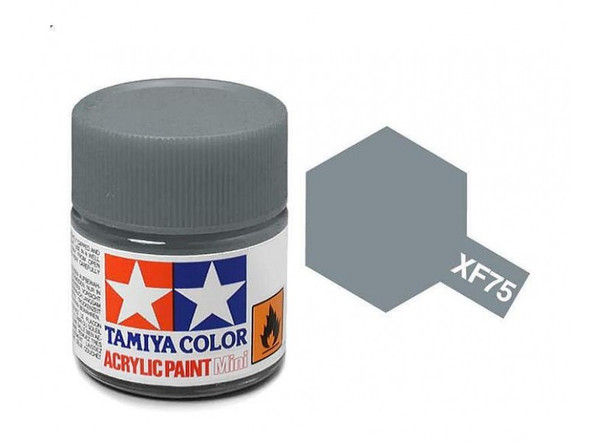
TAMXF75 - Tamiya - Flat IJN Gray Acrylic - 10mL Bottle
Tamiya
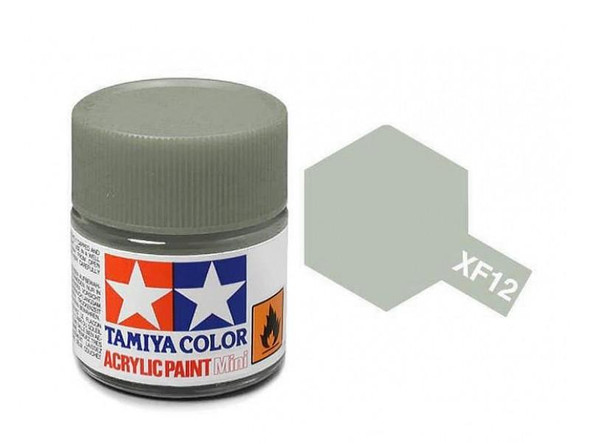
TAMXF12 - Tamiya - Flat IJN Gray Acrylic - 10mL Bottle
Tamiya
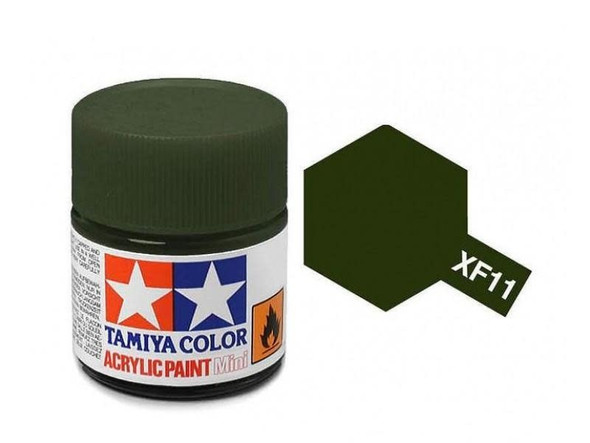
TAMXF11 - Tamiya - Flat IJN Green Acrylic - 10mL Bottle
Tamiya

TAMXF70 - Tamiya - Flat IJN Dk Green 2 Acrylic - 10mL Bottl e
Tamiya

TAMXF87 - Tamiya - IJN Gray Acrylic - 10mL Bottle
Tamiya