
Tamiya
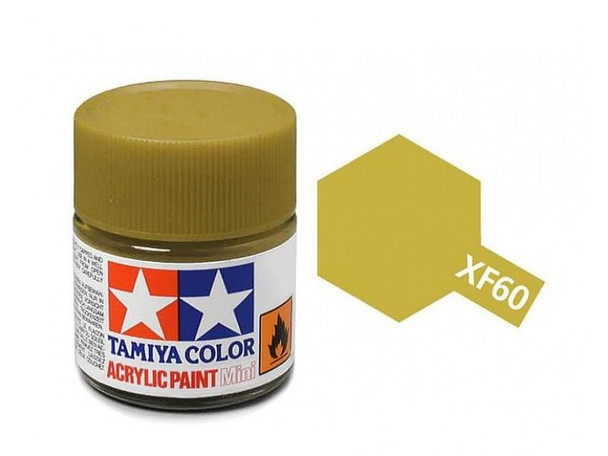
TAMXF60 - Tamiya - Flat Dark Yellow Acrylic - 10mL Bottle
- SKU:
- TAMXF60
- UPC:
- 45035869
- Condition:
- New
- Availability:
- In-Stock items usually Ship within the next business day
- Shipping:
- Calculated at Checkout

Description
TAMXF60 - Tamiya - Flat Dark Yellow Acrylic - 10mL Bottle
Tamiya XF-60 Flat Dark Yellow is the primary Tamiya approximation of RAL 7028 Dunkelgelb ("Dark Yellow") — the mandatory base colour for all German Wehrmacht and Waffen-SS armoured vehicles, self-propelled guns, and field artillery introduced by directive in February 1943 and applied as a factory-applied base coat through to the end of the war in May 1945. Tamiya's original colour guide designates XF-60 as "German tanks" and it is called out directly in Tamiya kit instructions for Tiger I, Panther, Panzer IV, StuG III, Jagdpanzer, and the full range of late-war German AFV subjects. The colour itself has been a subject of ongoing discussion in the modelling community: the current formulation skews toward a more ochre-tan tone, and for a scale-effect representation appropriate for 1/35 subjects, lightening with XF-57 Buff or XF-2 Flat White is widely recommended. The standard Tamiya formula for a pre-lightened Dunkelgelb is 7 parts XF-60 + 3 parts XF-2 Flat White. XF-60 is also an RAF aircraft camouflage component — mixed 1:1 with XF-59 Desert Yellow it produces the intermediate mid-stone tone used in Tamiya's documented RAF desert aircraft painting approach.
Tamiya Acrylic paints are a hybrid acrylic formula built on water-soluble resin — they can be thinned with water, isopropyl alcohol, or lacquer thinner, and clean up easily with water before curing. When thinned with Tamiya Lacquer Thinner, the paint lays down faster, dries harder, and bonds more aggressively to the substrate. The hybrid resin chemistry means the paint film remains slightly soluble after initial drying — subsequent brush strokes can reactivate and lift the layer below if applied without restraint. For this reason, airbrushing is strongly recommended for large surface coverage. Brush painting is workable for detail and touch-up work, but requires a gentle, deliberate stroke and a fully cured base layer. See our Tamiya Acrylic vs. Enamel vs. Lacquer guide for a full breakdown of paint type differences.
- Wehrmacht and Waffen-SS AFV Dunkelgelb base — mandatory factory-applied base colour on all German armoured vehicles, self-propelled guns, and artillery from February 1943 through May 1945; applied to Tiger I (sPzAbt 501, 502, 503, 509), Panther A/D/G (Panzerregiment 33, 4th Panzer Division; Leibstandarte SS Adolf Hitler; Das Reich), Panzer IV H/J, StuG III G, Jagdpanzer IV, Jagdpanther, Tiger II (Königstiger), Wespe, Hummel, and the full catalogue of late-war German AFV subjects in all theatres
- Eastern Front three-colour Dunkelgelb scheme — XF-60 base with XF-61 Dark Green and XF-64 Red Brown camouflage patches in hard-edge or soft-edge spray patterns applied by unit crews; standard appearance on German armour at the Battle of Kursk (July 1943), the Dnieper defensive battles (autumn 1943), and the Korsun-Cherkassy Pocket (January–February 1944)
- Normandy and Western Front camouflage — Dunkelgelb base with XF-61 and XF-64 ambush pattern or three-colour disruptive camouflage on Panther G and Tiger I subjects of the Schwere SS-Panzerabteilung 101 and 102 at Villers-Bocage (June 1944) and the Falaise Pocket (August 1944)
- Italian Front German armour — Dunkelgelb base applied to StuG III G, Panzer IV, and Sd.Kfz.251 half-tracks operating with the 1st and 4th Fallschirmjäger Divisions during the Anzio and Gothic Line defensive campaigns, 1943–45; Italian theatre vehicles often showed heavy fading and dusting over Dunkelgelb that XF-57 and XF-2 highlights replicate well
- German Afrika Korps figure uniforms — XF-60 serves as the Afrika Korps designation in Tamiya's original guide; the olive-yellow DAK tropical field uniform worn by infantry figures of the 15th and 21st Panzer Divisions and 90th Light Africa Division at El Alamein and throughout the North African campaign, 1941–43
- Panzer grey to Dunkelgelb transition vehicles — some vehicles transitioning from Panzergrau (RAL 7021) to the new Dunkelgelb scheme during 1943 were field-repainted, producing uneven coverage, thinned-down applications, and visible primer showing through; XF-60 applied thinly over XF-63 German Grey base replicates this characteristic transition appearance
- RAF desert camouflage Midstone component — Tamiya documents a 1:1 mix of XF-60 Dark Yellow + XF-59 Desert Yellow to produce a Midstone intermediate tone for RAF desert aircraft camouflage on Spitfire Vc Trop, Kittyhawk, and Hurricane IIc Trop subjects operating with the Western Desert Air Force, 1941–43
- Scale-effect Dunkelgelb lightening — for 1/35 subjects, a mix of 7 parts XF-60 + 3 parts XF-2 Flat White is the standard Tamiya community formula for a pre-lightened Dunkelgelb that compensates for scale compression; for 1/48 and 1/72, an even higher proportion of XF-2 is typically added to achieve the correct apparent tone under normal viewing conditions
For full Tamiya paint colour references and modelling compatibility charts, visit our Tamiya Paint Colour Chart — Complete Guide for Scale Modellers.
Thin and airbrush with Tamiya Lacquer Thinner, Mr. Color Thinner, or Mr. Color Leveling Thinner.
- 10ml glass jar
- Part of the Tamiya Acrylic paint range
Related Products
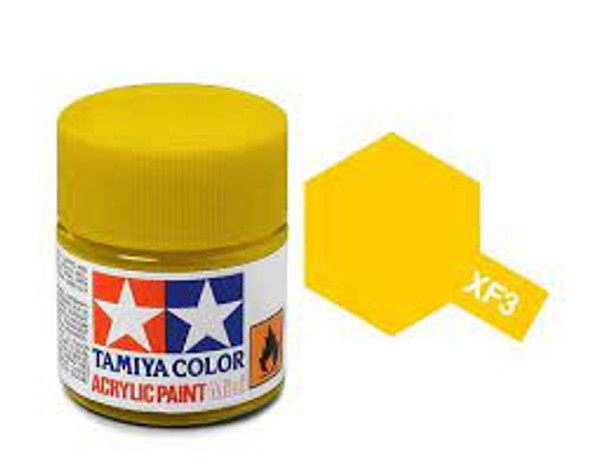
TAMXF3 - Tamiya - Flat Yellow Acrylic - 10mL Bottle
Tamiya
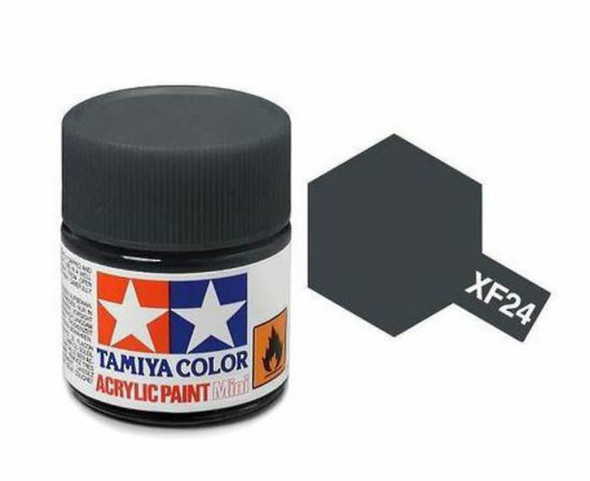
TAMXF24 - Tamiya - Flat Dark Gray Acrylic - 10mL Bottle
Tamiya

TAMXF61 - Tamiya - Flat Dark Green Acrylic - 10mL Bottle
Tamiya

TAMXF84 - Tamiya - Flat Dark Iron Acrylic - 10mL Bottle
Tamiya

TAMXF28 - Tamiya - Flat Dark Copper Acrylic - 10mL Bottle
Tamiya