
Tamiya
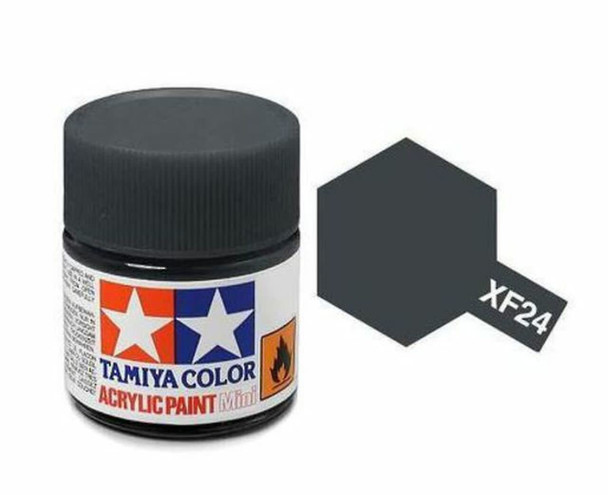
TAMXF24 - Tamiya - Flat Dark Gray Acrylic - 10mL Bottle
- SKU:
- TAMXF24
- UPC:
- 45035715
- Condition:
- New
- Availability:
- In-Stock items usually Ship within the next business day
- Shipping:
- Calculated at Checkout

Description
TAMXF24 - Tamiya - Flat Dark Gray Acrylic - 10mL Bottle
Tamiya XF-24 Flat Dark Gray is Tamiya's designated representation of RLM 66 Schwarzgrau ("black-grey") — the dark, near-neutral grey adopted as the standard Luftwaffe cockpit and crew area colour following the November 1941 revision of the Luftwaffe paint specification L.Dv. 521/1. From this directive onward, all cockpit areas and crew spaces visible through aircraft glazing were to be painted RLM 66, replacing the earlier warm grey-green RLM 02 that had been used since the mid-1930s. RLM 66 is significantly darker and more neutral than RLM 02, with no meaningful warm or green undertone. Some manufacturers — including Heinkel and Junkers — had already been applying RLM 66 to bomber cockpits from as early as 1940 before it became mandatory. The colour remained the standard Luftwaffe cockpit grey for all aircraft types through to the end of the war in 1945. XF-24 used straight from the jar is a close but slightly lighter representation of RLM 66; for a more precise match, a small addition of XF-1 Flat Black will deepen it to the darker end of the documented chip range. XF-24 is also a critical mixing component for RLM 74 Graugrün (3:2 with XF-27 Black Green) and RLM 75 Grauviolett (5:1:2 with XF-50 Field Blue and XF-2 Flat White) — two of the most-used late-war Luftwaffe upper surface colours.
Tamiya Acrylic paints are a hybrid acrylic formula built on water-soluble resin — they can be thinned with water, isopropyl alcohol, or lacquer thinner, and clean up easily with water before curing. When thinned with Tamiya Lacquer Thinner, the paint lays down faster, dries harder, and bonds more aggressively to the substrate. The hybrid resin chemistry means the paint film remains slightly soluble after initial drying — subsequent brush strokes can reactivate and lift the layer below if applied without restraint. For this reason, airbrushing is strongly recommended for large surface coverage. Brush painting is workable for detail and touch-up work, but requires a gentle, deliberate stroke and a fully cured base layer. See our Tamiya Acrylic vs. Enamel vs. Lacquer guide for a full breakdown of paint type differences.
- Messerschmitt Bf 109 F/G cockpit interior — RLM 66 cockpit side walls, seat, structural framing, and instrument panel on Bf 109 F-2 through G-14 variants from 1941 onward; operated by all major Jagdgeschwader on the Eastern Front, Mediterranean, and Western European theatres including JG 2, JG 3, JG 5, JG 52, and JG 54 through to 1945
- Focke-Wulf Fw 190 A/D cockpit interior — standard RLM 66 cockpit on the Fw 190 A-4 through A-9 and Fw 190 D-9 (Dora) operating with JG 2, JG 26, JG 51, and JG 54 from 1942 through to the end of the war; the Fw 190 D-9 is one of the most modelled late-war subjects and XF-24 is the correct interior call-out
- Messerschmitt Me 262 A cockpit interior — RLM 66 throughout the cockpit of the world's first operational jet fighter, serving with JG 7 and Kampfgeschwader 51 from August 1944; at the war's end some undercarriage components were also painted RLM 66 due to paint shortages
- Heinkel He 162 A Salamander cockpit — RLM 66 interior on the emergency Volksjäger jet fighter entering service with JG 1 at Parchim and Leck from February 1945; undercarriage components were also painted RLM 66 on some examples due to late-war supply constraints
- Junkers Ju 88 G night fighter cockpit — RLM 66 interior on the radar-equipped Ju 88 G-1/G-6 serving with NJG 1, NJG 2, NJG 3, and NJG 6 in the Nachtjagd night defence campaign over Germany, 1943–45; Junkers had used RLM 66 in bomber cockpits from 1940 before it became the mandatory standard
- Heinkel He 219 Uhu cockpit interior — RLM 66 on the purpose-built night fighter serving with NJG 1 from Venlo, Netherlands from 1943; one of the few Luftwaffe aircraft with ejection seats and a heavily instrumented two-seat cockpit
- RLM 74 Graugrün mixing — XF-24 is the dark grey base in the standard RLM 74 mix (3 parts XF-24 + 2 parts XF-27 Black Green), used for the upper surface mottled grey-green on late-war Fw 190 A-8/A-9, Bf 109 G-10/K-4, and Me 262 subjects from 1943 onward
- RLM 75 Grauviolett mixing — XF-24 forms the primary component in RLM 75 (5 parts XF-24 + 1 part XF-50 Field Blue + 2 parts XF-2 Flat White), the grey-violet upper surface mottle applied alongside RLM 74 on late-war German fighters and bombers
For full Tamiya paint colour references and modelling compatibility charts, visit our Tamiya Paint Colour Chart — Complete Guide for Scale Modellers.
Thin and airbrush with Tamiya Lacquer Thinner, Mr. Color Thinner, or Mr. Color Leveling Thinner.
- 10ml glass jar
- Part of the Tamiya Acrylic paint range
Related Products
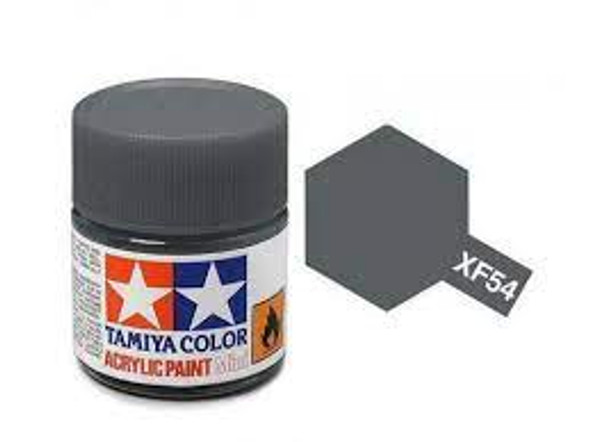
TAMXF54 - Tamiya - Flat Dark Sea Gray Acrylic - 10mL Bottle
Tamiya

TAMXF84 - Tamiya - Flat Dark Iron Acrylic - 10mL Bottle
Tamiya

TAMXF61 - Tamiya - Flat Dark Green Acrylic - 10mL Bottle
Tamiya

TAMXF28 - Tamiya - Flat Dark Copper Acrylic - 10mL Bottle
Tamiya
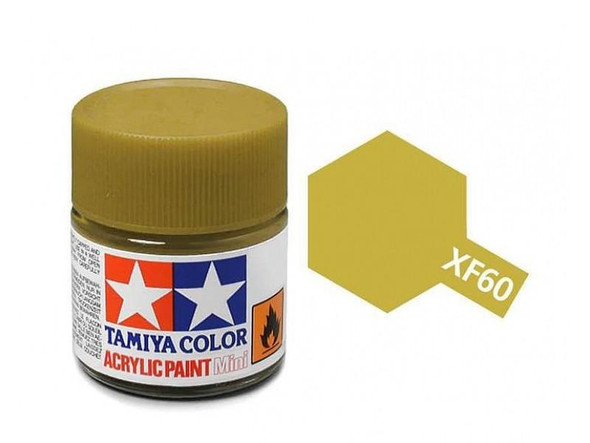
TAMXF60 - Tamiya - Flat Dark Yellow Acrylic - 10mL Bottle
Tamiya