
Tamiya
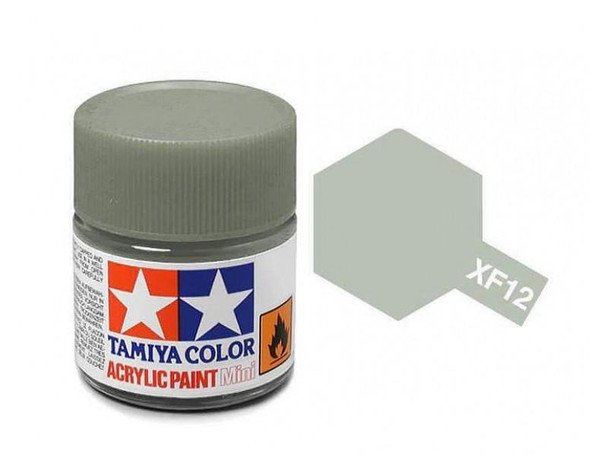
TAMXF12 - Tamiya - Flat IJN Gray Acrylic - 10mL Bottle
- SKU:
- TAMXF12
- UPC:
- 4950344069613
- Condition:
- New
- Availability:
- In-Stock items usually Ship within the next business day
- Shipping:
- Calculated at Checkout

Description
TAMXF12 - Tamiya - Flat IJN Gray Acrylic - 10mL Bottle
Tamiya XF-12 Flat IJN Gray represents the standard Nakajima lower-surface colour — known in Japanese documentation as J3 hai-ryokushoku (灰緑色, "greenish ash") — applied to Imperial Japanese Navy aircraft from 1943 onward. It is a cool, muted grey with a subtle green undertone, quite distinct from a plain neutral grey, and is one of the most researched and debated colours in Japanese aviation modelling. The shade applies specifically to Nakajima-manufactured airframes; Mitsubishi-built aircraft of the same types used a different, warmer grey-green (hai-ryokushoku closer to FS 24201/16350), represented in the Tamiya range by XF-76. Relic analysis by researchers including James F. Lansdale — using actual aircraft fragments from the Smithsonian Conservation Analytical Laboratory and wartime crash sites — has confirmed that Nakajima lower surfaces from mid-1943 onward corresponded closely to FS 36307/36314, placing XF-12 as the correct Tamiya choice for Nakajima-contract undersurfaces. The colour also appeared on fabric-covered control surfaces — elevators, rudders, and ailerons — across a broader range of IJN aircraft types regardless of manufacturer, where the doped fabric took on a slightly lighter and more neutral appearance than adjacent metal panels.
Tamiya Acrylic paints are a hybrid acrylic formula built on water-soluble resin — they can be thinned with water, isopropyl alcohol, or lacquer thinner, and clean up easily with water before curing. When thinned with Tamiya Lacquer Thinner, the paint lays down faster, dries harder, and bonds more aggressively to the substrate. The hybrid resin chemistry means the paint film remains slightly soluble after initial drying — subsequent brush strokes can reactivate and lift the layer below if applied without restraint. For this reason, airbrushing is strongly recommended for large surface coverage. Brush painting is workable for detail and touch-up work, but requires a gentle, deliberate stroke and a fully cured base layer. See our Tamiya Acrylic vs. Enamel vs. Lacquer guide for a full breakdown of paint type differences.
- Nakajima A6M2 Zero-sen (Model 21) — lower-surface J3 grey on Nakajima-built A6M2s from early 1943, operating from carriers Shokaku and Zuikaku at the Battle of the Coral Sea (May 1942) and Midway (June 1942) and from land bases at Rabaul, Lae, and Buna through the Solomons campaign, 1942–43
- Nakajima A6M5 Zero-sen (Model 52) — the definitive application; flat J2/J3 grey-green undersurfaces on Nakajima-built Model 52s from the Koizumi plant in Gunma Prefecture, from 1943 through to August 1945; relic research confirms FS 36307/36314 for lower surfaces of Nakajima A6M5s at the Battle of the Philippine Sea (June 1944) and the defence of the Home Islands
- Nakajima A6M2-N Rufe — the floatplane adaptation of the A6M2 operating from Tulagi (May 1942), Shortland Islands (1942–43), and Kiska Island in the Aleutians (1942–43); XF-12 documented specifically for the Kiska-based Rufes on fabric surfaces
- Nakajima B5N2 Kate — lower-surface grey on Nakajima-built torpedo bombers from carriers Akagi, Kaga, Soryu, and Hiryu at the Pearl Harbor attack (December 1941) and Midway (June 1942); also applied to fabric-covered control surfaces on later production aircraft
- Nakajima B6N2 Tenzan (Jill) — J3 grey undersurfaces on the replacement torpedo bomber entering service from August 1943, operating from Taiho and Junyo at the Philippine Sea and from land bases at Kanoya during the Okinawa campaign, April–June 1945
- Aichi D3A2 Val — lower-surface grey-green on fabric-covered elevator and rudder surfaces of the Type 99 dive bomber operating from all six carriers of the Kido Butai at Pearl Harbor (December 1941) and at the Indian Ocean Raid (April 1942); the D3A2 remained in frontline carrier service through Midway (June 1942) and the Eastern Solomons (August 1942)
- Fabric control surface painting — applicable as a base coat for the doped linen elevators, rudders, and ailerons across a wide range of IJN types including the Mitsubishi G4M Betty, Kawanishi H8K Emily flying boat, and Aichi E13A Jake floatplane, where fabric surfaces required separate painting from adjacent metal panels
- Weathered and faded finish mixing — XF-12 lightened with XF-2 Flat White (approximately 4:1) to simulate sun-bleached and salt-air degraded undersurfaces on Pacific theatre aircraft; a well-documented effect on late-war operational Zero relics
For full Tamiya paint colour references and modelling compatibility charts, visit our Tamiya Paint Colour Chart — Complete Guide for Scale Modellers.
Thin and airbrush with Tamiya Lacquer Thinner, Mr. Color Thinner, or Mr. Color Leveling Thinner.
- 10ml glass jar
- Part of the Tamiya Acrylic paint range
Related Products
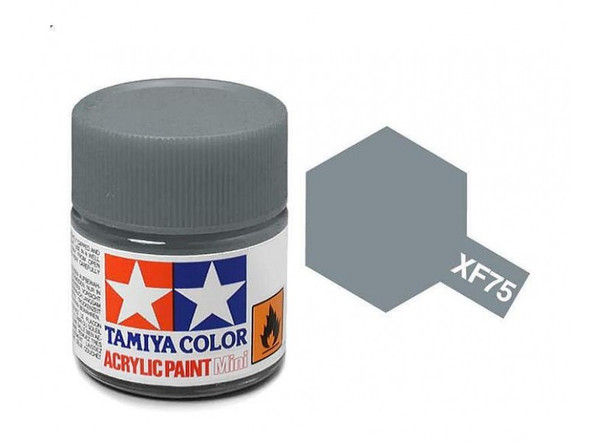
TAMXF75 - Tamiya - Flat IJN Gray Acrylic - 10mL Bottle
Tamiya

TAMXF87 - Tamiya - IJN Gray Acrylic - 10mL Bottle
Tamiya
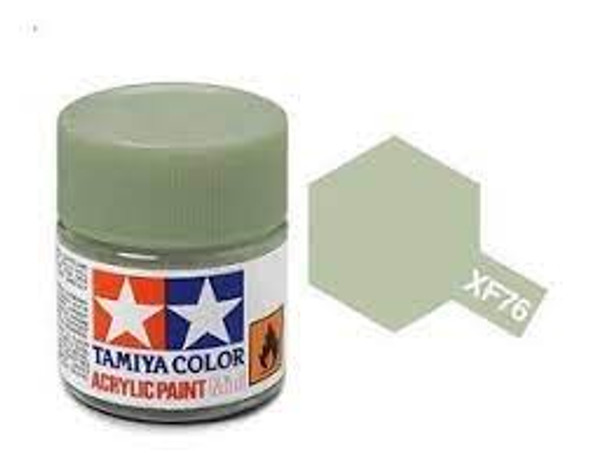
TAMXF76 - Tamiya - Flat IJN Gray Green Acrylic - 10mL Bottl e
Tamiya
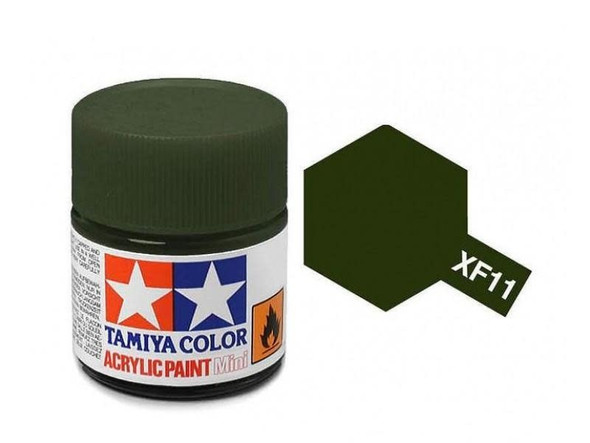
TAMXF11 - Tamiya - Flat IJN Green Acrylic - 10mL Bottle
Tamiya
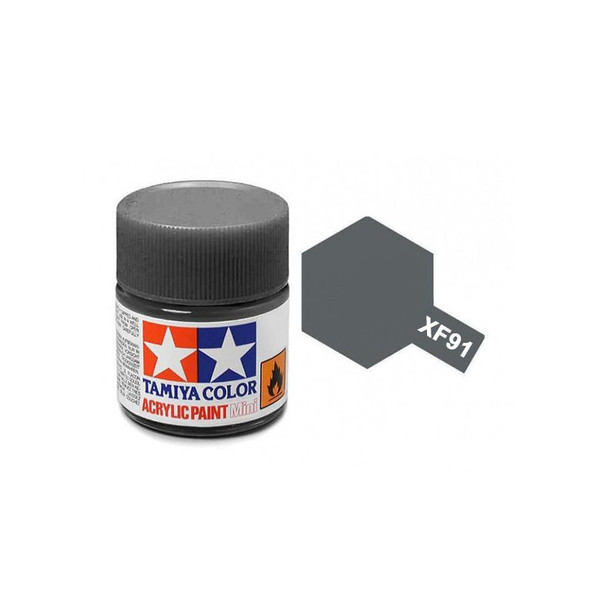
TAMXF91 - Tamiya - IJN Grey Acrylic - 10mL Bottle
Tamiya